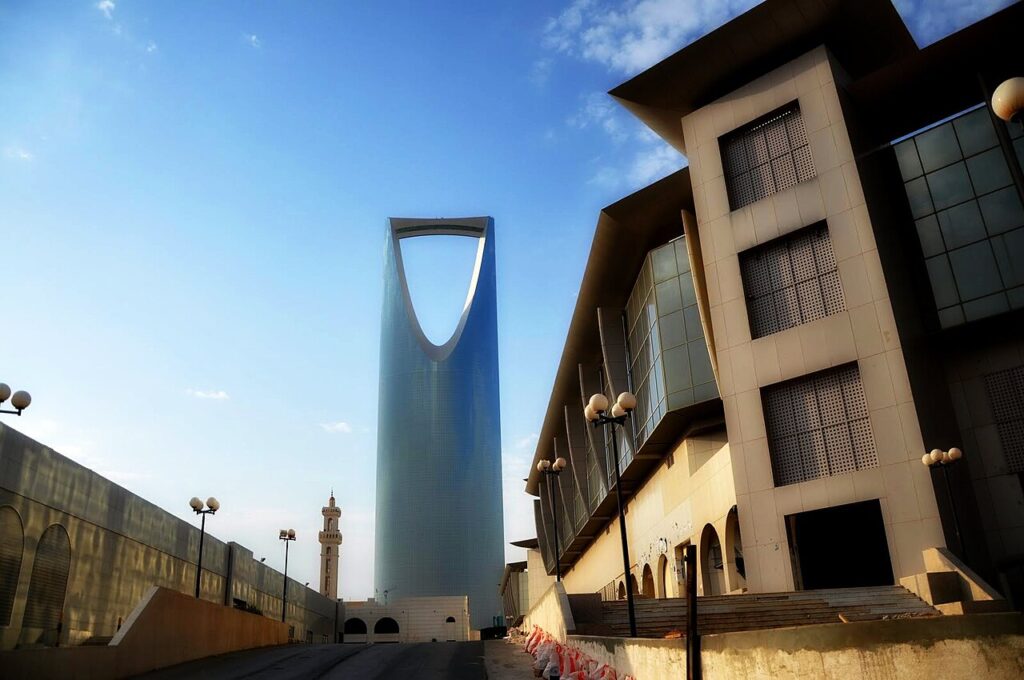
On Sunday morning, the management of Riyadh’s most famous skyscraper sent an email to every office tenant in the building. Remote working arrangements were “mandatory”, it said, “effective immediately and until further notice”. “Kindly refrain from attending the offices during this period.”
No reason was given. None was really needed.
The building is Kingdom Centre, a 99-storey tower with a giant inverted arch carved out of its top third, towering over central Riyadh. It is the address of some of the most powerful names in global finance and consulting: Bank of America’s Merrill Lynch, the consultancy McKinsey, and the International Monetary Fund all keep offices there. On Sunday, those offices emptied.
The order follows last week’s deadly strike on Riyadh’s international airport, after which the airport remained closed. Schools in the capital have extended remote learning. The shopping mall at the foot of Kingdom Centre, notably, remains open.
The remote-work order came the same day the Saudi-led coalition announced that two helicopter pilots had been killed in Najran, near the Yemen border. Coalition spokesman Turki al-Malki, quoted by the official Saudi Press Agency, said an AH-6i reconnaissance helicopter belonging to the Ministry of National Guard had crashed inside Saudi territory “due to a technical malfunction”.
“The accident resulted in the martyrdom of its aircrew, consisting of two officers,” al-Malki said.
The Houthis told a different story. Late on Saturday, Houthi military spokesman Yahya Saree said the group had “downed an Apache helicopter belonging to the Saudi enemy” in the same area. The two accounts of the helicopter crash have not been reconciled, and neither side has produced evidence the other accepts.
What is not in dispute is that the threat is moving closer to the capital. Overnight, the coalition said it had intercepted two drones over the Riyadh area and a third over the kingdom’s Eastern province, and shot down two ballistic missiles in the country’s south. Saudi authorities issued a threat alert in the capital.
The escalation is part of a wider war that has pulled the region back into open conflict. The Houthis, the Iran-backed rebel movement that controls much of northern Yemen including the capital Sanaa, have been fighting the Saudi-led coalition — which backs Yemen’s internationally recognized government — for more than a decade. The fighting reignited during the ongoing US-Iran war. The Houthis have struck tankers in the Red Sea, oil facilities, and Riyadh’s King Khalid International Airport; the coalition has launched repeated air raids on Houthi-held territory. On Saturday, the Houthis said Saudi strikes killed 12 people in Yemen, including three children.
The regional reverberations are growing. On Sunday, Egypt’s parliament was due to hold an emergency session after President Abdel-Fattah el-Sissi asked lawmakers to authorize support to defend Saudi Arabia against Houthi attacks. “I’m not talking about fighting anyone or attacking anyone,” el-Sissi said on Saturday. “We are speaking only about defense.”
Why does a remote-work email from one office tower matter? Because Kingdom Centre is not just any tower. Saudi Arabia has spent years courting Wall Street banks, consultancies and multinational firms to the capital as part of its drive to diversify the kingdom’s economy beyond oil. An indefinite work-from-home order for a building that houses the IMF and McKinsey is the war crossing a threshold — from borderlands, shipping lanes and military bases into the rooms where the kingdom’s money moves. A closed international airport, remote classrooms and an emptied landmark, taken together, are the most visible sign yet that the conflict is reaching daily life in Riyadh.
For the world beyond Saudi Arabia, the trajectory is worrying on two fronts. One is energy: the Houthis have declared a maritime blockade on Saudi Arabia and captured territory around the Bab el-Mandeb strait, the Red Sea choke point through which much of Europe and Asia’s oil and cargo flows. The other is escalation: Egypt weighing a formal defense role, Saudi Arabia’s deepening war with the Houthis drawing in new actors, and an airport in the kingdom’s capital closed for days at a time.
The mall at the foot of Kingdom Centre stayed open on Sunday. Life, in the Saudi way, goes on. But upstairs, behind darkened glass, nobody came to work.

One Comment