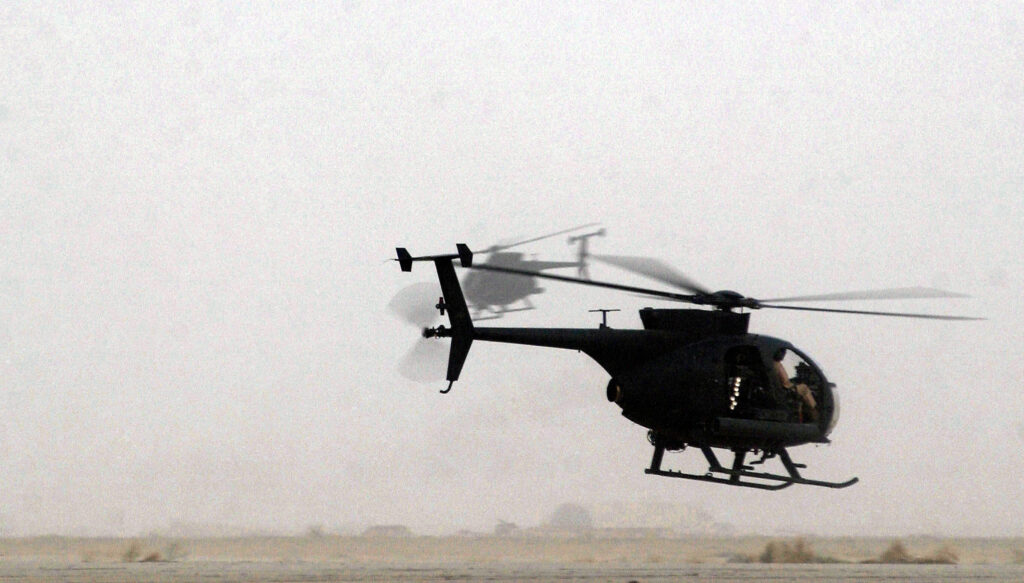
Two crew members of a Saudi reconnaissance helicopter were killed when their aircraft crashed in the Najran region near the border with Yemen on Sunday, the Saudi-led coalition announced — while Yemen’s Houthi fighters insisted the helicopter had been shot down by their forces a day earlier.
The conflicting accounts left it unclear whether both sides were describing the same aircraft.
Coalition spokesman Major General Turki al-Maliki said in a statement that the AH-6i helicopter crashed in an area under the jurisdiction of the Saudi National Guard Ministry, attributing the crash to a technical malfunction. Both crew members died, he confirmed.
A day earlier, Houthi military spokesman Yahya Saree wrote on X that the group’s forces had shot down a Saudi Apache helicopter near Najran, claiming it was carrying out what he described as hostile activities targeting Houthi positions along the border.
Al-Maliki answered him directly on Sunday, replying to Saree’s post with a photograph of several Apache attack helicopters lined up on a tarmac. “You claim to have shot it down, but it will enter the battlefield soon,” he wrote.
A contested border
Najran sits in southwestern Saudi Arabia, a short distance from the Yemeni border. The area has come under repeated Houthi attack in recent weeks as fighting between the Saudi-led coalition and the Iran-aligned Houthis has escalated sharply — the Yemen conflict becoming, in the words of regional analysts, another front in the wider US-led confrontation with Iran.
The war in Yemen flared up again in July after a years-long lull. Since then, Saudi Arabia has faced near-daily drone and missile strikes on its airports and energy infrastructure, including a deadly strike on Riyadh’s airport. The kingdom says it intercepted a fresh wave of drones only on Saturday.
Why the two stories matter
The gap between the two accounts is itself the story. The coalition’s technical-malfunction explanation and the Houthi shoot-down claim cannot both be true — and neither side has produced evidence that would settle the question independently. That pattern has repeated across this conflict: Houthi claims of downed aircraft have sometimes been vindicated by footage and wreckage, and at other times dismissed as propaganda by Riyadh.
For a global audience, the incident is one more sign that the war in Yemen is spilling across the border into Saudi territory — and into the machinery that keeps the world economy running. Brent crude has been trading above $110 a barrel on the back of attacks on tankers and energy installations in the region, and every fresh exchange of fire raises the risk premium on shipping through the Red Sea and the Strait of Hormuz.
What happens next
The coalition has not said whether it will publish the findings of its investigation into the crash. Houthi spokesmen have in the past followed shoot-down claims with video of wreckage; if such evidence appears in the coming days, the coalition’s account will be hard to sustain. If it does not, Riyadh’s version stands.
Meanwhile, the wider fight shows no sign of easing. Egypt’s president said on Saturday that Cairo stood ready to help defend the kingdom if asked — and the UAE has now agreed to resume backing anti-Houthi forces in southern Yemen. The coalition that fought the Houthis for a decade is reassembling. What that means for the weeks ahead will depend on whether the Houthis answer with escalation of their own.
Read more: Missiles Hit Aden Airport as Saudi Defenses Intercept a Strike on Yanbu, the Kingdom’s Oil Lifeline



One Comment