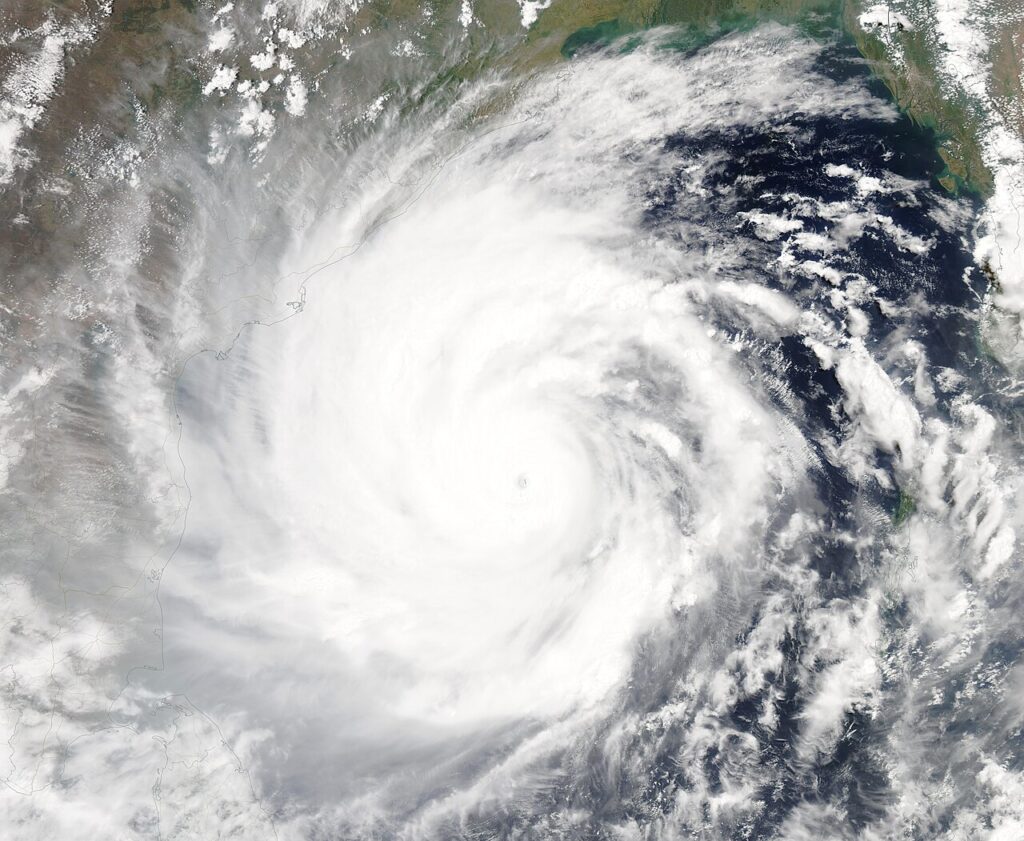
Informopedia Explains: the storm heading for India’s east coast this week is called Arnab — pronounced “Ornab”, a name proposed by Bangladesh, meaning, roughly, the sea. It was not chosen this week, or by anyone watching the storm form. It was picked years ago, from a list drawn up by thirteen countries, and it has been waiting its turn ever since. The system behind that list is one of the quietest pieces of international cooperation on Earth, and it saves lives.
Why storms need names at all
Before names, storms were tracked by latitude and longitude — “the storm at 15.1°N, 91.0°E” — which is precise and useless in a radio warning to a fishing village. A short, pronounceable name travels faster, is remembered longer, and keeps two storms in the same ocean from being confused with each other. The practice took hold in the Second World War, when US Navy and Army forecasters in the Pacific began naming storms after colleagues and partners, and it was formalised in the 1950s when the US National Weather Service began using female names for Atlantic hurricanes. Male names joined the Atlantic lists in 1979.
Today the World Meteorological Organization (WMO), the United Nations’ weather agency, coordinates the system through five regional bodies. A storm gets its name when it reaches tropical-storm strength — sustained winds of about 63 kmph (39 mph). Weaker systems stay numbered depressions. Once bestowed, a name sticks for the storm’s whole life, even if it weakens again.
One ocean, thirteen lists
The rules differ by ocean, which is why Arnab sounds nothing like an Atlantic hurricane. In the Atlantic and the eastern Pacific, names run alphabetically down a list of 21, alternating male and female, and the list repeats every six years — the 2025 list is the 2019 list again, minus retired names. Letters like Q, U, X, Y and Z are usually skipped because too few names work across English, Spanish and French.
In the North Indian Ocean — the Bay of Bengal and the Arabian Sea — the system works differently. Thirteen countries bordering the basin, from Bangladesh and India to Iran, Oman, Saudi Arabia, Thailand and Yemen, each contribute names in turn. The names are not personal names at all in most cases: they are words for flowers, animals, birds, trees, foods or descriptive adjectives, chosen to be short and easy to pronounce across the region. The list does not restart at “A” each year; it cycles continuously through the contributing countries in order. Arnab was Bangladesh’s turn, and it became the name the moment the depression strengthened into a cyclonic storm on Monday morning.
Why some names are never used again
After each season, the regional bodies meet and decide whether any name should be retired. The rule is unwritten but consistent: if a storm was so deadly or destructive that reusing its name would cause confusion or distress, it is struck from the list and replaced. Katrina (2005), Sandy (2012) and Haiyan (2013) will never name another storm. In the North Indian Ocean, the same practice applies — a name attached to a catastrophe is quietly shelved.
That is also why the naming system matters beyond convenience. Research on risk communication has repeatedly found that a named storm is taken more seriously than an anonymous one: people share warnings more, prepare earlier, and remember which storm they are preparing for. A name turns a weather system into an event with an identity — and an identity is something a community can act on.
What happens to Arnab’s name now
Arnab will keep its name through landfall on 28 October and whatever remains of the storm inland. If its damage is limited, the name returns to the cycle and will be used again years from now. If it becomes a byword for a disaster, it will be retired, and Bangladesh will be asked to propose a replacement. Either way, the next name on the list is already waiting — drawn up years ago, by a committee most of us will never hear of, for a storm that does not exist yet. The UK Met Office’s guide to tropical cyclone names sets out the regional lists in full. Related coverage: Odisha braces for the October 28 landfall and why the Bay of Bengal breeds the world’s deadliest cyclones.