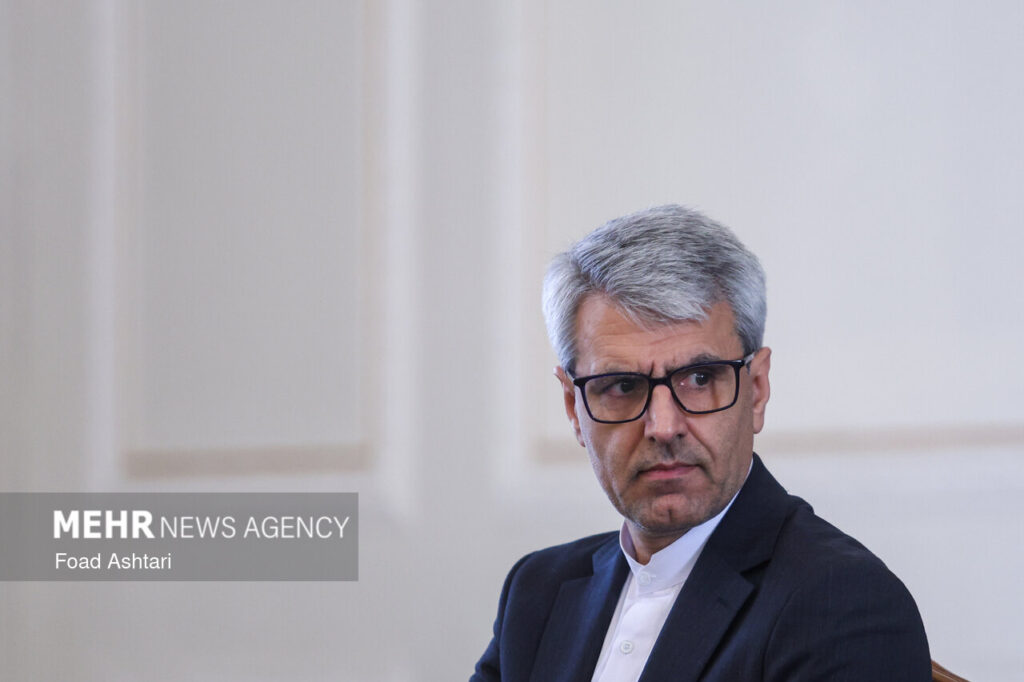
BAGHDAD — Iran is offering to sit down as a mediator to end the war between Saudi Arabia and Yemen’s Houthis, Tehran’s top diplomat said Saturday, even as the kingdom accused Iran of pushing the Houthis into escalation and fighting showed no sign of easing.
Iranian Foreign Minister Abbas Araghchi made the pitch in a speech at the 52nd session of the Organization of Islamic Cooperation’s (OIC) Council of Foreign Ministers, hosted in Iraq’s capital — and repeated it in closed-door meetings with his Egyptian and Libyan counterparts on the sidelines.
“We support an inclusive and comprehensive political process as the only practical and sustainable way to resolve the issue,” Araghchi said, according to multiple outlets carrying his remarks.
The offer is not new — Iran’s Deputy Foreign Minister Saeed Khatibzadeh disclosed earlier that Tehran had already extended the overture, and that Riyadh has not responded. But the Baghdad setting, with 57 Muslim-majority countries in the room, turns a quiet diplomatic note into a public play.
“No military solution”
Araghchi put his argument in terms of arithmetic: 12 years of fighting between Saudi Arabia and the Houthis had demonstrated, he said, that “there was no military solution” to the conflict — a phrase he used both in his OIC speech and in his meeting with Egyptian Foreign Minister Badr Abdelatty.
His framing was deliberate. On Friday, a day before the Baghdad session, Saudi Arabia accused Tehran of encouraging the Houthis’ escalation. Iran denied having anything to do with the Houthi attacks the same day. Araghchi’s answer was a counter-offer of sorts: a warning and an invitation.
“Either we build security together, or we will endure insecurity together,” he said, adding that Tehran was willing “to cooperate with all its brothers and neighbours to achieve the first option.”
The Hormuz blame game
Araghchi also weighed in on the other crisis consuming the region — the Strait of Hormuz, where Tehran insists the waterway is closed to traffic that defies its rules. According to a statement posted to his Telegram channel and carried by Al Jazeera’s live coverage, the foreign minister blamed insecurity in the strait squarely on what he called U.S. and Israeli aggression against Iran, saying attacks that began on February 28 had continued in various forms since.
That framing matters for world oil markets. Tankers have been attacked in and around the strait for nearly a week — including two strikes in a single day off Saudi Arabia’s Jubail port — transits are down roughly 70 percent from pre-conflict levels, and crude prices have surged past $110 a barrel. Washington maintains the strait is open; Tehran insists it controls transit. Araghchi’s line gives investors the clearest picture yet of how Iran sees the standoff — not as maritime lawlessness, but as a consequence of the war against it.
A call for the Muslim world
In Baghdad, Araghchi also called for collective action by Islamic countries to end Israel’s occupation of Palestinian territories — a standard Iranian line, but one that landed harder in a week when fighting has touched three seas.
And in what appeared to be a bid to reassure at least one Arab capital, he briefed Abdelatty on Iran’s latest diplomatic consultations with Washington through mediators, complaining that the United States had repeatedly broken its commitments — including, he claimed, violating an agreement signed in Islamabad in July just two weeks after it was inked.
Why this matters
Wars in the Gulf do not stay in the Gulf. A mediator’s offer from Tehran — the country Saudi Arabia accuses of arming the very group firing missiles at Riyadh’s airport and oil terminals — is either a genuine off-ramp or the most cynical move on a crowded chessboard. The honest answer is that nobody knows yet, because Riyadh has not said a word about the offer.
What matters beyond the region is simpler. The fight between Saudi Arabia and the Houthis is the land war; the fight over Hormuz is the one that touches every driver and factory on Earth. Every week these conflicts burn, the world pays for fuel in higher prices and slower trade. A real mediation would lower the temperature in both. A rejected one would confirm what the oil market already fears: that nobody is in charge of calming things down.
For now, the missiles are still flying, the tankers are still burning, and Iran’s foreign minister is offering to talk. Whether anyone takes him up on it is the question that will decide whether this is diplomacy — or just theater.

One Comment