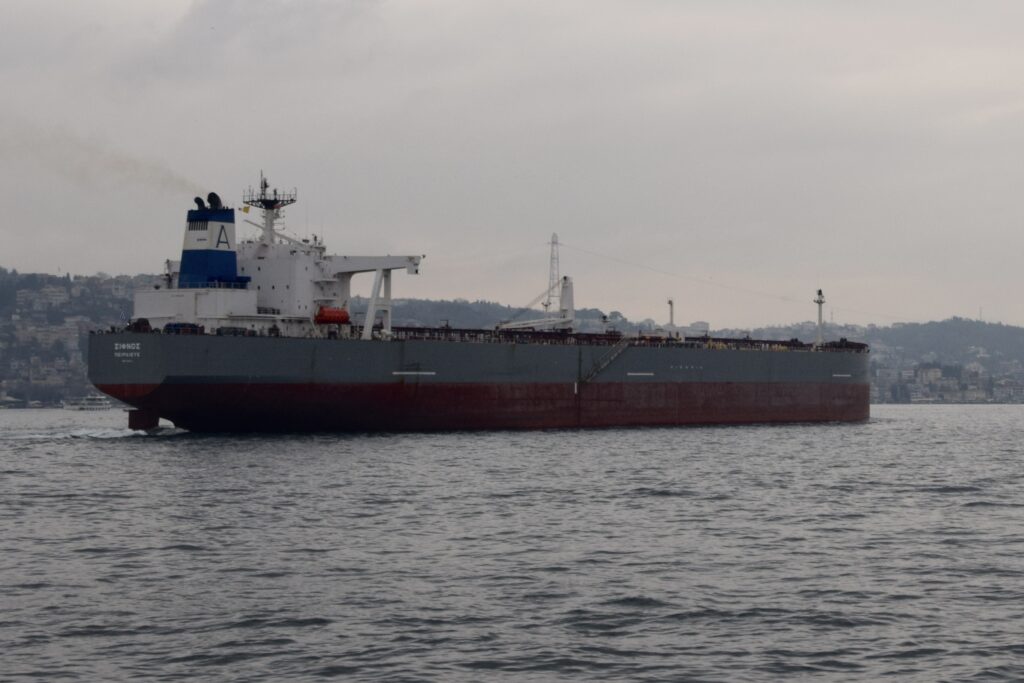
Iran’s Islamic Revolutionary Guard Corps (IRGC) Navy said on Friday that two supertankers struck naval mines while trying to pass through what Tehran calls an unauthorised southern route of the Strait of Hormuz, leaving both vessels disabled and their crews abandoning ship.
The statement, carried by Iranian state broadcaster IRIB, said the two vessels were carrying a combined total of more than 4.5 million barrels of crude oil. “Earlier today, two illegal supertankers that attempted to pass through the unauthorised southern route of the Strait of Hormuz hit a naval mine, causing their engine rooms to malfunction after an explosion and severe fire, and they stopped in place,” the IRGC Navy’s public relations office said, as quoted by IRIB.
That is where the confirmed detail ends, and readers should be clear about what is claim and what is verified. Tehran has not named either vessel, given their flags, said how many crew were aboard, or reported casualties or pollution. No independent source — no shipping tracker, maritime agency, or Western navy — had publicly confirmed the incident at the time of writing. The claim comes solely from Iran’s military, which has an obvious interest in presenting its grip on the waterway as total.
Still, the claim itself is news, and it fits a pattern that has escalated sharply this month. Iran has previously claimed supertankers struck mines on unauthorised routes through the strait, including a second supertanker earlier in October and a third tanker days later, each time warning that vessels sailing without its permission would face a firm response. What is different this time is the scale: two vessels at once, and the largest combined cargo yet claimed.
It is also a different kind of incident from the one reported a day earlier by the United Kingdom Maritime Trade Operations (UKMTO), which said a tanker was hit by an unknown projectile on October 22 about seven nautical miles northeast of Limah, Oman, while sailing out of the strait. That vessel continued its voyage. The IRGC’s account describes something else entirely: two ships stopped dead, on fire, and abandoned.
The stakes are hard to overstate. The Strait of Hormuz, a strip of water roughly 30 kilometres wide at its narrowest between Iran and Oman, carries about a fifth of the world’s seaborne oil. The US Energy Information Administration put average flows through it at 21.2 million barrels a day in 2025. Since the war between the United States, Israel and Iran widened in late February, Tehran has demanded that ships seek its authorisation before transiting, while Washington has imposed its own naval counter-blockade on Iranian oil exports. Oil prices have already pushed above $116 a barrel this week.
Washington’s public response on Friday was defiance, not confirmation. US Treasury Secretary Scott Bessent said Gulf oil exports had “surpassed pre-conflict levels” despite Iran’s efforts. “Despite Iran’s efforts to disrupt energy shipments, oil exports from the Persian Gulf are roaring back and have surpassed pre-conflict levels,” Bessent wrote on X. “The message is clear: Iran’s threats have failed to stop the flow of energy to global markets.”
At the same time, the man who would have to order any American response sounded both threatening and open to a deal. Tom Barrack, the US ambassador to Turkey and President Donald Trump’s special envoy, said on Friday that a US strike on Iran this weekend was possible. “Could there be a strike this weekend? Absolutely,” Barrack said in an interview, while adding that Trump remained open to negotiations. The president, he said, was “open and available and accessible to a deal.”
Saturday brought a reminder that the confrontation is not confined to the water. The Saudi-led coalition said its air defences intercepted a ballistic missile launched by Yemen’s Houthis toward Riyadh, and two explosions were heard in the Saudi capital early in the morning. The Houthis have kept up near-daily attacks on the kingdom throughout the war.
Why this matters beyond the Gulf: a claim like this does not need to be confirmed to move markets, raise shipping insurance, or narrow the space for diplomacy. If the vessels are real and are now drifting, abandoned, in one of the world’s busiest shipping lanes, the risk of a collision, a spill, or a misread American response rises fast. If the claim is exaggerated, it still tells the world what Tehran wants its enemies — and oil traders — to believe: that it can close the strait at will. What to watch now is independent confirmation — vessel names from shipping trackers, satellite imagery, or a statement from a maritime agency — and whether Monday’s oil market treats this as another unverified claim or as a genuine escalation.