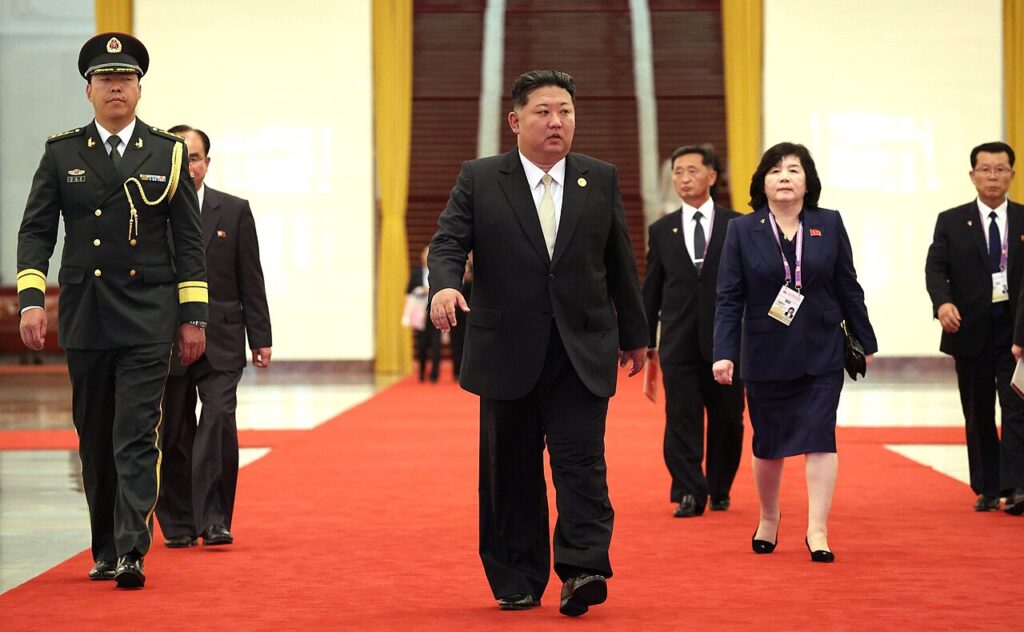
North Korean leader Kim Jong Un crossed into China on Saturday in a surprise visit, arriving in the border city of Dandong by special train via the New Yalu River Bridge — a crossing that opened less than two weeks ago.
South Korea’s Yonhap News Agency broke the news, citing a government source in Seoul who said Kim reached Dandong, China’s Liaoning Province, through the bridge across the Amnok River — known as the Yalu on the Chinese side. South Korea’s Unification Ministry subsequently confirmed the visit, and the JoongAng Ilbo reported that Chinese Premier Li Qiang greeted Kim on his arrival. Earlier on Saturday, Japan’s Kyodo News had noted strict traffic controls in parts of Dandong and hotel reservations suddenly becoming unavailable — a classic early signal that a senior North Korean figure was in town.
The bridge itself is part of the story. The four-lane, 3.03-kilometre crossing links Dandong with Sinuiju in North Korea’s North Pyongan Province and cost China roughly US$310 million to build. It was finished in 2014 — and then sat unused for 12 years, because North Korea never built the connecting roads and customs facilities on its side. It finally opened on October 15. Kim’s visit is its first known use by a North Korean leader, which makes Saturday’s crossing something of an inaugural run for a project that had become a symbol of stalled ambition.
The timing is deliberate. Sunday marks the 76th anniversary of China’s entry into the 1950–53 Korean War, when Beijing sent troops to fight alongside North Korea against US-led forces. Kim’s visit appears timed to coincide with commemorative events marking that date.
This is Kim’s first trip to China in more than a year. His last known visit was in September 2025, when he attended Beijing’s 80th Victory Day celebrations and held a summit with Chinese President Xi Jinping. Xi, in turn, made a state visit to North Korea in June this year — the clearest sign yet that Beijing and Pyongyang are patching up a relationship strained by the pandemic border closures.
The trip also lands amid a bout of death rumours about Kim circulating on overseas social media — speculation his state media has answered in its usual way, with photographs. Just this weekend, the North’s official Korean Central News Agency published images of Kim presiding over a Korean People’s Army company commanders’ conference on Wednesday and Thursday, looking very much alive and in charge.
The visit comes with the United States watching closely. President Donald Trump has said he wants to restart talks with Kim before the end of the year, and China is set to host the Asia-Pacific Economic Cooperation (APEC) summit in Shenzhen next month — an event Trump is expected to attend. North Korea test-fired two submarine-launched cruise missiles earlier this month, and South Korea’s own hypersonic weapons program is accelerating — the peninsula’s security temperature is high, and any American attempt to re-engage Kim will have to go through Beijing.
Why this matters
Kim almost never leaves North Korea — each foreign trip is a carefully chosen signal. Choosing Dandong, and the new bridge, is Beijing and Pyongyang showing off a trade artery that is finally open after a dozen years of concrete in limbo. Dandong is North Korea’s economic lifeline; for years the two countries did their border business through an older, smaller bridge. A working four-lane crossing means goods, workers and — not least — sanctions-evasion capacity can move at a different scale.
For the wider world, the visit is a reminder of where the real leverage sits. If Trump and Xi end up in the same room at APEC next month, the question of who gets to talk to Kim — and on what terms — will be decided by whatever was arranged on this trip. Saturday’s train ride across the Yalu may well turn out to have been the opening move.