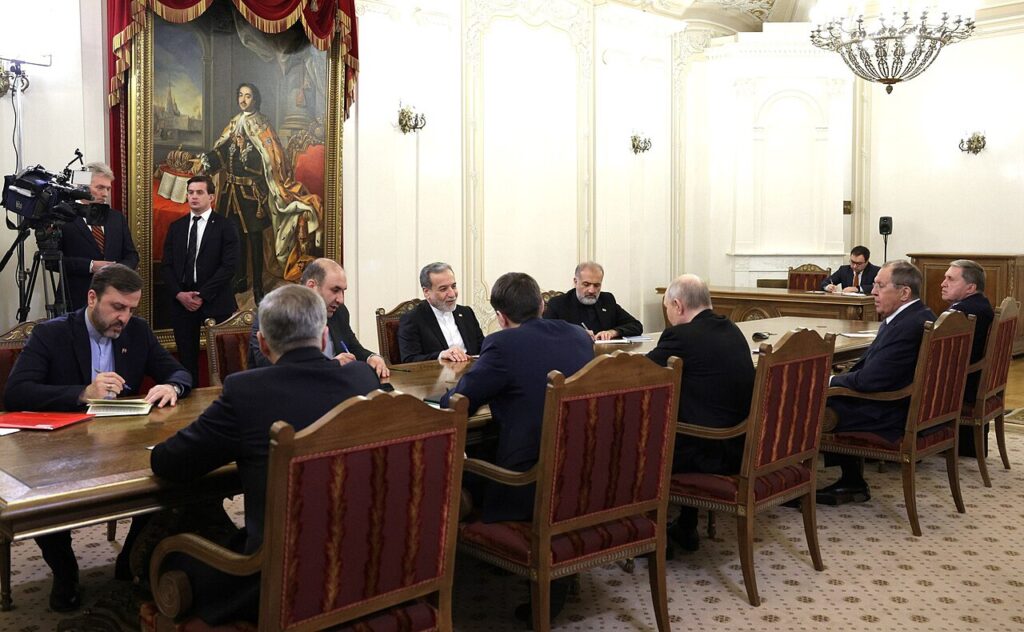
Sergey Lavrov landed in Tehran on Monday afternoon, the first Russian foreign minister to set foot in Iran since the war that began with American and Israeli strikes in February. It is the kind of trip that would have been routine five years ago; now it carries the weight of a conflict that has redrawn shipping lanes, oil markets, and alliances across the Middle East.
The veteran diplomat is scheduled to meet President Masoud Pezeshkian and Foreign Minister Abbas Araghchi later on Monday. Iranian foreign ministry spokesman Esmaeil Baqaei confirmed the trip on Sunday, saying in a statement that the two sides would discuss “regional and international developments.”
Lavrov has said Moscow’s efforts are “aimed at preventing the return of a large-scale war,” with direct talks between Tehran and Washington stalled. Russia’s foreign ministry said discussions during the visit were expected to focus on “ways to resolve the acute international crisis triggered by the unlawful aggression of the US and Israel against Iran.”
Before Tehran, there was Manama. Lavrov spent Sunday in Bahrain for a strategic dialogue session between Russia and the Gulf Cooperation Council — a grouping of Arab monarchies that Iran itself has struck repeatedly during the war. The Gulf states had a direct request: use Moscow’s influence with Tehran to press for “serious dialogue” and get ships moving through the Strait of Hormuz again. GCC chief Jasem Al-Budaiwi said member states had faced more than 7,000 Iranian missiles and drones since the war began. The council’s closing statement went further, demanding that Iran’s nuclear and missile programmes, as well as its support for regional armed groups, be included in any future settlement.
The Hormuz question is the beating heart of this war. Iran claims authority over the strait — the waterway through which roughly a fifth of the world’s hydrocarbons pass in normal times — and has been striking or seizing vessels that cross without its authorization. Washington has kept a naval counter-blockade on Iranian ports in response. Iran has made three separate mine claims against tankers in four days this week alone, while Araghchi has offered to reopen the waterway in seven days if the United States meets Tehran’s conditions. Brent crude has pushed past $108 a barrel.
The visit follows a phone call in early October in which Russian President Vladimir Putin told Pezeshkian that Moscow was prepared to contribute to mediation efforts. Russia and Iran — two of the most heavily sanctioned nations in the world — have only grown closer since Russia’s invasion of Ukraine in 2022, trading weapons, oil logistics, and diplomatic cover. That closeness is precisely why the visit matters, and precisely why it raises eyebrows in Washington, Riyadh, and Brussels. Araghchi, the man Lavrov is coming to see, issued his “be our guest” dare to Donald Trump just last week.
For the rest of the world, this is not really a story about a handshake in Tehran. It is a story about what the next barrel of oil costs, whether the ships carrying it are insured, and whether the most dangerous waterway on the planet stays open. Lavrov is playing mediator, but he arrives carrying baggage: his own country is fighting a war in Ukraine and under Western sanctions itself, and his government is Iran’s closest great-power ally — hardly a neutral chair. The Gulf states know this; their message in Bahrain read less as “please mediate” than “lean on Tehran.” The real question of this visit is not whether Lavrov and Araghchi smile for the cameras, but whether Moscow can deliver something Washington and Riyadh have not: an Iran that stops shooting at ships.
“The timing of visits to the Gulf monarchies and Iran, taking place almost simultaneously, is a deliberate signal: Moscow wants to show that it approaches relations with all these countries on broadly equal terms and is equally interested in cooperation with each of them,” said Nikita Smagin, an analyst and researcher on Iran and Russia’s role in the Middle East, quoted by AFP. He said Lavrov also wants to maintain Russia’s status as a mediator, “despite the impact of the Ukraine war on its global reputation.”
The talks are scheduled for later on Monday. Watch for the joint language afterward — any mention of the Strait of Hormuz, of Tehran’s conditions for reopening it, or of a timetable for renewed US–Iran contacts. If Lavrov leaves Tehran with nothing more than a handshake, the war’s shadow over oil markets and shipping lanes stays exactly where it is.