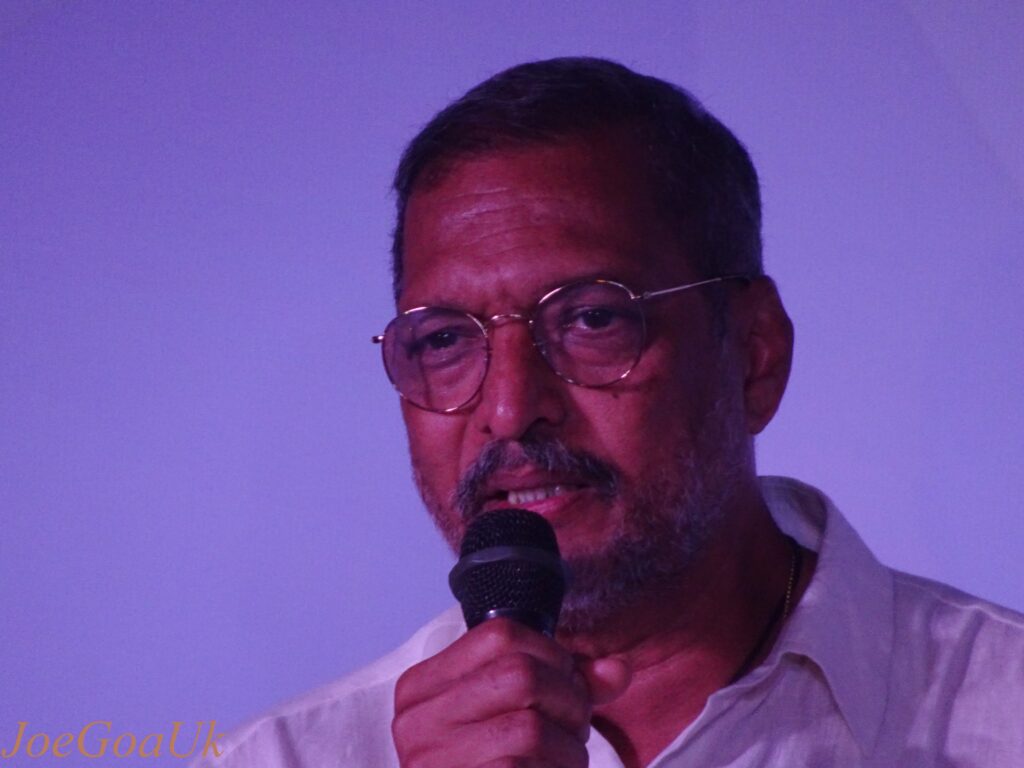
Veteran actor Nana Patekar died early Thursday morning at his home in Goa after suffering a cardiac arrest. He was 75.
Patekar was found unconscious at his apartment in Dona Paula, near Panaji, and rushed to Manipal Hospital. Doctors attempted resuscitation for nearly 45 minutes but could not revive him. He was declared dead at 5:20 am, Dr Shekhar Salkar of the hospital told news agency ANI. A medico-legal case has been registered, and authorities will conduct a post-mortem.
According to people close to him, Patekar had sent a message to a friend around 2:30 am saying he was feeling unwell. The friend reached his residence around 4 am. His son, Malhar Patekar, was in Pune and left for Goa after hearing the news.
The tributes began within hours and kept coming through the morning. Prime Minister Narendra Modi wrote on X that few actors had possessed Patekar’s “intensity, individuality and unmistakable presence,” and that his frank, forthright views were as admired as his acting. “He brought remarkable versatility and creativity to every role and gave us characters that will be remembered for generations,” Modi wrote. “His passing leaves a deep void.”
Defence Minister Rajnath Singh called it an “irreparable loss to Indian cinema,” and said Patekar was “not merely an actor; he was an institution in himself.” Rajinikanth, Amitabh Bachchan, Akshay Kumar, Alia Bhatt, Sunny Deol, Anupam Kher, Manoj Bajpayee and Paresh Rawal all posted condolences. President Droupadi Murmu pointed to his social work beyond the screen. Goa Chief Minister Pramod Sawant, who called Patekar a close friend, said: “I have lost a good friend.”
Maharashtra Cultural Affairs Minister Ashish Shelar announced that Patekar would be given a full state funeral, citing his contribution to Marathi theatre as well as Marathi and Hindi cinema.
Born Vishwanath Patekar on 1 January 1951 in Murud-Janjira, Maharashtra, he grew up painting cinema posters to support his family before studying at Mumbai’s Sir J.J. Institute of Applied Art. He came up through Marathi theatre and made his film debut in Gaman in 1978. The breakthrough arrived a decade later with Parinda (1989), where his terrifying gangster Anna Seth won him the National Film Award for Best Supporting Actor. Krantiveer (1994) brought the National Film Award for Best Actor. Along the way came Angaar, Agni Sakshi, Khamoshi, the encounter-cop drama Ab Tak Chhappan, and his directorial debut Prahaar, for which he trained as an Army officer — a uniform he later wore for real, serving as an honorary officer in the Territorial Army during the 1999 Kargil War.
Then, at an age when most actors settle into grandfather roles, Patekar reinvented himself. His Uday Shetty in Welcome (2007) — the lovable don with the mangled threats — made him a comic icon and, later, one of Bollywood’s most memed men. A generation that never saw Parinda knows him as the “Control Uday, Control” guy. His turn as the broken stage veteran in the Marathi film Natsamrat (2016) reminded everyone of the actor underneath the memes. The Padma Shri came in 2013.
Off screen, he lived famously simply — a one-bedroom flat in Andheri — and in 2015 co-founded the Naam Foundation with Makarand Anaspure to support drought-hit farmers in Maharashtra.
That is why the grief feels larger than a film industry mourning one of its own. Patekar belonged to the last generation of Indian stars who were famous for being difficult: difficult to cast, difficult to interview, impossible to ignore. He shouted on screen because he refused to whisper off it, and in an era of managed celebrity, that bluntness read as honesty. The state funeral will honor the actor. The memes, already flooding timelines, will keep the other version of him — Uday Shetty mid-rant — alive far longer.



One Comment