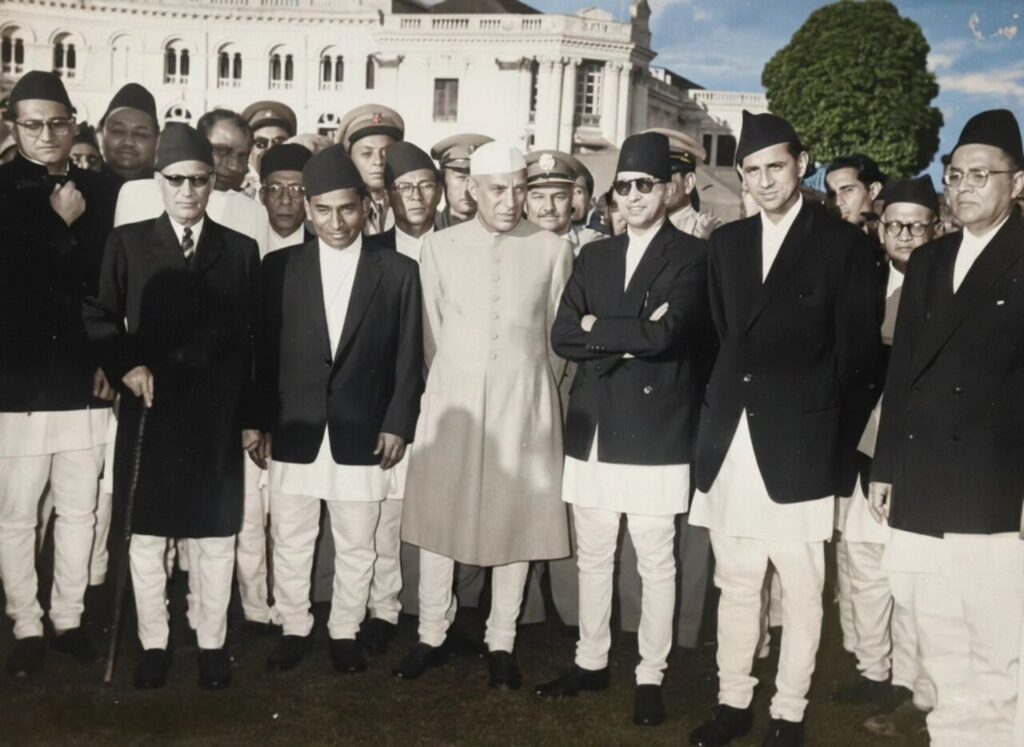
A photograph doing the rounds on social media shows Jawaharlal Nehru, India’s first prime minister, laughing with Indian soldiers in Gaza in 1960. The caption travelling with it claims that on the way home, two Israeli fighter jets shadowed his United Nations aircraft and tried to force it down. It sounds like the kind of story the internet invents. This one, almost uniquely, is documented — in India’s own parliamentary record.
What the viral version leaves out is the bigger story: the India of 1960 was one of Israel’s sharpest critics and the Palestinian cause’s loudest non-Arab champion. The India of today is Israel’s biggest arms customer — while formally insisting its Palestine policy has not changed at all.
What actually happened in May 1960
Nehru stopped in Gaza on 19 May 1960, on his way home from the Commonwealth Prime Ministers’ Conference in London, travelling via Beirut. His purpose was to visit the Indian contingent of the United Nations Emergency Force (UNEF), the peacekeeping force stationed along the Egypt–Israel armistice line since the 1956 Suez war. The force was, at the time, commanded by an Indian — Lieutenant General P. S. Gyani. Nehru ate with the Indian officers, visited the graves of Indian soldiers, and addressed the contingent at Deir el-Ballah, headquarters of the 4th Battalion of the Kumaon Regiment.
Then came the incident. Two Israeli jet fighters flew close alongside the UN aircraft carrying Nehru — close enough, and insistently enough, that the UN lodged a protest and the UN Secretary-General conveyed his regret to Nehru. Accounts differ on whether it happened on the flight in (the framing of the question later put in India’s Rajya Sabha, on a route that briefly overflew Israeli-held territory) or on the return leg to Beirut. Israel said the plane had strayed about a mile inside Israeli territory, and never apologised.
What is not in dispute is the record. On 1 August 1960 Nehru told the Lok Sabha the Israeli action was “unwarranted”, noting that Israel had known of his Gaza visit in advance. A week later, Deputy Minister of External Affairs Lakshmi Menon confirmed it formally in the Rajya Sabha: “Two Israeli jet fighters did fly near the United Nations’ plane in which the Prime Minister travelled to Gaza. This action seemed altogether unwarranted.” India treated the matter as one for the UN, and considered it closed once the Secretary-General had written.
Why Nehru’s India stood where it stood
The Gaza stopover was not a courtesy call; it was a statement of where India stood. India had voted against the UN partition plan for Palestine in November 1947 — it had instead backed a federal, single-state plan — and in May 1949 it voted against admitting Israel to the United Nations. When India did recognise Israel, on 17 September 1950, it did so without warmth: no embassy, no full diplomatic relations, only a consulate permitted in Bombay. Full ties waited another 42 years, until January 1992.
The reasoning was layered. Nehru’s Congress party, fresh from opposing India’s own partition on religious lines, was ideologically hostile to a state founded on religion — Gandhi had written in 1938 that “Palestine belongs to the Arabs in the same sense that England belongs to the English.” There was anti-colonial solidarity with the Arab world, soon formalised in the Non-Aligned Movement Nehru built with Egypt’s Nasser and Yugoslavia’s Tito. And there were hard interests too: oil, the Hajj pilgrimage, and Indians working in the Gulf.
The pattern held for decades. In 1974 India became the first non-Arab country to recognise the Palestine Liberation Organization as the sole legitimate representative of the Palestinian people; a PLO office opened in New Delhi in 1975 and was upgraded to an embassy in 1980. In November 1988 India was among the first countries to recognise the newly declared Palestinian state.
The exception: the year Nehru asked Israel for weapons
And yet the archive contains a twist neither side advertises. In October 1962, as Chinese forces advanced on India’s Himalayan frontier, Nehru wrote personally to Israeli Prime Minister David Ben-Gurion. Documents in Israel’s state archives, reported by The Hindu, show Ben-Gurion replied expressing Israel’s “fullest sympathy and understanding” — and Israel supplied weapons to India during the war, which Nehru’s letter of 18 November 1962 thanked him for. The country India would not host an embassy for was, in its hour of military desperation, a supplier it quietly turned to.
From cold shoulder to embrace
The thaw began with the Cold War’s end: full diplomatic relations in January 1992 under Prime Minister P. V. Narasimha Rao, then Israeli ammunition and drones rushed to India during the 1999 Kargil war — help New Delhi did not forget. Under Narendra Modi, a discreet relationship became a public one, under a doctrine diplomats call “de-hyphenation”: ties with Israel and with Palestine would each stand on their own, pursued openly and separately.
In July 2017 Modi became the first Indian prime minister to visit Israel — a standalone trip that pointedly did not include a stop in Ramallah. Seven months later, in February 2018, he became the first Indian prime minister to visit Palestine. The substance followed the symbolism: according to SIPRI, India took 34 percent of all Israeli arms exports between 2020 and 2024, more than any other country. India joined the I2U2 grouping with Israel, the UAE and the United States in 2022, and in September 2023 signed on to the India–Middle East–Europe Economic Corridor, a trade route running through Israel that the Gaza war has since stalled. The strategic logic driving today’s Gulf diplomacy — the same theatre where Britain is now sending RAF Typhoons to defend Saudi Arabia — runs through New Delhi too.
The Gaza war stress test
The war that began on 7 October 2023 tested the new doctrine immediately. Within hours of the Hamas attack, Modi condemned it as terrorism and declared solidarity with Israel, speaking to Prime Minister Benjamin Netanyahu three days later. On 19 October he also called Palestinian President Mahmoud Abbas, offering condolences for the dead at Gaza’s Al-Ahli hospital and repeating India’s “long-standing and principled position” — and India began flying aid to Gaza via Egypt, delivering some 70 tonnes of medical and relief supplies in the first two consignments that autumn. The humanitarian channel has only grown more urgent since, as the World Food Programme ends food aid for half a million people in Gaza.
At the United Nations, India’s votes traced the balancing act precisely. In October 2023 it abstained on a ceasefire resolution, objecting that the text did not condemn the 7 October attack. In December 2023 and again in December 2024 it voted in favour of ceasefire resolutions. In June 2025 it swung back to abstaining — one of only 19 countries to do so, as 149 voted in favour — explaining that India believed “there is no other way to resolve conflicts but through dialogue and diplomacy.”
What changed, and what did not
Analysts who track the shift point to converging drivers. Israel offers India high-end defence technology with few political conditions, at a moment when India’s legacy Russian supplier base is under strain. The Gulf Arab states — home to millions of Indian workers and much of India’s energy supply — have themselves normalised or deepened ties with Israel, lowering the cost to New Delhi of doing the same. And a New Delhi that now practises “multi-alignment” no longer treats the old non-aligned solidarity as binding.
What has not changed is the formal position. India still recognises the Palestinian state it recognised in 1988, still funds Palestinian refugees through UNRWA, still sends aid, and still says the answer is two states. What has changed is the temperature: a relationship with Israel once conducted in whispers — jets buzzing a prime minister’s plane, arms shipped in secret mid-war — is now conducted on beaches and in joint statements, in the open.
Nehru, looking out of the window of that UN aircraft in May 1960, watched the jets of a state his government barely acknowledged flying alongside him in protest at his presence in Gaza. Sixty-five years on, his successors buy that state’s weapons by the shipload and call its government a partner.
Read this story in Urdu on 101urdu.com: کیا نہرو واقعی 1960 میں غزہ گئے تھے؟ — اسرائیلی طیاروں کا واقعہ اور بھارت کی بدلتی فلسطین پالیسی