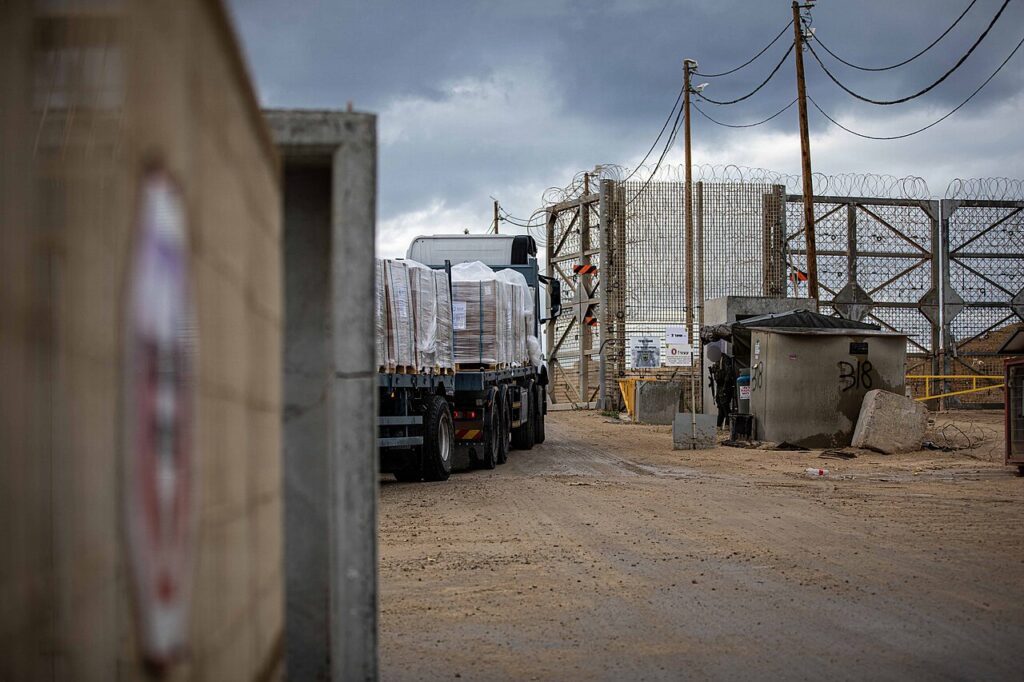
The United Nations World Food Programme said Monday it will stop monthly food assistance to 500,000 people in Gaza because the money has run out — the sharpest rollback of hunger relief in the territory since the ceasefire took hold a year ago.
“As of this month, we’re now cutting half a million people from the number of people that we’re assisting,” Shaun Hughes, the WFP’s country director for the Palestinian territories, told Agence France-Presse from the agency’s office in east Jerusalem.
The cuts take effect this month. The number of Palestinians receiving WFP help — food parcels, flour, hot meals or cash assistance — drops by roughly a third, from 1.6 million to 1.1 million. That is still about half of Gaza’s war-battered population of 2.1 million.
What is being cut
The reductions are across the board, and they hit hardest as winter approaches. The number of hot meals served daily at WFP-backed community kitchens falls from 250,000 to 150,000. Flour and ration boxes, which once reached 1.1 million people a month, will go to 600,000. Families will get one food parcel instead of two, along with a smaller bag of wheat flour.
In hard-to-reach areas — including neighborhoods near the so-called Yellow Line, the boundary marking the zone under Israeli military control — families will receive a hot meal every other day instead of daily. Cash transfers, which let families buy food in local markets and were already reduced in July, now reach fewer people: about 75,000 families are affected.
The West Bank is being squeezed too. WFP says it has halved assistance there, from 400,000 recipients to 200,000.
The money problem
The agency says it received less than half of its usual funding for Palestinian operations this year. It urgently needs $450 million to keep critical operations running over the next six months, through March 2027.
The cuts are driven by finances alone, Hughes stressed — not by any improvement on the ground. “People are not safe. Airstrikes continue on a daily basis. People continue to be displaced,” he said. “Almost everybody remains without a permanent home to live in. And the humanitarian conditions are brutal.”
The agency’s acting executive director, Carl Skau, visited Gaza on Sunday and described conditions as brutal, with life at a standstill.
Why it matters beyond Gaza
This is a measure of how fragile the recovery in Gaza really is. In August last year, the UN’s Integrated Food Security Phase Classification declared that parts of Gaza were suffering famine conditions — a finding Israel disputed, calling it a lie. The famine classification was lifted in December, two months after a US-brokered ceasefire was announced. Since that ceasefire, WFP had been able to scale up, reaching between 1.5 million and 1.8 million people every month. “This has been a lifeline,” Hughes said. “But now, rather than being able to sustain and scale up that assistance, we’re actually having to reduce it.”
The needs have not followed the money downward. According to the latest assessments, 1.4 million people — two-thirds of Gaza’s population — are still acutely food insecure and need humanitarian assistance to survive. Around 200,000 face emergency conditions that require immediate food aid to prevent deaths from hunger. Only one in five children gets a sufficiently diverse diet, and unemployment exceeds 80%, leaving most families unable to buy nutritious food on their own.
Mervat al-Satari, a displaced mother of five sheltering at a camp in the al-Mawasi area of Khan Younis, learned of the cuts from aid workers. “It’s a disaster! What will we do with these reduced rations? How will we provide for the little ones?” she said. “Sometimes we wait for these meals to eat.”
What makes this announcement significant for the wider world is the timing and the trend. Aid budgets are shrinking globally, and Gaza’s case is a warning about what donor fatigue looks like in practice: a UN agency that held back famine now telling families it can feed a third fewer of them, just as cold weather arrives and prices in local markets remain out of reach. WFP itself cautions that the modest improvements since the October 2025 ceasefire remain “fragile” and could quickly be reversed by further reductions in humanitarian assistance.
Israel has kept striking Gaza since the ceasefire, vowing to kill anyone involved in the October 7, 2023 attack on it by Hamas. Hughes was blunt about what the agency is witnessing: “These are very fragile gains, easily reversed, and the situation is still brutal.”