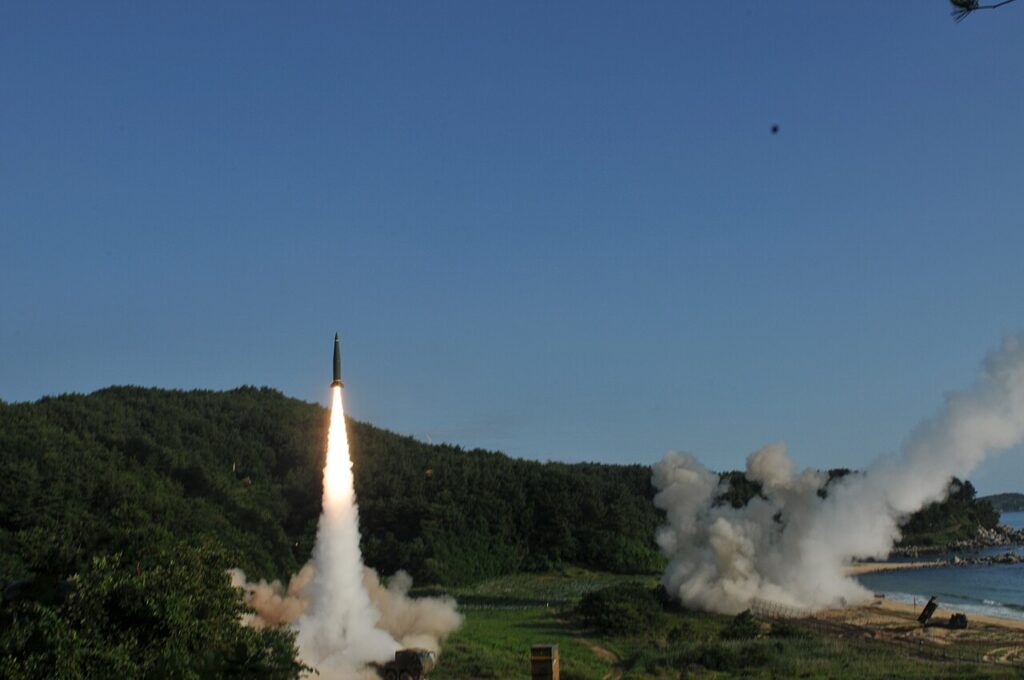
North Korea has tested a cluster-bomb warhead designed for its tactical ballistic missiles, state media reported on Sunday, and claimed the weapon can wipe out an area the size of about 18 soccer fields in a single strike.
The test, carried out on Saturday by the country’s Missile Administration, was designed to assess what Pyongyang called the “combat adaptability and power” of the warhead. According to the Korean Central News Agency (KCNA), research institutes under the Missile Administration confirmed that the “Standard Type 2 cluster-bomb warhead is capable of turning into ashes a target area of 12 to 13 hectares with its highest-density power.”
A cluster warhead works differently from a conventional one. Instead of a single explosion, it splits open above its target and scatters dozens to hundreds of smaller bomblets across a wide area, striking many points at once. For a short-range missile, that turns one incoming weapon into a weapon that can hit a runway, a battery of vehicles, or a troop position all at once.
The general director of the Missile Administration said the cluster warheads fall into four categories, depending on their purpose, and promised speed. “Within this year we will enable units to select and use all those types according to operational aims and specific features of targets,” the director said, according to KCNA. In other words, Pyongyang says the warheads will not stay in the laboratory: they are headed for front-line units before 2026 is out.
The test was overseen by Kim Jong-sik, a senior Workers’ Party official and member of the country’s Central Military Commission, rather than by leader Kim Jong Un himself. South Korea’s military confirmed that a launch took place, saying it had tracked the missile from the area around Chongju, in the country’s northwest, as it flew toward the Yellow Sea. “Under close information sharing between South Korea and the United States, (we) tracked relevant activities before North Korea’s missile launch and maintained a readiness posture,” South Korea’s Joint Chiefs of Staff said on Sunday.
Seoul usually announces North Korean ballistic missile launches within minutes of detecting them. This time it did not, which suggests the launch may have been detected late or assessed differently from a standard ballistic test. Shin Jong-woo, secretary-general of the Seoul-based Korea Defense and Security Forum, said the missile appeared to belong to the Hwasong-11 Ra family, a short-range system North Korea has tested repeatedly.
That identification matters because this is not the first time Pyongyang has paired the Hwasong-11 Ra with a cluster warhead. In April, North Korea said it tested cluster bombs mounted on the same missile, a launch overseen by Kim Jong Un himself — and by his daughter Ju-ae, whose growing public profile Seoul now reads as a sign she is being groomed as his successor. Saturday’s test, without either of them present, reads less like a showcase and more like a step toward deployment.
The timing is hard to ignore. The test came three days after North Korea fired more than 10 short-range ballistic missiles from its east coast, its first launch in 17 days, while Germany’s chancellor was visiting Seoul. It also landed as the top diplomats of South Korea, the United States and Japan met in Atlanta to renew their call for the complete denuclearization of North Korea. On Saturday, US Secretary of State Marco Rubio said President Donald Trump remains open to talks with Kim Jong Un if Pyongyang is willing to discuss Washington’s concerns — though no meeting has been scheduled.
Why this matters goes beyond one more entry in North Korea’s long test log. Tactical ballistic missiles are, by definition, battlefield weapons: short-range, fast, and aimed at targets in South Korea rather than at distant continents. Fitting them with cluster warheads multiplies what each missile can do, and it changes the maths for air defence. A single warhead can, in principle, be intercepted. A warhead that has already scattered its bomblets cannot be undone, and any bomblets that fail to explode stay dangerous on the ground long after the fighting stops.
That lingering danger is why more than 100 countries have banned cluster munitions under the 2008 Convention on Cluster Munitions. North Korea is not one of them. Neither, for that matter, are the United States, Russia or South Korea — a reminder that the weapon Pyongyang is now testing sits in a legal grey zone where condemnation is easy and enforcement is almost nonexistent.
Two cautions apply. The performance figures — 12 to 13 hectares flattened — come from Pyongyang alone and have not been independently verified. Seoul has confirmed a launch happened; it has not confirmed what the warhead did. And a warhead that works in a controlled test still has to survive the stresses of real deployment, storage and targeting.
What happens next is concrete enough to watch. If Pyongyang keeps its promise, four types of cluster warheads will be in the hands of its missile units within weeks. Seoul and Washington will have to decide whether the test changes their calculus — and whether the Atlanta talks, and Rubio’s open door, survive another demonstration that North Korea’s weapons programme is not waiting for diplomacy to catch up.
Related: North Korea Fires More Than 10 Short-Range Ballistic Missiles From Wonsan in First Launch in 17 Days · Seoul Says Kim Jong Un’s Daughter Ju Ae Is Now His Designated Successor