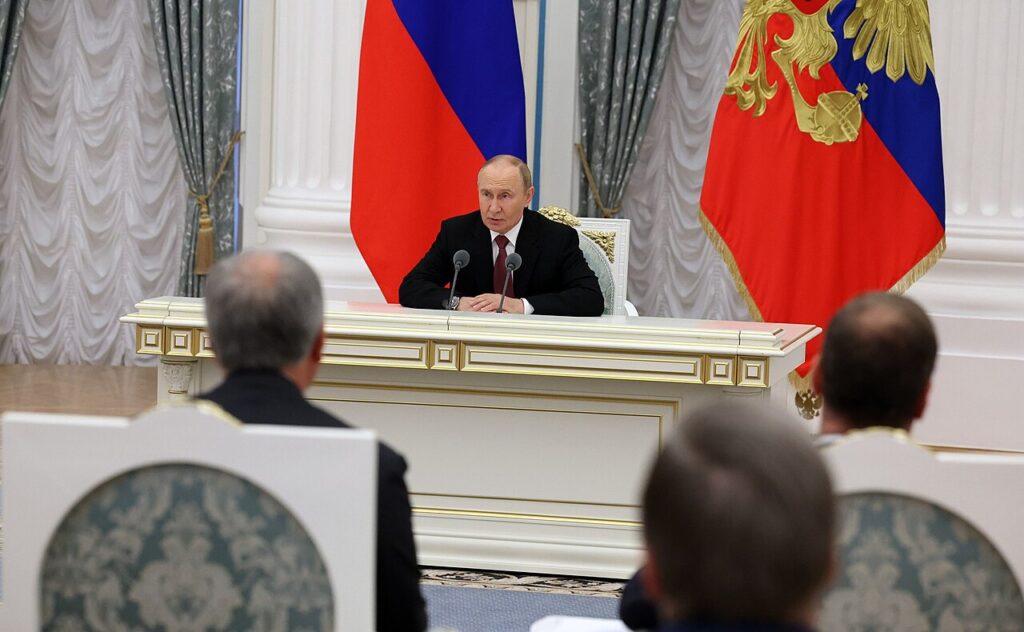
Russian President Vladimir Putin has proposed that he, US President Donald Trump, and Chinese leader Xi Jinping meet next month to negotiate an end to the war in Ukraine — a summit that would decide the fate of a country whose president would not be in the room. The Wall Street Journal reported the proposal on Monday, citing people familiar with the discussions.
According to the report, Putin floated the idea during an October 9 phone call with Trump — the same conversation that produced a deal for the United States to buy Russian diesel fuel. The Kremlin has suggested holding the three-way meeting on the sidelines of the Asia-Pacific Economic Cooperation summit, scheduled for November 18–19 in Shenzhen, the southern Chinese tech hub.
Kremlin spokesman Dmitry Peskov confirmed to the Journal that discussions over a potential meeting are taking place, while stressing that nothing is settled: “There is no clear understanding yet regarding the meeting itself or its potential agenda, although all three parties acknowledge the hypothetical possibility of such a meeting taking place.”
A senior US official told the Journal that Trump has not agreed to the summit — but could be receptive, given his longstanding promise to settle the war. Trump campaigned on ending the conflict on “day one” of his new term; nearly two years in, the war grinds on.
The proposal lands in the middle of the worst week yet in the relationship between Washington and Kyiv. On Sunday, Trump wrote on Truth Social that he was “in the process of negotiating Peace in the war between Russia and Ukraine,” claimed “great progress is being made,” and accused Ukrainian President Volodymyr Zelensky of not wanting the war to end — while defending his decision to hold off on new sanctions against Moscow and strike a diesel deal with Russia instead.
Zelensky, meanwhile, has decided to stop biting his tongue. In interviews with British media this week, he called Putin “a real evil of today” and asked, “How can Trump be friends with him? I think that it’s a mistake.” The Journal reported that Zelensky made the decision to confront Trump publicly while traveling by overnight train to meet European allies, after Russian missiles pounded Kyiv without the usual US warning of a launch for the second straight day. “Americans are on our side,” Zelensky said. “I know that the majority of the United States supports Ukraine.”
Trump, for his part, said this week: “I find Zelensky to be more difficult to deal with than Putin.” On Sunday, Zelensky spoke with Trump’s envoys Steve Witkoff and Jared Kushner in an effort to patch things up, even as both sides kept striking each other’s energy infrastructure — Russia leaving thousands without power, Ukraine carrying out its largest drone attack on St. Petersburg since the invasion began in 2022.
Why it matters
If it happens, a summit on Ukraine without Ukraine would be unprecedented in modern diplomacy. Since 1945, even the most lopsided peace talks have at least seated the country being carved up — or, failing that, triggered furious backlash. Putin’s gambit is a bid to return to an older model: great powers settling the map in a closed room. It would hand Moscow exactly the format it has always wanted — negotiations with Washington over Kyiv’s head — while giving Xi Jinping, whose country has bankrolled Russia’s wartime economy, a seat at the table where the war’s endgame is drawn. For Europe, which has poured billions into Ukraine’s defense and now watches its biggest ally flirt with a separate peace, the alarm bells are already ringing.
For now, the summit exists only as a proposal. Peskov’s carefully worded confirmation leaves every door open and none committed. But the fact that all three capitals are even entertaining the idea — while the man whose country is being fought over is publicly feuding with the American president — says everything about how far the ground has shifted beneath this war.