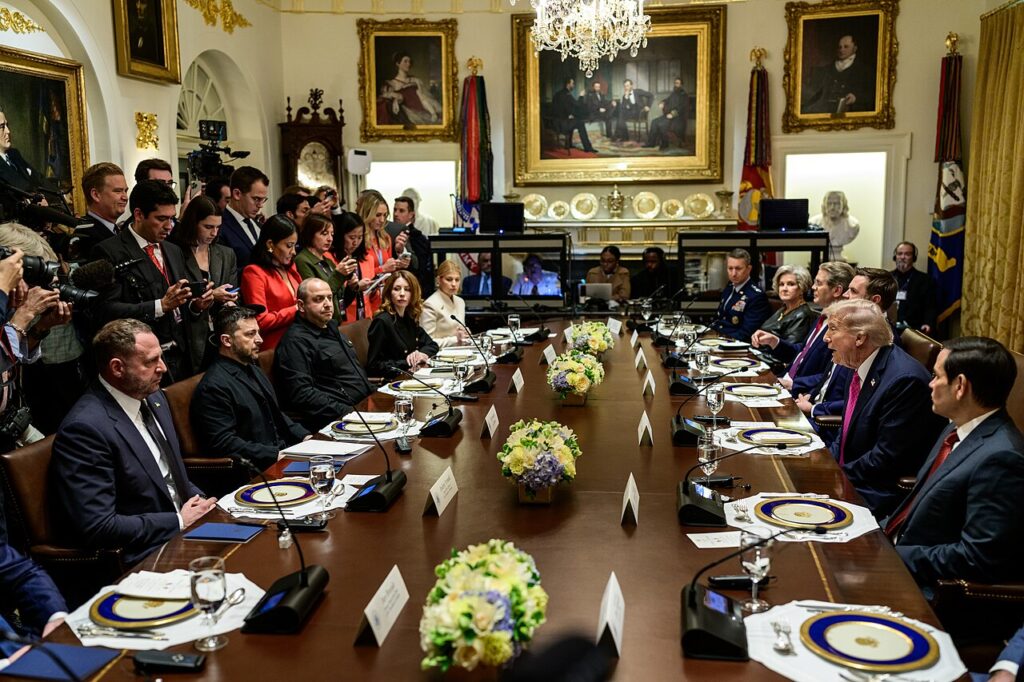
Donald Trump has accused Volodymyr Zelensky of not wanting to end the war with Russia — the sharpest public rebuke the American president has yet aimed at the Ukrainian leader, delivered on his Truth Social platform on Sunday.
“I am in the process of negotiating Peace in the war between Russia and Ukraine, and don’t want to do anything that will drive, foolishly, Russia away from the bargaining table,” Trump wrote, insisting that “great progress is being made.”
Then came the accusation. “Zelenskyy doesn’t care, and frankly, with all of the money that Europe is famously giving him … he doesn’t want to end this war, and probably never did.”
The outburst followed one of Ukraine’s largest drone attacks of the year. Overnight into Sunday, Ukrainian drones hit a key oil terminal in St. Petersburg — the biggest such strike on Russia’s second city since the invasion began, according to AFP. Russia’s defense ministry said its air defenses shot down 1,015 Ukrainian drones over various parts of the country in a single night.
Trump tied Kyiv’s targeting choice directly to the global economy. “Zelenskyy is using Diesel Refineries in Russia as a target, knowing that these attacks are seriously hurting the world diesel markets, including those in the United States,” he wrote.
The strikes also ran against the grain of an understanding Trump himself brokered: both sides would stop hitting energy infrastructure. Zelensky says it is Russia that has broken that deal — 76 times, by his count.
“76,” the Ukrainian president said on Sunday, referring to what he described as Moscow’s violations of the so-called energy ceasefire. Russia, in turn, accuses Ukraine of doing the same. The truce, if it ever really held, is in tatters: Russia bombed Ukraine’s power grid overnight on October 16, killing eight and cutting electricity to more than a million people across nine regions, while Ukraine has kept striking Russian refineries and terminals.
But Zelensky’s tone, at least toward Washington, was conciliatory. He said he spoke on Sunday with Steve Witkoff, Trump’s special envoy, and Jared Kushner, the president’s son-in-law and informal diplomatic go-between, as part of what he called “nonstop communication” aimed at peace.
“We are doing everything on our part to make this happen, and to ensure that America’s position is strong and helps bring peace closer,” Zelensky wrote on X after the calls. He said the two men had discussed deliveries of American Patriot air-defense systems, as Ukraine braces for another winter of Russian missile and drone barrages.
Ukraine is ready to work “constructively” and “honestly,” Zelensky added. “We expect exactly this approach from all our partners — both from the Europeans and, of course, from the American side.”
Hours earlier, on NBC’s “Meet the Press,” Zelensky had offered a blunter warning: for Washington to formally side with Moscow would be a “historic mistake.” He said he hoped Trump would “change his decisions” — a reference to the American president’s recent moves: blocking new sanctions on Russia, striking a diesel deal with the Kremlin, and earlier this week threatening to cut Kyiv’s intelligence lifeline before restoring its missile early-warning coverage after three days of blindness.
It is a strange moment for American diplomacy. Trump says peace talks are making great progress — and in the same breath says the man he is negotiating alongside does not want peace at all. The White House has not said whether Witkoff and Kushner’s call with Zelensky produced anything beyond the conversation itself.
Why this matters beyond Ukraine
Read the two claims side by side and the picture darkens. Trump argues the war should end because it is hurting markets and because negotiation is working; Zelensky argues it is Russia breaking every restraint while he is the one accused of prolonging the fight. Both cannot be true — and the gap between them is where Europe now sits, uneasily.
That gap is the real story. In Kyiv and across European capitals, officials fear Washington is tilting toward Moscow: sanctions blocked, a diesel deal signed, envoys now floating the idea of Russian gas returning to Europe. If the American president believes Zelensky is the obstacle to peace, the pressure — intelligence, air defenses, diplomacy — will keep shifting accordingly. And winter is coming: the October 16 grid attack showed what Russia intends to do with Ukraine’s power stations as temperatures fall.
A US president publicly questioning whether an ally wants peace is not normal diplomatic friction. It is a verdict — or at least the threat of one. Everything that follows, from Patriot deliveries to the next round of sanctions, will be decided in its shadow.



One Comment