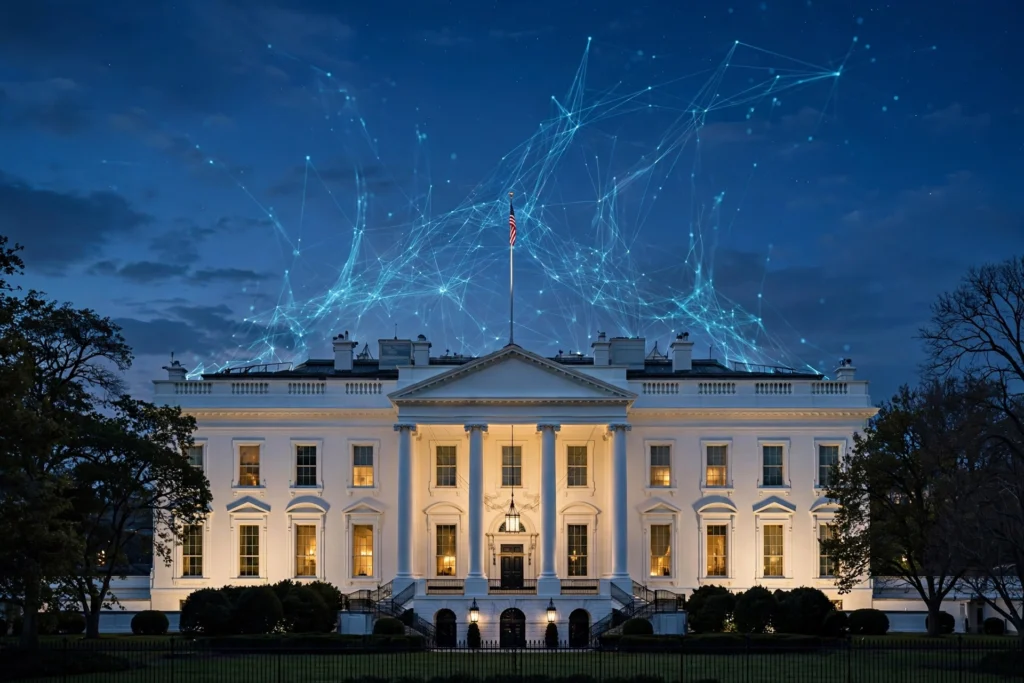
President Donald Trump announced on Sunday that he is creating a new federal task force dedicated to artificial intelligence — and ordering the government to stop calling it that.
In a Truth Social post on October 4, Trump said he was establishing a “Super Intelligence Force” to oversee the country’s AI strategy. The name follows a directive he issued on September 29 instructing federal agencies to replace the term “artificial intelligence” with “Super Intelligence” in official use — a rebrand the White House says better reflects the technology’s significance.
The task force will be led by Director of National Intelligence Jay Clayton — an unusual choice for a technology brief. Clayton is a longtime Wall Street lawyer who served as chairman of the Securities and Exchange Commission during Trump’s first term and was confirmed as the nation’s top intelligence official in July. He has no background in the technology industry.
Joining him are Federal Trade Commission Chairman Andrew Ferguson, Pentagon technology official Emil Michael, and Office of Personnel Management Director Scott Kupor. The group will report directly to Trump and his chief of staff, Susie Wiles, giving it a direct line to the top of the administration.
According to the announcement, the task force is charged with ensuring that America leads the world in AI — and with using the technology to “protect the interests, and improve the lives, of all Americans.” It is expected to consult widely: with consumers, public-interest groups, religious organisations, infrastructure providers and AI companies alike.
Within 120 days, the group is to deliver a report on the risks and opportunities of the technology and the federal government’s role in shaping its future, according to reporting by the Wall Street Journal via Reuters. That document will effectively become the administration’s AI blueprint.
The move follows a White House meeting last week with leading AI executives and a voluntary industry accord on self-policing — part of an approach that has so far favoured industry cooperation over regulation. But public unease is running high: a Quinnipiac poll found that 73 percent of Americans are concerned AI could one day threaten human survival, and 81 percent say safety matters more than rapid innovation.
Look at the personnel and the priorities are plain to see. An intelligence chief, a competition regulator, a Pentagon technology hand and a civil-service director: this is a task force built to frame AI as a question of national security and economic competition, not laboratory ethics. That framing answers a real anxiety — most Americans want safety put first — but it also explains why the announcement has landed as odd. The technology’s deepest experts are consulted as stakeholders, not seated at the table, while the man holding the gavel has spent his career policing securities markets rather than training neural networks. Whether that lineup can produce a credible plan for the most consequential technology of the century is the open question the 120-day clock now forces.
The rebrand itself has already drawn attention. Detractors argue that swapping an established technical term for a grander one does little to address the substantive questions of safety, jobs and accountability surrounding the technology. Supporters counter that the new name reflects the administration’s ambition to treat AI as a strategic national priority on par with the space race. Either way, the task force’s 120-day report will be the first concrete test of whether the rhetoric translates into policy.