Informopedia Explains: what a black hole really is, how one is born, and what would happen if you fell into one — according to the physics we can test, and the parts nobody can.
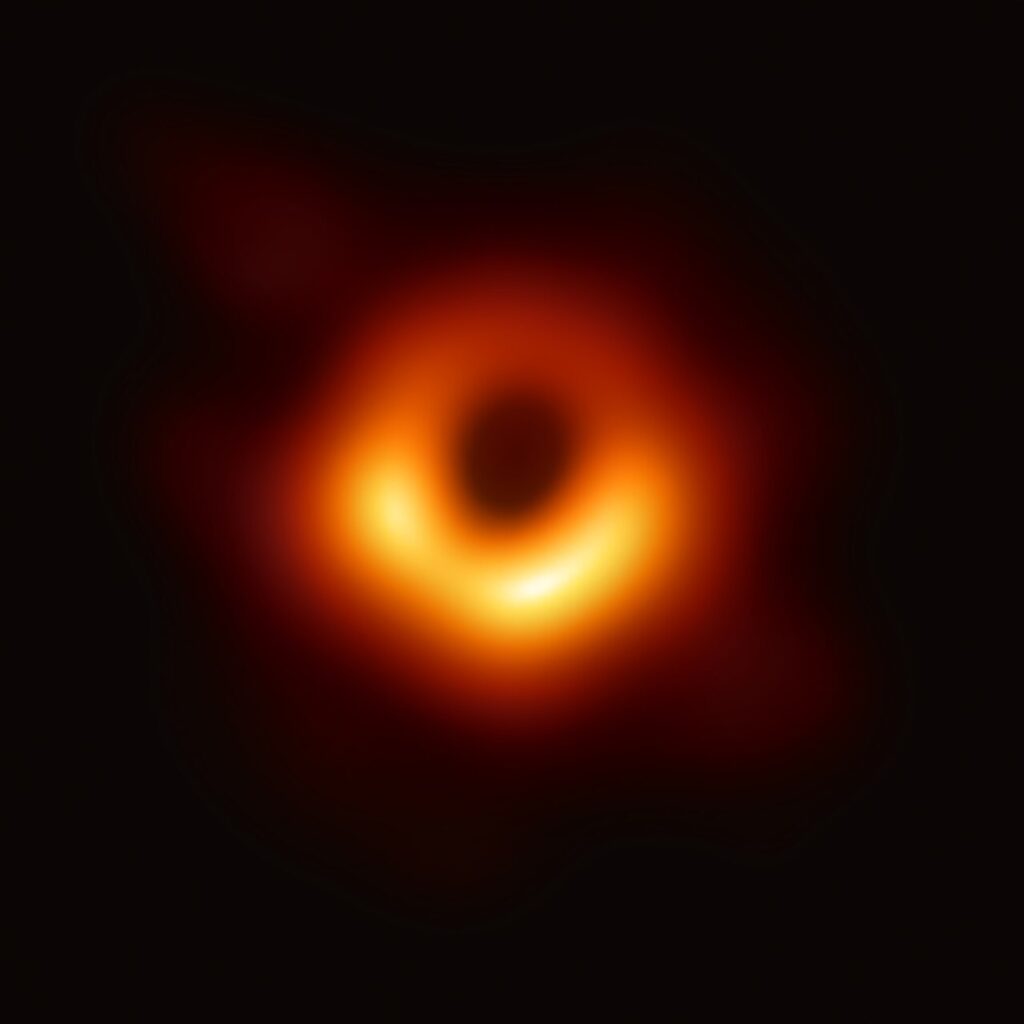
On 10 April 2019, six press conferences on four continents showed the world the same picture at the same moment: a ring of orange fire around a perfect black circle. It looked like a doughnut photographed in the dark. It was, in fact, the first image ever taken of a black hole — a monster 55 million light-years away, holding as much mass as 6.5 billion suns. More than 200 scientists had spent two years turning petabytes of radio data into that single blurry ring. When the director of the project, Sheperd Doeleman, spoke that morning in Washington, he put it plainly: “We have seen what we thought was unseeable.”
The picture answered one question and sharpened a hundred others. Here is what we actually know — and where the knowing stops.
Not a hole, not a vacuum cleaner
A black hole is a region of space where so much matter has been squeezed into so small a volume that gravity overwhelms everything else. The defining feature is a boundary called the event horizon. Cross it, and escape would require moving faster than light. Since nothing can, nothing gets out — not gas, not dust, not light itself. That is why black holes are black.
Two common pictures of them are wrong. First, a black hole is not a hole in the usual sense. It is a physical object: a huge concentration of matter packed into a tiny space, as NASA puts it. The event horizon is not a surface you could stand on. It is a boundary in space, a line past which the rules change. Second, black holes do not go around sucking things in. From a safe distance, their gravity behaves exactly like the gravity of anything else with the same mass. NASA makes the point with a striking thought experiment: if you replaced the Sun with a black hole of the same mass, Earth would freeze in the dark — but the planets would keep orbiting exactly as they do now.
What makes a black hole dangerous is not hunger. It is gradient: the difference in gravity between two points close together. Near a black hole, that difference becomes extreme. And that is where falling in gets ugly.
How one is born
Most black holes start with a death. When a very massive star — many times heavier than the Sun — runs out of fuel, it can no longer hold itself up against its own gravity. The core collapses in a fraction of a second, and the outer layers rebound in a supernova explosion. What is left behind, if the core is heavy enough, collapses past the point of no return. The smallest known black hole is only 3.8 times the mass of the Sun, locked in orbit with a companion star.
Then there are the giants. Nearly every large galaxy, including our own, has a supermassive black hole at its centre. The one in the Milky Way, Sagittarius A*, weighs about 4.3 million suns and sits roughly 26,000 light-years from Earth. The one in the galaxy M87 weighs 6.5 billion suns. The largest known, TON 618, tips the scales at 66 billion solar masses, according to NASA. How the supermassive ones grew so enormous remains an open argument: they may have started as collapsed stars and fed for billions of years, or they may have formed directly from collapsing clouds of gas in the early universe. Astronomers are still working it out.
The range is part of the fascination. The same physics produces objects a few times the Sun’s mass and objects billions of times heavier — and a star that dies in our galaxy today, like the white dwarf remnant at the heart of the Phoenix planet discovery, shows the gentler end of what stellar death can leave behind.
The fall: stretched like spaghetti
Imagine falling feet-first toward a black hole. Your feet are closer to it than your head, so gravity pulls on them harder. As you get closer, the difference grows. You are stretched lengthwise and squeezed sideways, pulled out into a long, thin shape. Astrophysicists call this spaghettification, a term popularised by Stephen Hawking in A Brief History of Time, and NASA describes it as a real, measurable effect of tidal forces.
Whether you would survive long enough to notice depends entirely on the size of the black hole. Around a small, stellar-mass black hole, the tidal forces become lethal well before you reach the event horizon. You would be torn apart first. Around a supermassive black hole, the horizon is so far from the centre that the tidal forces there are comparatively gentle. In theory, you could cross the boundary of a black hole like Sagittarius A* without feeling anything dramatic at all. Nothing about the crossing itself would announce itself. There is no wall, no flash, no alarm. You would simply pass a line in space and never be able to come back.
That is the other strangeness of the fall: time itself behaves differently. Gravity slows time, and near a black hole the effect becomes extreme. To someone watching from a safe distance, you would appear to slow down as you approached the horizon. Your light would stretch toward red and fade. In the idealised picture, the distant watcher would never actually see you cross — your image would hover, dimming, at the edge forever. To you, meanwhile, your own watch would tick normally, and you would cross in a finite amount of time. Both descriptions are correct. They are just told from two different places in the universe.
NASA made this visceral in 2024, when astrophysicist Jeremy Schnittman at the Goddard Space Flight Center released a simulation of a camera falling into a black hole with 4.3 million solar masses — a stand-in for Sagittarius A*. The camera crosses the horizon, and the sky warps into a ring of distorted light. It is a visualisation, not footage, but it is built on real equations, and it is the closest anyone has come to showing what the journey looks like.
What we have actually seen
For most of the twentieth century, black holes were a prediction of Einstein’s general relativity with no direct evidence. That changed in stages. Astronomers tracked stars whipping around the centre of the Milky Way in tight, fast orbits — proof of an enormous unseen mass there. That work won the 2020 Nobel Prize in Physics. In 2015, detectors called LIGO picked up gravitational waves: ripples in space-time from two black holes colliding more than a billion light-years away.
Then came the pictures. The Event Horizon Telescope is not one telescope but a planet-wide array: eight radio dishes from Arizona to Antarctica, synchronised with atomic clocks, acting as a single instrument the size of Earth. In April 2017 it stared at M87*; two years of computation later, it produced the orange ring the world saw in 2019. In May 2022 it did the same for Sagittarius A*, our own galaxy’s black hole — a harder target, because it is smaller and changes faster. The ring in each image is not the black hole itself. It is hot gas glowing around it, bent by gravity into a circle, with the black hole’s shadow — about 2.5 times wider than the event horizon — sitting dark in the middle.
Astronomers now study the universe through more than light alone. Gravitational waves, and ghostly particles called neutrinos that pass through almost everything, each carry information light cannot. Black holes sit at the centre of that multi-messenger picture: the most extreme laboratories physics has.
What nobody knows
Here is the honest edge of the map. General relativity predicts that everything falling into a black hole ends at a singularity — a point of infinite density where the equations break down. Almost nobody believes nature actually contains infinities. Something else must happen there, and the theory that would describe it — a working marriage of general relativity and quantum mechanics — does not exist yet.
There is also the question of information. Quantum physics says information about what falls in cannot be destroyed. But a black hole, classically, swallows it without a trace and then slowly evaporates away through Hawking radiation. Where does the information go? Hawking himself argued about it for decades. The argument continues, and it is one of the liveliest disputes in modern physics.
What we do know is this: black holes are real, they are common, and we have photographed two of them. They are not portals, not shortcuts, and not monsters with appetites. They are what happens when gravity wins completely — and they are still teaching us how much of the universe we have left to understand.