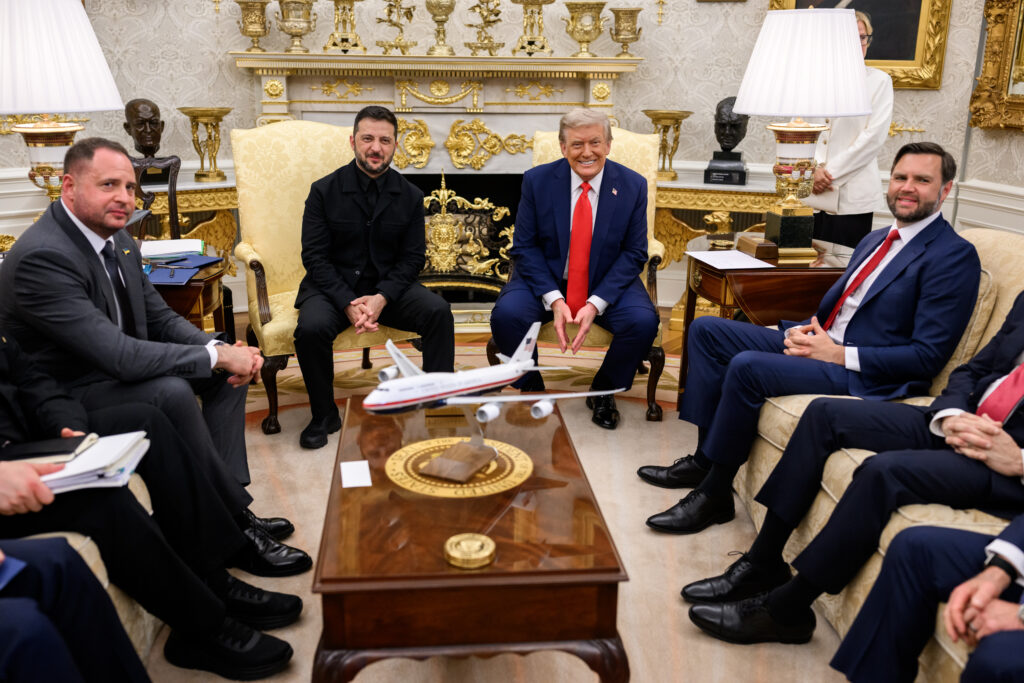
Donald Trump’s diesel deal with Vladimir Putin was barely a day old when it detonated the most public rupture yet between the American president and Volodymyr Zelenskyy — with Trump openly demanding Ukraine replace its wartime leader, Zelenskyy accusing Washington of funding Russian terror, and Europe breaking ranks with the White House.
Friday: Trump announces the deal
Trump said he had spoken by phone with Putin and agreed that Russia would release large quantities of diesel onto world markets. Writing on Truth Social, he said Moscow would “immediately supply” more than 300,000 tons of diesel, followed by another 500,000 tons in November, 1,000,000 tons “immediately thereafter,” and then 3,000,000 tons “within a short period of time.” The US Treasury Department smoothed the path with a general license allowing companies to buy or sell Russian diesel without fear of American sanctions.
Zelenskyy’s verdict was swift. He called the move “unworthy of our partners” and “a weak decision” that would feed Putin’s war machine.
Saturday: Moscow moves, Zaporizhzhia burns
Russia acted on the arrangement within hours, saying on Saturday it had partially lifted its ban on diesel exports with immediate effect.
Zelenskyy tied that decision directly to the bloodshed the same day. “Today, Russia said thank you for the lifting of sanctions on diesel exports by dropping five glide bombs on residential buildings in Zaporizhzhia,” he said. The strike has now killed at least 20 people, including children. Zelenskyy dismissed the American deal as “an investment in a war that must be ended, not prolonged.”
Saturday: Trump turns on Zelenskyy
Asked about the criticism at the White House, Trump did not defend the deal’s merits — he attacked the Ukrainian president personally. He accused Zelenskyy of disobeying his orders not to strike Russian refineries. “He better damn well stop,” Trump said, arguing the attacks risked worsening global fuel shortages tied to the US-Israeli war on Iran.
Then came the line that turned a policy dispute into a political earthquake: “I think it’s time for Ukraine to get a new president.”
“I suggest they get a new leader who can make a deal because he could have made many deals, but for some reason he never does,” Trump told reporters. “Russia would like to make a deal… but for whatever reason, Zelensky does not want to make a deal.”
A US official added context that made the outburst look less spontaneous: Trump had been fuming at Zelenskyy over the refinery attacks before the diesel arrangement was even struck, and Washington had repeatedly asked Kyiv to halt the strikes to no avail. Ukraine’s continued attacks were part of what pushed Trump toward the deal. Kyiv has claimed strikes on five Russian refineries in the past week alone.
Saturday: Europe splits from Washington
While Trump was dressing down Zelenskyy, the European Union was moving in the opposite direction. EU foreign policy chief Kaja Kallas said lifting sanctions on Russian diesel “would only help fuel the Kremlin’s war on Ukraine,” noting that Russian strikes had killed more than 80 Ukrainian civilians in two days.
“This is not the time to ease pressure on Russia, and Europe won’t,” she wrote. EU foreign ministers intend on Monday to approve the biggest set of sanctions listings targeting Russia’s war machine since the war began — a direct rebuke of Washington’s easing.
Why this matters
This is the sharpest Washington-Kyiv rupture since the disastrous February 2025 Oval Office meeting. A sitting American president is now openly campaigning for the removal of an allied wartime leader while cutting an energy deal with Moscow — and his European allies are answering with more sanctions, not fewer.
The diesel itself may matter less than the signal. The announced volumes amount to roughly 6 million barrels, about a day and a half of American demand, according to the US Energy Information Administration. Former US officials are openly doubtful Putin can even deliver that much, given the strain Ukraine’s refinery campaign has put on Russian supplies.
What is driving Trump is closer to home: diesel prices have surged since the Iran war broke out in February, and soaring fuel costs have become a political liability for Republicans with midterm elections next month. Cheap Russian diesel is a domestic play dressed as diplomacy.
What happens next will be decided on three fronts: whether EU ministers follow through on Monday’s sanctions package, whether Moscow actually ships the diesel it promised, and whether Ukraine keeps hitting the refineries Trump wants left alone. None of the three looks likely to bend toward Washington.


2 Comments