Informopedia Explains: the flash and the rumble are the same event, split in two by the fastest and the slowest messengers in nature.
Count with a child during a thunderstorm and you will hear the rule before you understand it: flash — one, two, three — boom. The longer the count, the further away the storm. Everyone knows the trick. Almost no one stops to ask why the trick works at all.
The answer is a race, and it is not close. Light travels at 299,792 kilometres per second. Sound crawls through air at about 343 metres per second — roughly a million times slower. When lightning strikes, the flash and the thunder are born in the same instant, in the same column of air. The light reaches your eyes before you have time to blink. The sound is still walking over.
What lightning actually is
A thundercloud is a charge-separation machine. Updraughts and downdraughts throw ice crystals and soft hail — graupel — against each other thousands of times. The collisions strip electrons away: the top of the cloud ends up positively charged, the bottom negatively charged, and the ground below becomes positively charged in response.
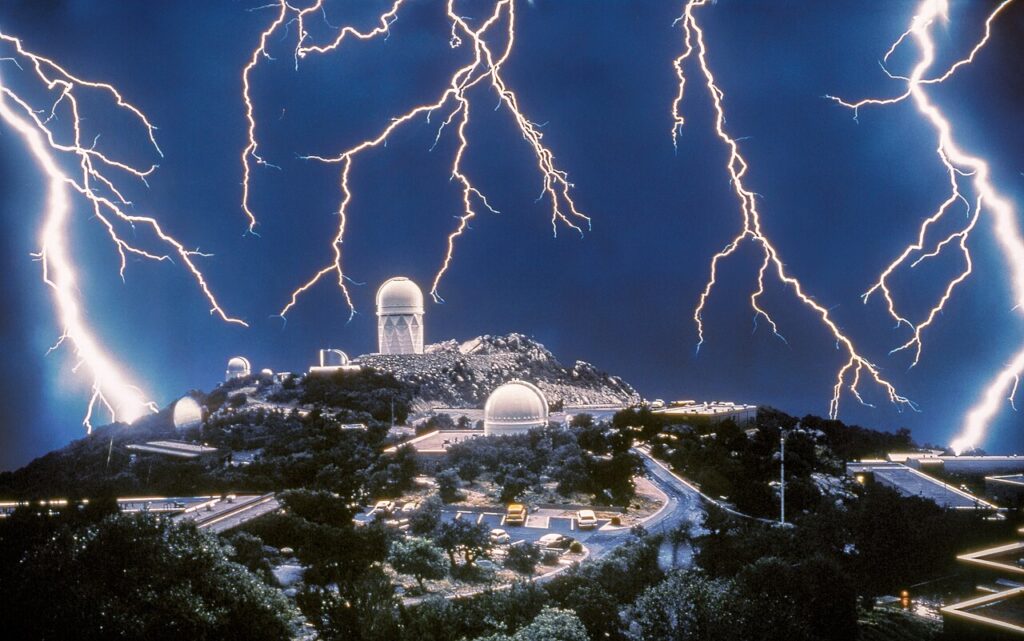
Air is an insulator, and it resists this for as long as it can. But the voltage keeps building — a typical flash carries a potential difference of around 300 million volts — until the air gives way. A faint, jagged channel called a stepped leader zigzags down from the cloud in steps of about 50 metres, while streamers of positive charge reach up from the ground to meet it. When they connect, the real event happens: the return stroke, a surge of current racing back up the channel at about a third of the speed of light.
That channel is, for a few dozen microseconds, the hottest thing for a thousand kilometres in any direction. The air inside it is heated to around 30,000 kelvin — about five times hotter than the visible surface of the Sun. It glows white-hot, and that glow is the flash you see.
And thunder is the sound of that heat
Air heated to 30,000 degrees does not expand gently. It explodes outward faster than the speed of sound, creating a shock wave — the same kind of pressure wave a supersonic jet makes, only far more violent. Within a few metres that shock wave slows to an ordinary sound wave, and it rolls across the sky as thunder.
This is why close lightning sounds like a crack and distant lightning sounds like a rumble. A bolt a kilometre away reaches you as one sharp shock. A bolt ten kilometres away has had its sound stretched and scattered by the air, by clouds, by hills — the high frequencies die first, the low ones roll on, and what arrives is a long, low growl that can last for seconds.
It is also why you can hear thunder from lightning you never see. The flash is blocked by cloud, horizon or hills; the sound bends and bounces its way around them. The reverse never happens: if you can see the flash, the thunder is always on its way.
The gap is a measuring tape
Because sound travels at a nearly constant speed in air — about 343 metres per second, or roughly one kilometre every three seconds — the delay between flash and thunder tells you the distance. Count the seconds, divide by three, and you have the distance in kilometres. Ten seconds means the strike was about three kilometres away. (In miles, count seconds and divide by five.)
That is also the basis of the safety rule the US National Weather Service repeats every storm season: when thunder roars, go indoors. If you can hear thunder, you are within striking distance — lightning can hit the ground 15 kilometres or more from the rain shaft, a phenomenon with the chilling name “a bolt from the blue.”
Lightning is not rare. Satellites have measured about 44 flashes every second somewhere on Earth — roughly 1.4 billion a year — and about 2,000 thunderstorms are active across the planet at any given moment. The tropics get most of them: the Congo Basin and Lake Maracaibo in Venezuela are the most lightning-struck places on the planet.
Why this matters
The flash-before-thunder gap is the most common physics lesson on Earth, and it is hiding a deeper truth about how the universe works: light and sound obey different rules because they are different kinds of thing. Light needs no medium — it crosses the vacuum of space at the same speed everywhere. Sound is a vibration in matter, and it can only travel as fast as the air lets it.
Every thunderstorm is a demonstration of that difference, staged in the sky above your house. The light wins the race by a factor of a million. The sound arrives late, tired, and transformed — and the gap between them is the distance to the storm, measured in seconds.
Next time the sky flashes, count. Then remember what you are counting: not the storm’s delay, but the speed of sound itself, announced by a bolt of lightning. The National Weather Service’s lightning safety pages carry the rules worth knowing before the next storm — and if you want to know what else the sky can do to the grid, a solar storm can knock out the power grid, while the blue of the sky itself is another trick of light in the same air.