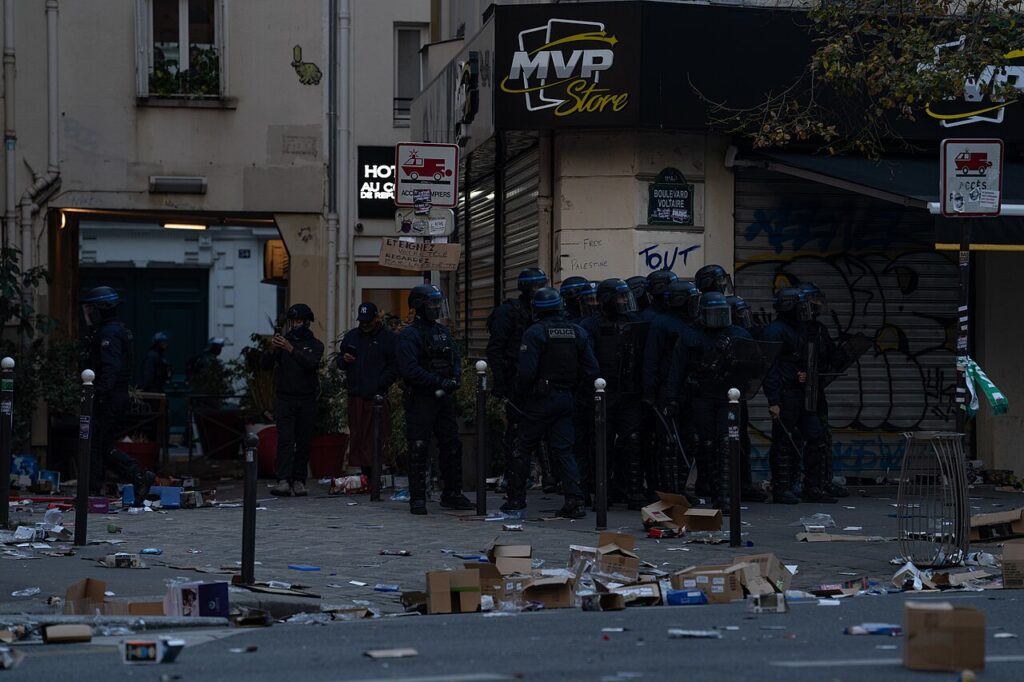
Emmanuel Macron faced the cameras on Sunday night and spoke the words a rattled France had been waiting for all weekend — anger and shame. After two nights of rioting that turned parts of Paris, Bordeaux, Marseille and Lyon into battlegrounds, the French president told the nation that those who looted the country’s most famous luxury stores “will have to pay back for the damage,” and that anyone who “sought to bring down the Republic will be held accountable.”
The televised address from the Élysée Palace was Macron’s first full response to what officials are calling some of the worst urban violence in France in years. By the time he spoke, the toll was staggering: roughly 2,400 people arrested on Saturday alone, nearly 1,000 police officers and gendarmes injured — nine of them seriously — and two deaths.
“How can French people do this to France?”
“Looking at these images, we have all asked ourselves: what was going through their minds? How can French people do this to France?” Macron said, his tone rarely this somber since he took office in 2017. “Nothing justifies it, nothing explains it, nothing excuses it. Tonight, we all feel anger and shame.”
He drew a hard line between the hundreds of thousands who marched peacefully — “yesterday, hundreds of thousands of our compatriots demonstrated to state legitimate claims,” he said — and what he called “seditious elements from far-left factions, joined by numerous delinquents,” whom he blamed for the looting and arson.
Macron also conceded the state had questions to answer. He said he had ordered a review of whether there were failures in intelligence gathering and police preparedness before the violence, and announced that prefects — the French state’s regional administrators — would be empowered alongside mayors to ban certain gatherings where necessary. He asked the government to bring students, teachers, trade unionists and business leaders to the table this week to draft what he called “concrete proposals” to address the crisis.
Looters stripped the luxury districts
What shocked France was not just the violence, but its targets. In Bordeaux, a masked crowd smashed down the doors of a Louis Vuitton store on the famous Rue Sainte-Catherine shopping street. In Marseille, rioters looted Hermès and Rolex outlets along with shops selling jewelry, makeup and clothes — firefighters had to douse a blaze that started in a designer shoe store. In Lille, an Apple store in the city center was stripped bare, the city’s socialist mayor Arnaud Deslandes confirmed.
In Paris, masked gangs looted the Galeries Lafayette — the luxury department store often described as France’s answer to Harrods or Bergdorf Goodman — and left a Christian Dior store vandalized. Dior went as far as hiring its own private security team to guard its flagship store after police appeared to lose control of the streets; a photograph of the company’s burly private guards outside the boutique went viral. In Nice, looters stormed sportswear outlets and a motorcycle dealership. Bordeaux’s mayor Thomas Cazenave said about 100 shops in his city had been hit.
The rioters also struck France’s civic heritage. In Limoges, in central France, a 140-year-old town hall was set on fire; its roof collapsed and flames nearly destroyed the building. In Lyon, the tourist office was torched. At Paris’s Place de la République, the central monument was covered in graffiti, paving stones were ripped up, and a nearby bar, La Barrique, was set alight after looters raided a supermarket for bottles to hurl at police.
Two dead, hundreds injured
Interior Minister Laurent Nunez said a 22-year-old police officer died in Nantes after being struck by a vehicle, and a protester died north of Paris of a cardiorespiratory arrest. The violence has now claimed lives on both sides of the barricades — something even the 2018 yellow-vest unrest never produced at this scale in a single weekend.
Even as Macron spoke on Sunday evening, fresh clashes erupted at the Place de la République, where police fired tear gas and stun grenades at hundreds of people who had gathered after social-media calls for an unauthorized rally. Small groups tried to set bicycles and trash bins on fire as darkness fell.
From school protests to a national crisis
The unrest began weeks ago as student demonstrations over deteriorating conditions in France’s lycées — the country’s secondary schools — and has snowballed into a broad anti-government movement over the cost of living. On Saturday, roughly 550,000 people marched nationwide, according to the interior ministry; the CGT trade union claimed more than 800,000.
Macron’s ministers have blamed “ultra-left” groups for the violence. Across the Atlantic, the unrest has become political ammunition: US President Donald Trump wrote on Truth Social that “France is burning,” blaming immigration, while Vice President J.D. Vance wrote on X that Western liberals had imported the third world in the name of diversity. National Rally chairman Jordan Bardella dismissed Macron’s address as “pathetic” — a sign the crisis is already feeding France’s 2027 presidential campaign, when the country elects Macron’s successor. Macron, term-limited, is in the final months of his presidency.
Why this matters beyond France
France is the European Union’s second-largest economy, and its luxury houses — LVMH, Hermès, Dior — are among the world’s most valuable companies. When looters smash through Louis Vuitton’s doors and Dior hires private guards because the police cannot guarantee the streets, the images travel worldwide in minutes, and they say something bleak about state capacity in the heart of Europe.
The pattern is familiar and global: a cost-of-living squeeze pushes students and workers onto the streets, organized fringe groups hijack the marches, and a government that has governed without a parliamentary majority since 2022 struggles to respond with either concessions or force. From the weeks of student-led protests that grew into a national movement to the protests that brought half a million people onto the streets on Saturday, France’s unrest has been building for weeks — and the world is watching how it ends.


One Comment