Informopedia Explains: the race to build a shield against the world’s fastest missiles — and why, for all the money pouring in, the shield doesn’t actually exist yet.
In October 2026, the Pentagon gave a new cybersecurity task force a job: protect the computer networks that will run America’s future missile shield, a layered system called Golden Dome. It lands inside a bigger story — one the US Missile Defense Agency stated in March 2025, when a destroyer off Hawaii tracked a mock hypersonic missile and pretended to shoot it down. The engagement was simulated. No missile left the ship. That simulation is about as close as anyone on Earth has come to stopping a hypersonic weapon in flight.
That’s the uncomfortable truth behind the arms race: offensive hypersonic missiles are deployed, tested, and multiplying, while the defenses are mostly blueprints.
Why the fastest missiles are also the hardest to see
Intercepting a missile means seeing it, predicting where it will be, and putting something explosive there at exactly the right moment. Hypersonic weapons attack all three steps at once — the offense side is detailed in our earlier piece on how hypersonic missiles actually work.
First, they fly in the gap. A typical hypersonic weapon cruises at altitudes of roughly 20 to 100 kilometers — above the ceiling of conventional air defenses, below the high-altitude regime where ballistic-missile defenses operate. Neither system was built to look there. Worse, glide vehicles give off less of the bright infrared signature that satellites watch for when a ballistic missile roars through its boost phase. They are fast — Mach 5 and up — but the real problem isn’t speed, it’s invisibility in the wrong airspace.
Second, they don’t fly straight. A ballistic warhead, once its booster burns out, follows a predictable arc through space: track it long enough and a computer can work out where that arc will land, minutes ahead, with an interceptor waiting. A hypersonic glide vehicle weaves — banking, climbing, diving inside the atmosphere all the way to its target — so any prediction of its position goes stale within seconds. You can’t ambush something whose path keeps changing.
Third, time works against the defender. Even in the best case, a hypersonic attack compresses the entire detect-decide-intercept sequence into minutes. The head of US Northern Command, Air Force General Gregory Guillot, has called hypersonics “probably the most technologically challenging threat we’re facing, and the most destabilizing.” The Pentagon’s research service put it bluntly in 2026: such weapons are “difficult to defend against, with no operational defence systems currently available.” Russia and China have fielded them. The United States has not — and it can’t yet stop them, either.
The American answer: a purpose-built interceptor
The closest thing to a real defense is a missile that doesn’t exist yet, called the Glide Phase Interceptor, or GPI. The name is the strategy: catch the weapon mid-flight, during the glide phase, instead of trying to hit it as it screams into its target at the last moment.
GPI is a joint American-Japanese program. Northrop Grumman won the contract in September 2024, and in April 2026 the Missile Defense Agency added $475 million to accelerate the work — pushing the total past $1.3 billion and pulling the delivery date from 2035 forward to 2031. The interceptor is designed to fire from the Navy’s existing Aegis-equipped warships, and Japan is developing the rocket motors.
Congress has even put the target in law: an initial GPI capability by the end of 2029 with at least a dozen missiles for testing, full operational capability by 2032. For a weapons program, that counts as a sprint — and on the most optimistic schedule, the first real hypersonic defense is still years away.
The eyes in space
An interceptor is useless without something telling it where to fly. The second half of the American bet is a constellation of satellites built to watch the “gap” from orbit.
The core is HBTSS — the Hypersonic and Ballistic Tracking Space Sensor. Older satellites mainly spot the bright plume of a launch; HBTSS is designed to track a dim, maneuvering vehicle through mid-flight and produce a “fire-control-quality” track: coordinates precise enough to guide an interceptor. The first two prototypes went up in February 2024, and one demonstrated on-orbit tracking in 2026.
The vision is a relay chain: wide-field satellites spot the launch and cue the precise trackers, which lock onto the gliding weapon and hand the data to a warship, which fires the interceptor. In June 2026 the Senate Armed Services Committee told the Space Force to field at least 45 of these sensors — but as with GPI, most is still construction, not capability.
What exists today: Aegis, the SM-6, and a simulated kill
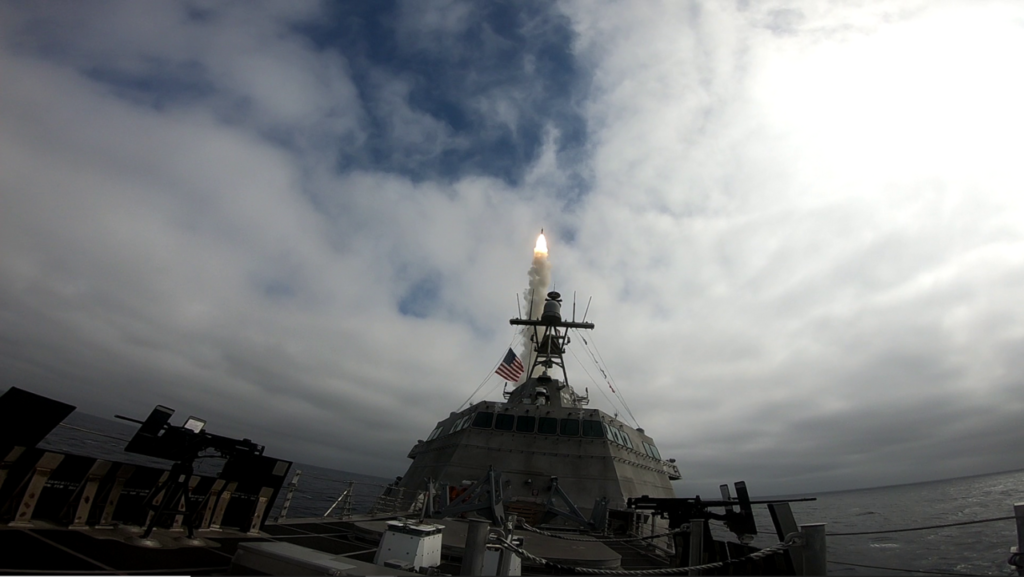
So what can actually be done right now? Something — but less than it sounds. The best current option is the Aegis combat system — the radar-and-computer heart of American destroyers — paired with the SM-6 missile, which handles aircraft, cruise missiles, drones, and ballistic missiles in their terminal phase. In March 2025, the destroyer USS Pinckney took part in a test off Hawaii called Stellar Banshee: the ship detected and tracked an air-launched target fitted with a hypersonic glide-vehicle front end, and ran a simulated SM-6 engagement against it. The Missile Defense Agency hailed it as a major step — and it was. But the engagement was simulated: no interceptor was fired.
This is also the moment to clear up a common confusion. The SM-3 is an exo-atmospheric interceptor for ballistic missiles — it flies outside the atmosphere, where hypersonic weapons don’t live. THAAD defends against ballistic missiles in their terminal phase. And the SM-6’s role against hypersonics is developmental, demonstrated so far only on a computer. Different threats, different physics, different weapons.
The honest limits: money, time, and math
Here’s where the story gets sobering, and it deserves to be stated without softening.
Nothing works yet at scale. As of 2026, no deployed defense anywhere in the world can reliably stop hypersonic weapons. The only Aegis test against one was simulated; the purpose-built interceptor is years from service.
The timelines are long. GPI’s target is 2031. The space-tracking constellation is still prototypes plus contracts. Building the sensors, the interceptors, and the command software — then testing them together — is a decade-scale project on a five-year schedule.
The economics are brutal. Missile defense has to be nearly perfect; the offense only needs one success. The Congressional Budget Office estimated in 2026 that a shield broadly matching the Golden Dome executive order could cost about $1.2 trillion to build and operate over 20 years, with space-based interceptors accounting for roughly $743 billion — about 60% of the total. The program office calls that a “sensational projection” and puts its own estimate at $185 billion over a decade. Even the lower number makes this one of the most expensive weapons programs ever conceived. And existing interceptor stocks are already thin: an October 2026 defense panel noted American upper-tier intercept rates ran 95 to 97% in the recent Iran campaign, but judged inventories were short before it and shorter now. Every interceptor fired has to be rebuilt, at enormous cost.
Then there’s the technology always “ten years away.” Directed-energy weapons — the Navy’s HELIOS laser, Army programs, Israel’s Iron Beam — are real and improving, but they target drones, rockets, and mortar shells, not maneuvering hypersonic glide vehicles.
Why this matters beyond Washington
It’s tempting to file this as an American defense story. It isn’t. The offense is spreading faster than the defense: Russia and China field hypersonic weapons, and South Korea’s first hypersonic test earlier this month showed the club is getting bigger. Every year the defense stays on the drawing board is a year in which more countries can hold carriers, airbases, and command centers at risk with weapons nothing can stop.
That asymmetry is what makes the threat “destabilizing,” in General Guillot’s word. Deterrence rests partly on defense — the belief that an attack might fail. Right now, against a hypersonic attack, there is no reason for an attacker to believe that. The race the Pentagon is running isn’t really against any rival. It’s against time: building a shield before the threat it was meant to stop becomes too common to matter.
What happens next
Watch three dates: 2028, when Northrop Grumman is expected to complete the preliminary design review for GPI — the moment the program graduates from plans to hardware, or starts slipping; 2029, Congress’s legal deadline for the first dozen interceptors; and the quiet drumbeat of satellite launches feeding the tracking layer. Above all, watch the honesty of the tests. Stellar Banshee mattered because it proved the tracking and software can handle a hypersonic target. The day a real interceptor collides with a maneuvering glide vehicle — not a simulation — is the day this story changes. Until then, the world’s fastest missiles remain, for practical purposes, unstoppable.