70,000 Officers, Elite Counterterrorism Units, the Louvre Dark: France Braces for a Saturday on Edge
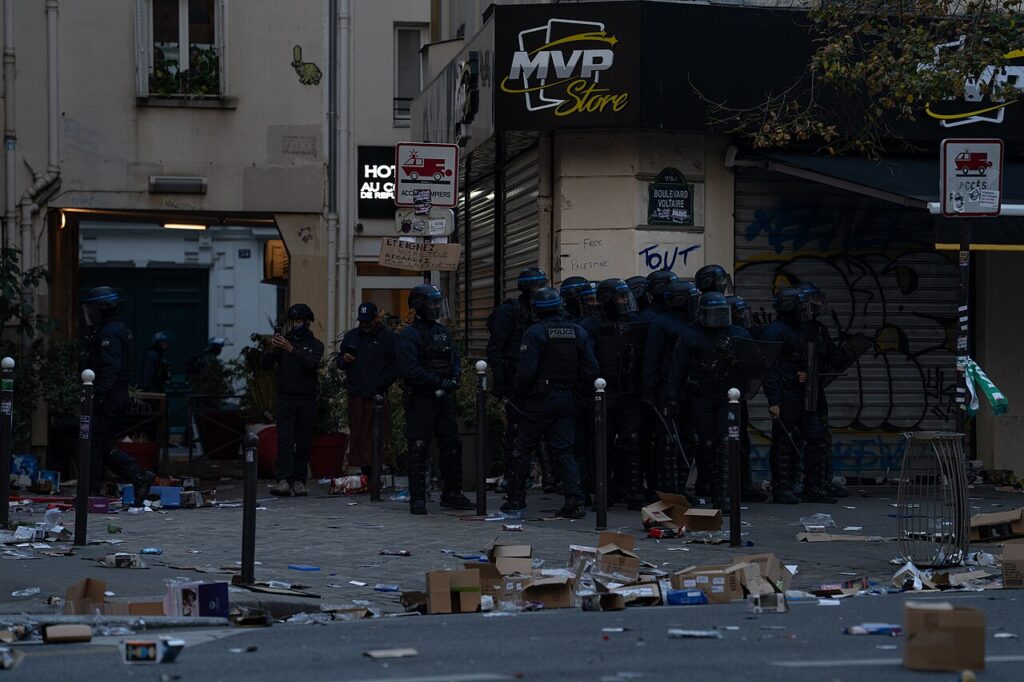
France has never put so many police on its streets for a single day of protest. Interior Minister Laurent Nuñez announced on Friday that roughly 70,000 police officers and gendarmes will be deployed across the country today, Saturday, October 24, as cost-of-living demonstrations return to French cities — and with them, the threat of the violence that shocked the country last weekend.
“We will be uncompromising with rioters, looters and all those who commit acts of violence,” Nuñez told reporters in Paris after a security meeting chaired by President Emmanuel Macron and attended by Prime Minister Sébastien Lecornu. “We will be absolutely uncompromising with those involved in violence. Police will have a very firm approach to making arrests, and there will be legal consequences.”
The deployment goes far beyond regular riot police. Nuñez said elite units normally reserved for counterterrorism operations and hostage rescues will be on the streets, alongside helicopters, drones, armored vehicles, mounted police, and water cannons. City halls and other public buildings will get special protection. France’s Ministry of Justice said authorities have already arrested 2,700 people since last weekend’s unrest.
The museums are staying closed. The Louvre — the most visited museum on earth — is shutting its doors for the day, and Art Basel Paris has cancelled its weekend programme, a measure of how seriously the government is taking the threat.
What spooked France so badly was last Saturday, October 17. Demonstrations that began largely peacefully against rising living costs and fuel prices descended into violence in Paris, Marseille, Lyon and other cities — fires, looting, smashed shopfronts, and clashes with police, in France’s worst unrest in years. The defining image was Limoges: the city’s 143-year-old town hall, its wooden clock tower collapsing in flames, partly destroyed as rioters torched one of the most iconic buildings in central France.
Two men, aged 66 and 34, have been arrested in connection with the Limoges fire. Prosecutors say the suspects have links to “radical-left networks,” and the city’s mayor has blamed the damage on the French hard left.
Today’s demonstrations draw from the same coalition that filled the streets last weekend and through September: students, the CGT labour union, and activists from the Yellow Vest movement, whose 2018–2019 protests against social injustice remain the reference point for everything happening now.
The stakes for Macron
Nuñez’s tone on Friday was not just about crowd control. He warned of “numerous calls from radical far-left groups on social media to commit acts of violence and vandalism” and said messages urging looting were “clearly being spread by rioters.” He called today’s gathering “absolutely not a peaceful, friendly demonstration.”
The timing sharpens everything. France is six months from a presidential election, and Macron’s government is struggling to prove it still controls the streets. Last Saturday, the government itself acknowledged it had “lost control” of the unrest. A second lost Saturday — fires in city centers, looted shops — would be a political catastrophe for the governing camp.
Embassies are already treating the day as a risk. The Indian and Philippine embassies in Paris issued safety advisories telling their nationals to avoid protest sites and leave the vicinity immediately if tensions escalate.
Why this matters beyond France
This is no longer a French domestic story. Street unrest is hitting at the heart of the eurozone’s second-largest economy, and markets have noticed — France’s bonds and equities have been twitchy since the October 17 violence, as investors price in political risk in a country that used to be the model of stability. A second Saturday of burning barricades would deepen that damage and hand ammunition to every populist movement in Europe watching closely: France’s crisis is becoming the template for what cost-of-living anger looks like when it turns physical. Six months from the presidential election, the outcome of today could shape who gets to run France — and how Europe’s establishment talks to its own angry streets.