BELGRADE — Aleksandar Vucic went on live television on Sunday night and said the words nobody in Serbia had heard from him in more than a decade: he had lost.
“It is clear that we have lost these elections, the Student List has won,” the Serbian president told supporters at his party’s election-night event, conceding on the basis of sample-based projections before final results were in. His Serbian Progressive Party (SNS) would take around 105 seats, he said, against 135 to 140 for the youth-backed Students’ List in the 250-seat parliament. No other party, he added, had cleared the threshold to enter parliament at all.
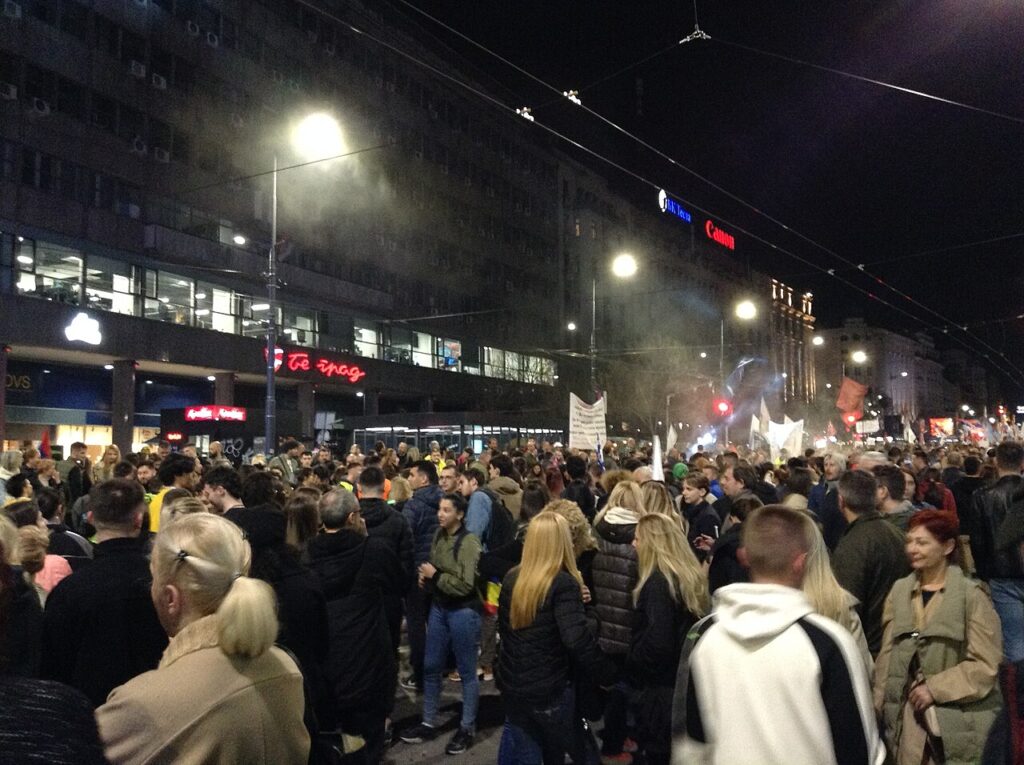
Within moments of the announcement, Belgrade’s main boulevards filled. Tens of thousands of people poured into the streets, cars honking, strangers dancing, students shouting “victory” and “he’s done”.
The concession capped a night of high turnout and rising tension in an election that pitted Vucic and his right-wing party against a movement that began in university lecture halls and ended up beating him at his own game. Serbia’s 6.4 million voters were choosing a new parliament, and a projection from the Centre for Free Elections and Democracy and Ipsos Serbia put the Students’ List at 52 percent of the vote against 39.3 percent for the SNS — roughly 2.2 million votes to 1.7 million.
Vucic did not go quietly. He blamed Serbia’s independent media, alleged interference by unnamed European countries and what he called an “American deep state” for the defeat. He told supporters he would not flee the country — “No one is going to run away” — and said he would not challenge the result in court, to avoid “unrest and clashes in the streets”. “I am proud of everything we have done,” he said.
It is a remarkable fall for a man who has dominated Serbian politics as prime minister from 2014 and president since 2017, who was endorsed by Russian President Vladimir Putin, and who spent two years denouncing the student movement as a foreign-led attempt to unseat him. Sunday’s vote was for parliament, not the presidency, so Vucic keeps that office. What he lost is control of the government.
The movement that beat him was born in grief. In November 2024, a concrete canopy collapsed at the railway station in Novi Sad, killing 16 people. Students blamed corruption and shoddy state work, occupied their faculties, and kept marching for nearly two years — against what they called creeping authoritarianism, a captured media and a state that answered to one party. Vucic called snap elections in September, gambling that a vote would settle the question. It did, just not in his favour.
“Tonight is a victory of courage over fear, and of faith that Serbia can and must be different,” said Radomir Sajcic, a chemistry professor at the University of Belgrade who stood as a candidate for the Student List and has been talked about as a possible future leader. Speaking for the students at their headquarters, he added: “Dear Serbia, tonight the voice of the people is being heard. Tonight we celebrate victory, tomorrow we build the future.”
The congratulations came fast from Brussels. European Commission President Ursula von der Leyen wrote: “Today, the people of Serbia turned out in record numbers to shape their country’s future. Congratulations to the Student List on its victory in the parliamentary elections. We stand ready to support reforms on the rule of law, media freedom, the fight against corruption and strong democratic institutions, and to work together to advance Serbia’s future in the European Union.” Enlargement Commissioner Marta Kos said Serbia had “raised its voice” after nearly two years of protests, and Council of Europe Secretary General Alain Berset welcomed Vucic’s acceptance of the result and his commitment to a peaceful transition. Even Milorad Dodik, the pro-Russian Bosnian Serb leader, congratulated the winners, writing: “The voice of the people is the voice of God.”
Why this matters beyond Serbia’s borders: Serbia is a candidate for European Union membership, and its accession talks have stalled for years over exactly the issues the students marched about — the rule of law, media freedom and corruption. A government formed by a movement with no experience of running a country must now do exactly that, in a state of some six million people, while managing the unresolved question of Kosovo and balancing ties with Russia and China against Brussels. And it must do so alongside a president who has just been humiliated at the ballot box but still holds his office — a cohabitation that could be cooperative or a daily standoff. Beyond the Balkans, the result will be read as a blueprint: it is the second time this year a long-entrenched leader has been beaten after student-led revolt, following the defeat of Hungary’s Viktor Orban in April, and student movements from Albania to France will be studying how Belgrade did it.
What happens next is less certain than the celebration. Final results are still to be confirmed, and the Student List must turn a protest movement into a governing coalition — choosing a prime minister, dividing ministries and proving it can run the state it spent two years denouncing. The students have won the election. Governing is the harder exam, and it starts now.

One Comment