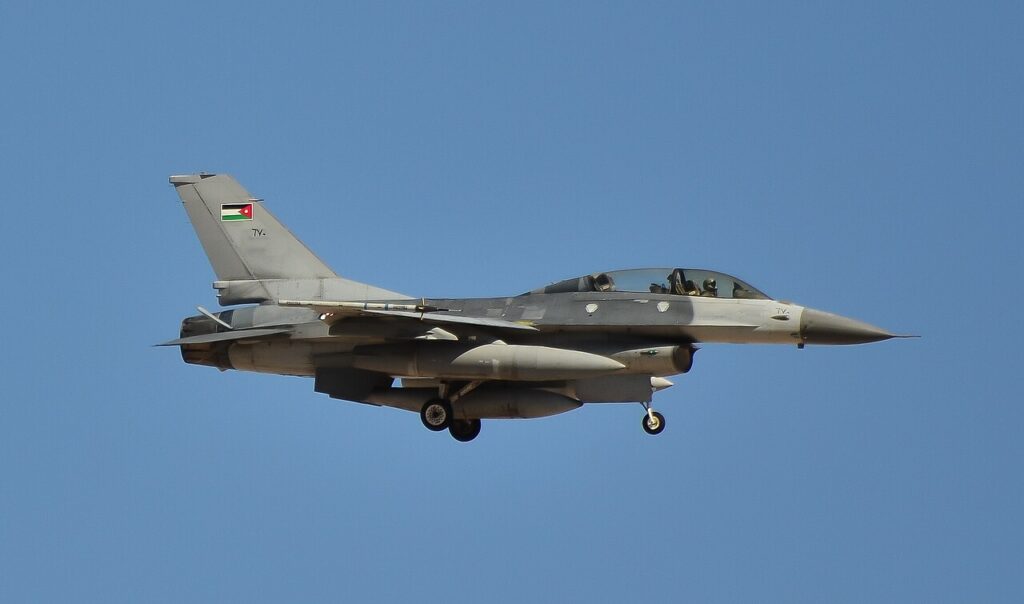
Jordanian fighter jets struck targets across the border in southern Syria late on Monday, in retaliation for a gun attack on a church funeral in Jordan that killed nine people three days earlier. Within hours, the two neighbours were telling sharply different stories about what had happened — and Syria shut the main border crossing between them.
The Jordanian Armed Forces said the Royal Jordanian Air Force had carried out “Operation Jordanian Deterrence – Hmoud”, hitting what it called hideouts of terrorist organisations in southern Syria. The operation, named after the village where the church attack took place, destroyed several militant positions, killed and wounded a number of their members, and destroyed their equipment, the military said in a statement carried by the state-run Jordan News Agency, Petra. Amman said the strikes were conducted in coordination with the Syrian government, and that the men behind the church attack had ties to the groups targeted.
Damascus denied both claims. Syria’s state news agency, SANA, citing the health director of Daraa province, reported that the strikes killed eight civilians, including an elderly man and three children, and wounded four more. The Syrian government said the attacks had been carried out without prior coordination, that it was investigating what happened, and that it wanted joint military and security coordination in border areas to protect Syria’s sovereignty. An earlier Syrian toll had put the dead at five, including women and children.
The dispute matters because it is the first time Jordan has publicly struck inside Syria in retaliation for an attack on its own soil, and because the two governments cannot even agree on whether they coordinated. A retaliation that one side calls a joint operation and the other calls an uncoordinated violation is exactly how border incidents harden into lasting diplomatic damage.
The strikes came hours after Jordanian security forces arrested the three men accused of the church attack itself. Public Security Director Major General Abdullah al-Maaytah named them on Monday as Hazza Zaidan Mohammed, Meshal Zaidan Mohammed and Ahmad Sami Hussein — two brothers and a relative by marriage. The men had barricaded themselves in an abandoned house, opened fire on security forces, and were wounded and taken to hospital, where one was reported in critical condition. Weapons and a large quantity of ammunition were recovered, and no security personnel were hurt.
There is, however, an unresolved tension inside Jordan’s own account. Interior Minister Mazen al-Faraya said on Monday that all the attackers were Jordanian nationals, that they had been holed up near the site of the attack, and that there was “no indication of any external contacts or collaboration with foreign parties”. The armed forces’ statement, issued the same evening, linked the attackers to groups in southern Syria. Neither statement names the groups allegedly targeted, and no evidence for the link has been published.
On Friday, gunmen had opened fire during a funeral at the Greek Orthodox Church of St George in Hammoud, a predominantly Christian village in Jordan’s southern Karak governorate, killing nine people and wounding 34. The victims were mostly older mourners. The victims were buried on Sunday and Monday. Prime Minister Jafar Hassan ordered three days of national mourning, with flags at half-mast.
King Abdullah II, who visited wounded victims in hospital wearing military fatigues, said security forces had pursued the attackers to the end. “We vowed the terrorists would not escape punishment, and no proponent of dark ideologies that divide Jordanians will be tolerated,” he wrote. “We will show them.”
Attacks on places of worship are rare in Jordan, a country where Christians make up only two to three percent of a Muslim-majority population. The last major attack in Karak itself came in December 2016, when gunmen targeted a security centre and police patrols, killing ten people.
Then, on Tuesday, Syria’s border and customs authority announced it was closing the Nassib crossing — known as Jaber on the Jordanian side — suspending all passenger and commercial traffic in both directions. For traders and travellers on both sides, that turns a military incident into an economic one.
Why this matters beyond Jordan and Syria is straightforward. The Middle East is already crowded with cross-border retaliation, and each new precedent makes the next one easier to justify. If a state can bomb its neighbour over an attack its own interior minister says showed no foreign links, the bar for cross-border force drops everywhere. For Syria’s fragile post-war government, still trying to assert control over its south, a foreign air force operating over Daraa — coordinated or not — is a sovereignty test it cannot afford to fail publicly. Whether the border closure is a brief protest or a longer freeze, and whether either capital produces evidence for its Monday-night claims, will become clear in the coming days.


One Comment