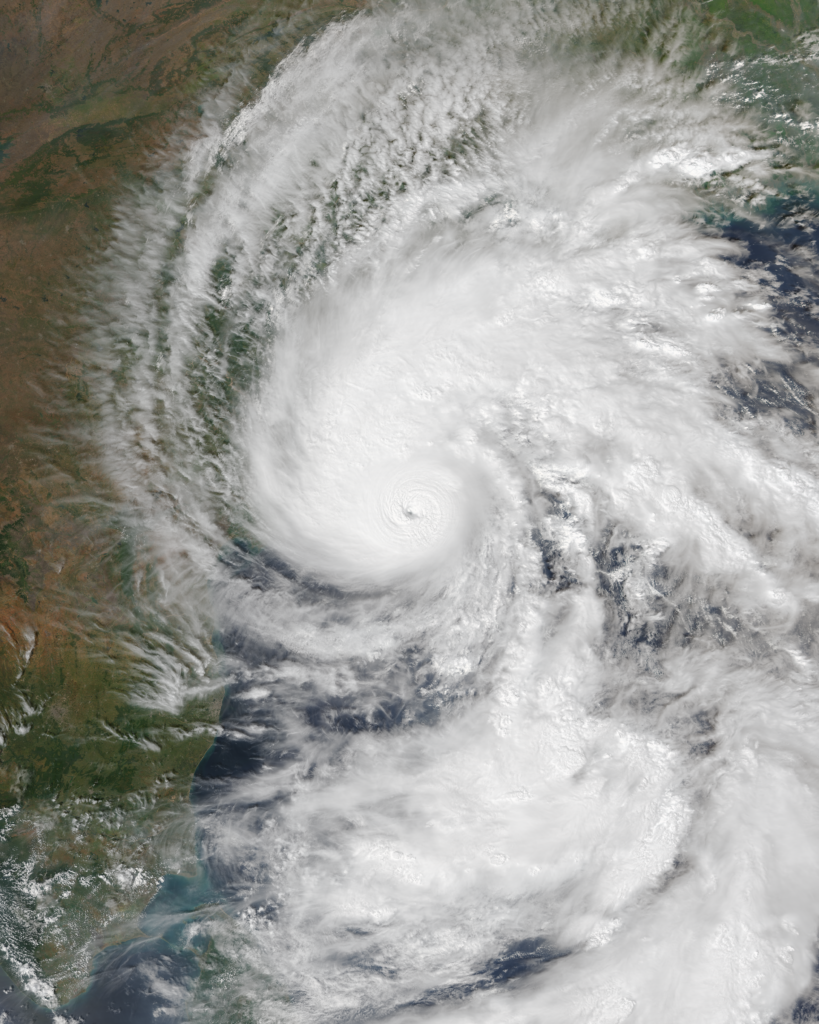
Very severe Cyclone Arnab began slamming into India’s east coast in the early hours of Wednesday, bringing winds of up to 150 kilometres per hour, a storm surge of up to 2.5 metres and driving rain to Andhra Pradesh and the neighbouring enclave of Yanam.
The landfall process started at about 1:20 a.m. local time on Wednesday, October 28, the India Meteorological Department (IMD) said, with the storm crossing the coast between Bapatla and Visakhapatnam, just south of Yanam — a small coastal enclave of the union territory of Puducherry, surrounded on three sides by Andhra Pradesh.
Arnab came ashore as a “very severe cyclonic storm,” the second-highest category on India’s scale, with sustained winds of 125 to 135 kmph and gusts reaching 150 kmph. The IMD said those winds would hold for roughly four hours as the storm’s centre crossed the coastline, before easing gradually.
“The wind speed of the cyclone will continue at the speed of 125 kmph to 135 kmph gusting 150 kmph for next four hours. The tip of the system has already entered the land mass and the entire process will take around four hours,” IMD Director General Mrutunjay Mohapatra said.
By Wednesday morning the storm’s centre was sitting very close to the coast, about 30 kilometres east of Narsapur and 45 kilometres south-southwest of Yanam, the IMD said in a later bulletin, with the northern spiral band of the cyclone already well inland.
Surge water, uprooted trees, rescues under way
The first damage reports were the familiar calling cards of a Bay of Bengal landfall: trees torn down, power lines snapped and seawater pushing into low-lying streets.
Strong winds uprooted several trees near the Yanam entrance on National Highway 216, disaster management officials said, while seawater inundated Savitri Nagar in Yanam, flooding the ground floor of a local relief camp as the sea rose three to four feet. In Kakinada district, police rescued four people stranded in floodwaters near Bombay Katta after heavy rain and seawater swamped the area.
Heavy rain and strong winds were reported across Anakapalli, Visakhapatnam, Kakinada, Konaseema and West Godavari districts, and the IMD warned of a storm surge of 1.5 to 2.5 metres above the normal tide inundating low-lying areas of Andhra Pradesh over the following six hours.
No loss of life had been reported so far, the office of Andhra Pradesh Chief Minister N. Chandrababu Naidu said, though trees were uprooted in several places and power supply was disrupted. Thousands of people had been evacuated along India’s eastern coast this week, and some train and flight services were cancelled ahead of the storm’s arrival.
One of the largest evacuation efforts of the season
Andhra Pradesh had spent days preparing. The state identified 2,199 cyclone shelters and evacuation plans prioritising the elderly, children, people with disabilities and pregnant women — more than 2,360 pregnant women were shifted to medical facilities before the storm arrived, according to the chief minister’s office.
Twelve teams from the National Disaster Response Force and ten from the State Disaster Response Force were deployed to the coastal districts, alongside police, fire services and medical teams, with the Navy and Coast Guard on standby. More than 8,400 power restoration personnel were mobilised, and control rooms operated around the clock. Chief Minister Naidu continued to receive updates from officials through the night as the storm crossed the coast.
Why this matters
The Bay of Bengal is one of the deadliest cyclone basins on Earth, and India’s east coast has paid for that geography repeatedly. A super cyclone that struck Odisha in October 1999 killed nearly 10,000 people and remains one of the country’s worst natural disasters. What has changed since is not the storms but the response: satellite tracking, early warnings and mass evacuations have turned landfalls that once killed thousands into events measured, so far, in uprooted trees and flooded streets.
Arnab is a test of that system at its sharpest end — a very severe storm striking a densely populated coastline at night, with a surge arriving on top of a high tide. Whether the “no deaths so far” holds through the morning, when the full damage picture emerges from the coastal districts, will be the real measure of it.
Related: Cyclone Arnab Is Now a Named Storm — and It Is Heading for India’s East Coast on October 28 | Why Is It Called Cyclone Arnab? How the World’s Storms Get Their Names