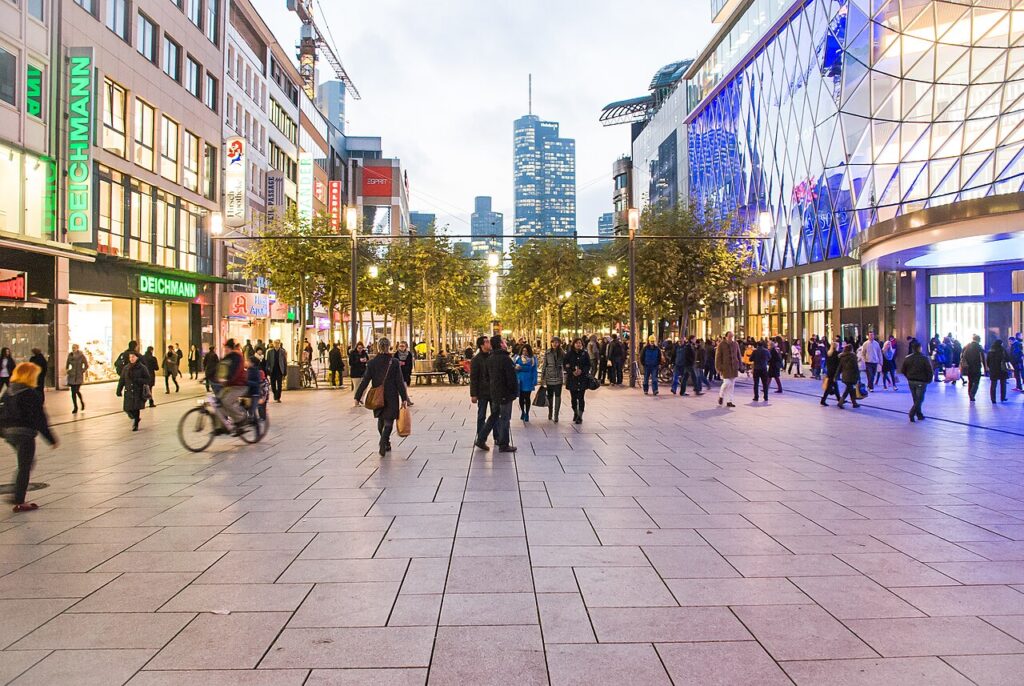
The day had ended peacefully. By nightfall in Frankfurt, it had not. Hooded rioters smashed shop windows and looted stores along the Zeil, the financial hub’s main shopping street, on Saturday night, turning Germany’s youth-led day of protest into the country’s first night of Gen Z looting.
Frankfurt police said the unrest was still going on late into the night. “Violent disturbances are continuing,” the force said in a post on X. “In the city centre, windows have been smashed at several shops. Molotov cocktails are also being thrown at the emergency services. We urge all bystanders to avoid the city centre or to leave the area.”
At least two stores were looted and several more damaged, according to a Reuters witness in the city centre. A gun store was among the shops targeted: its windows were smashed, a suspect was arrested and police seized two weapons. A trainer shop and a perfume store were also looted, according to the German daily Bild. Police closed off a large section of the Zeil as riot police and vans moved in, and officers used water cannon and pepper spray against crowds throwing stones, fireworks and petrol bombs. Several police officers were injured.
Frankfurt was the worst of it, but not the only flashpoint. Violence also broke out in Berlin, Cologne and Hamburg as some groups refused to disperse after the daytime marches. Police used water cannon in Hamburg and Cologne after emergency workers were pelted with fireworks, stones and bottles, and barricades were set on fire in Hamburg.
The contrast with the daytime picture could hardly be sharper. Saturday’s marches had been largely peaceful, with police counts in Frankfurt, Munich and Berlin putting turnout at around 18,000 — roughly half the 36,000 listed on the organisers’ website, and far below the 182,000 the organisers had initially expected. The marches, organised by the campaign group “Gen Z regelt” — “Gen Z takes charge” — took place in 34 cities, including Berlin, Frankfurt and Munich.
The protesters’ demands are familiar from a summer of youth unrest across Europe: more money for schools and universities, relief from rising living costs, and opposition to compulsory military service, alongside better support for health services and a fairer sharing of the burden as Germany’s population ages and its economy stalls. “We are here today to fight for peace and freedom, rather than for war and coercion,” Gen Z regelt spokesperson Lina Friedrich said in Berlin on Saturday.
What happens next will depend on which version of Saturday survives in public memory: the daytime marches, or the night in Frankfurt. Hesse’s interior minister, Roman Poseck, said around 100 identified left-wing extremists had joined the Frankfurt protest. “It is shameful how this event here in Frankfurt has ended,” he said. The federal interior ministry had warned before the marches that parts of Germany’s far-left extremist scene, along with some groups linked to foreign extremist movements, were mobilising around the protests. Germany’s national school student umbrella organisation has distanced itself from the campaign and plans its own separate day of protest on 20 November.
Why this matters beyond Germany: until Saturday night, the country’s Gen Z wave had been the peaceful exception to a European pattern that has already produced looting and running street battles in France. A movement that began as a demand to be heard on classrooms and living costs now faces the question every protest movement dreads — whether a violent fringe at night undoes a peaceful majority by day, and whether a government that has offered the young protesters little so far answers the looting with crackdowns, concessions, or both.