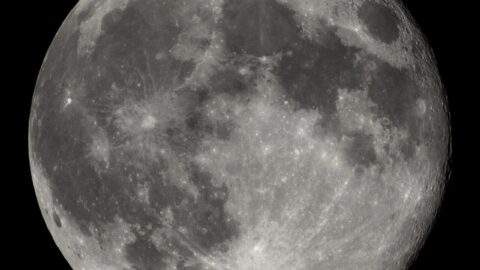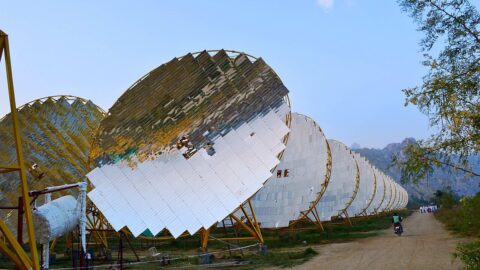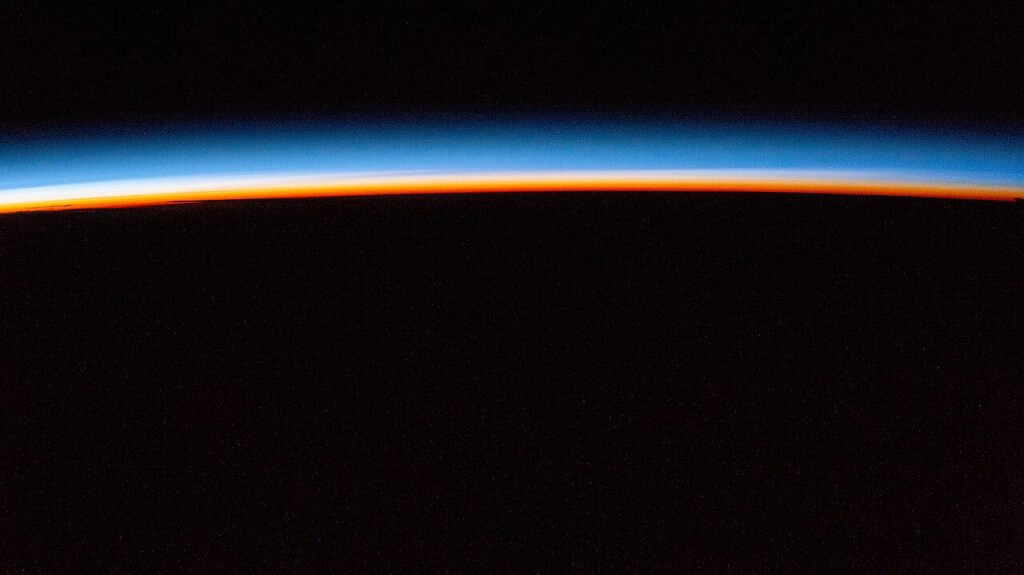
Informopedia Explains: in August, Elon Musk posted on X that “sentient satellites” launched from the Moon could shade the Earth from sunlight and solve global warming for roughly a billion years. It sounded like a throwaway line from a man who posts many of them. This month, a serious engineering report landed on the same idea — and found that, on paper at least, it is not absurd. A giant sunshade in space could, in principle, cool the planet by about one degree Celsius. The catch is everything else.
The basic physics is simple
Earth warms because greenhouse gases trap heat from sunlight that has already arrived. A sunshade attacks the other end of the equation: stop some sunlight arriving in the first place. Climate models suggest that blocking about 1% of the sunlight reaching Earth would lower average temperatures by roughly 1°C. That is a large number in climate terms — about the total warming since the late 19th century — and it is why the idea keeps returning despite sounding like science fiction.
Where would you put it?
Between Earth and the Sun, at a gravitational balancing point called L1, roughly 1.5 to 2 million kilometres sunward from Earth. At L1, the pulls of the Sun and Earth roughly cancel out, so an object can hover in place with little fuel. The concept dates to at least 1989, when James Early at Lawrence Livermore National Laboratory sketched a reflector at L1. For 35 years it stayed theoretical. The new report, from the US nonprofit Planetary Sunshade Institute — drawing on a consortium of engineers and climate scientists, including researchers linked to NASA, and funded by a £400,000 grant from the UK Advanced Research and Invention Agency — is an attempt to move it from papers to plans. It examines six possible designs.
The leading design: 5,000 spinning giants
The core proposal is a fleet of “heliogyro” satellites: thin, reflective structures that spin to stay rigid, each about 40 kilometres across. About 5,000 of them, working together, would shade roughly 1% of incoming sunlight. A second design would create a cloud of reflective dust or specially designed particles at the same point. Both would sit far enough from Earth to dim the Sun slightly for the whole planet at once — which is both the point and the problem, as we will see.
The number that stops the conversation
Mass. The heliogyro fleet would weigh around 67 to 70 million tonnes — about 1,500 times the total mass of everything humanity has ever launched into space. Launching that from Earth is, for practical purposes, out of the question. The consortium’s own workshop estimate is that 99.96% of the material would have to come from the Moon, with only about 23 kilotons launched from Earth — roughly 230 heavy-lift flights for the sunshade components alone, before counting the lunar mines and factories needed to build the rest. In other words, you cannot have a sunshade without first industrialising the Moon. That is why the report puts construction 20 to 40 years away, depending on how fast heavy-lift rockets develop.
What would it cost?
Nobody knows, and the report says so plainly: uncertainty is too great to reliably estimate costs. Chantal Cappelletti, a space systems engineer at the University of Nottingham who took part in the consortium, has suggested tens of trillions of dollars. Thousands of rocket launches would also cause significant pollution of their own, and the long-term effects of dimming the Sun — on rainfall patterns, on crops in some regions, on the ozone layer — remain uncertain. A shade that cools the global average could still make some places drier or wetter, and there is no agreed way to compensate the losers.
Who controls the thermostat?
That is the deepest objection, and it has nothing to do with engineering. A sunshade is global by nature: you cannot shade one country and not its neighbour. Who decides the temperature? Who is liable if monsoon rains shift? What happens if one country builds it unilaterally, or if a future government decides to take it down? Supporters argue the system has one advantage over the rival geoengineering idea — spraying reflective particles into the stratosphere: a sunshade can, in principle, be moved, thinned or removed, while particles injected into the atmosphere cannot easily be recalled. Critics answer that this reversibility is theoretical comfort for a project that would take decades to build and would create powerful interests in keeping it up.
So is it a plan, or a warning?
Neither, quite. The report’s real value may be as a measuring stick. It shows that cooling the planet from space is physically possible but logistically staggering, and that the staggering part is not the mirrors — it is the mining, manufacturing and governance. The planet is warming faster, not just warming, and the temptation to reach for a grand fix will grow with every record summer. The sunshade deserves to be studied, if only so that when someone proposes building it, we know what we are actually being asked to build. Cutting emissions remains the only intervention with no side effects on the sky itself — unlike the invisible climate leak in every air conditioner, which we are still learning to plug. A shade in space might one day buy us time. It cannot buy us an excuse.