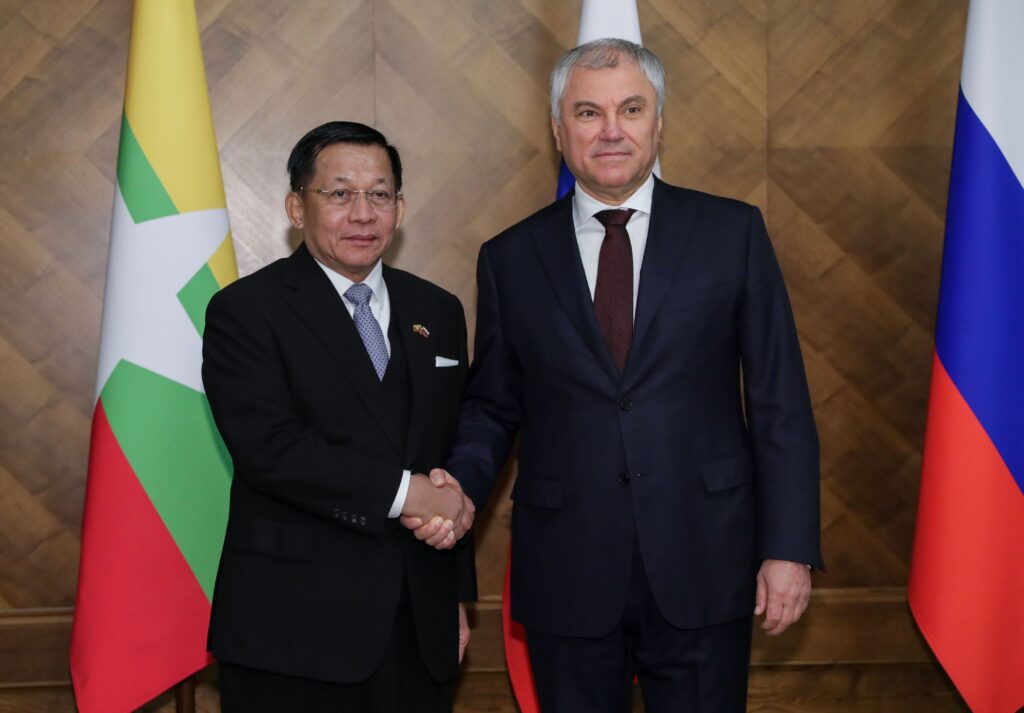
WASHINGTON — For five years, Washington treated Myanmar’s generals as pariahs. That ended in Naypyitaw last month, when a senior American official sat across the table from the man who seized the country in a coup.
The Trump administration has begun direct talks with Myanmar’s military-installed government, Reuters reported on Thursday, in a sharp reversal of the isolation policy the United States has pursued since the army toppled Aung San Suu Kyi’s elected government in February 2021.
Leading the outreach is Michael Vance, the Assistant Secretary of State for Intelligence and Research, who was confirmed to the post in August. Vance met coup leader-turned-president Min Aung Hlaing in the capital Naypyitaw on September 15 and 16 — the highest-level American contact with the junta since the coup, according to seven current and former officials familiar with the shift.
The meeting’s stated purpose was to secure the release of Adam Castillo, an American businessman and former head of the American Chamber of Commerce in Myanmar, detained at Yangon’s airport on June 11 on charges his supporters describe as trumped up. Castillo has since been freed and deported.
But the conversations reached well beyond one man’s freedom. One person familiar with the back-channel negotiations said Myanmar asked for only a single thing in return: an official engagement with the US government at the right level. The September meeting followed a June session in Tokyo, also involving Vance, where officials from the Treasury Department, the Department of Homeland Security, and the Pentagon took part.
What Washington wants out of the new channel is coming into focus. American officials have pressed Myanmar’s generals to help shut down the industrial-scale scam centers operating on its territory — fraud operations that have cost Americans billions of dollars. The FBI has made direct contact with Myanmar’s authorities over cyber scams, two people familiar with the matter said, though researchers caution that many of the compounds sit in militia-controlled areas, with some of the proceeds flowing to the military itself.
Also on the table: Myanmar’s vast deposits of heavy rare earth minerals, used in electric vehicles and wind turbines. US officials discussed access to the deposits, which mostly lie in territory held by ethnic armed groups fighting the military — and which China, currently the main importer, would read any American role in as a direct challenge.
The outreach has already drawn fire in Washington. Representative Gregory Meeks, the top Democrat on the House Foreign Affairs Committee, called the shift contrary to both American values and interests, accusing the administration of handing legitimacy to a murderous regime while sidestepping congressionally mandated sanctions and democracy funding.
The criticism lands on a brutal timeline. Less than two weeks after Vance’s visit, Myanmar’s military bombed a crowded marketplace in the town of Kyauktaw in Rakhine state, killing at least 50 civilians and injuring dozens more, according to United Nations human rights officials. Min Aung Hlaing himself remains under US sanctions for human rights abuses, including the mass killings and expulsions of hundreds of thousands of Rohingya Muslims that Washington declared a genocide.
The State Department defended the engagement. “You don’t solve problems by ignoring them. You solve problems by addressing them,” spokesman Tommy Pigott said in a statement, adding that the administration raises the need to cease violence and release political prisoners in its dealings with Naypyitaw.
The turnabout is stark against what came before. After the 2021 coup, the Biden administration froze Myanmar’s assets at the Federal Reserve Bank of New York and sanctioned senior officers and military-linked businesses. In 2022, Congress authorized non-lethal support for the opposition — funding early-warning systems for airstrikes and incentives for officers to defect. Most of those programs were cut during Trump’s foreign-aid overhaul, the officials said.
Min Aung Hlaing, meanwhile, has been campaigning hard for international respectability. He installed himself as president earlier this year after elections widely condemned as a sham, hired Washington lobbyists — with longtime Trump ally Roger Stone consulting for DCI Group on the junta’s account since April, according to foreign-agent filings — and has been touring the region; he is currently on a two-day visit to Malaysia.
Why this matters
This is the clearest expression yet of the Trump administration’s foreign policy doctrine: transactional engagement over democracy promotion. Myanmar is the test case because almost nothing about it has changed — the generals still hold power, the killing continues, and the sanctions are still on the books. What changed is what Washington wants: scam networks dismantled, a foothold in rare earths that could loosen China’s grip on the supply chain, and a partner that no longer has to pass an American values test to be useful.
The gamble is that dealing with the junta achieves more than isolating it. But the early returns argue otherwise: Naypyitaw got its high-level American meeting, and days later its jets were bombing a marketplace. If engagement becomes a reward for atrocities rather than leverage against them, the United States will have bought nothing — and paid for it with the moral standing it spent five years building.




One Comment