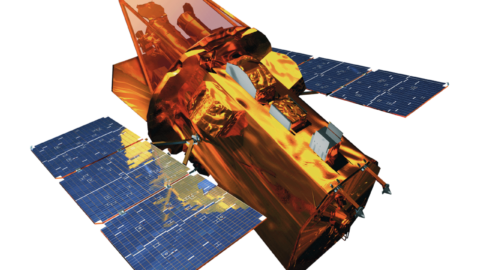
Informopedia Explains: today, NASA’s Swift Observatory is falling out of the sky after 22 years in orbit. Forecasters can tell you roughly when, and roughly where — a band around the equator, a window of hours — but not the town, not the field, not the patch of ocean. That vagueness is not a failure of tracking. It is physics, and it is worth understanding, because thousands of satellites will follow Swift down in the coming decade.
Why things fall in the first place
A satellite stays up because it is moving sideways so fast that it keeps missing the Earth as it falls — around 7.5 kilometres per second in low orbit. But low orbit is not empty space. A thin breath of atmosphere reaches hundreds of kilometres up, and it drags on every spacecraft, slowing it by a fraction with each lap. Left alone, that drag wins: the orbit shrinks, the air thickens, the drag grows, and the descent accelerates. Operators fight this with occasional engine burns that push the satellite back up. When the fuel runs out, or the spacecraft dies, the fall becomes a matter of time.
Swift’s fall was hurried along by the Sun. Unusually strong solar activity in late 2024 heated Earth’s upper atmosphere, puffing it outward so that it reached higher and dragged harder. A telescope built for a two-year mission in 2004 had survived into an era when the Sun itself changed the terms of its retirement.
Why the forecast stays vague until the last orbit
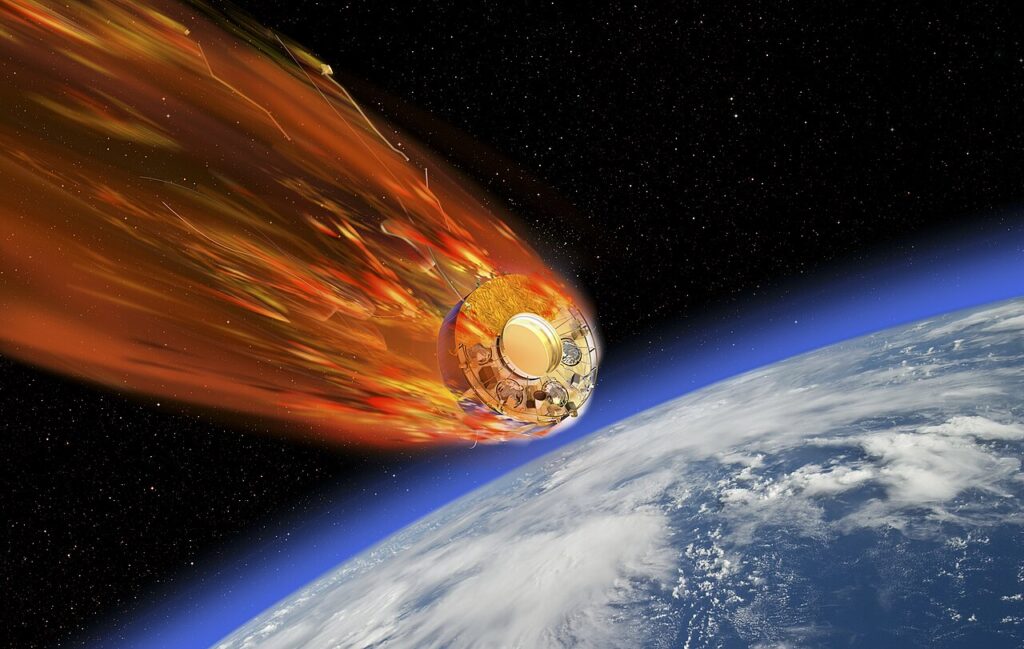
Re-entry prediction is a weather forecast for a place no weather station has ever been. The drag on a tumbling spacecraft depends on the density of the upper atmosphere, which depends on solar activity, which changes by the hour. It depends on the spacecraft’s shape and tumble, which change as pieces break off. And a difference of a few minutes in re-entry time means a difference of thousands of kilometres on the ground, because the spacecraft is travelling at orbital speed.
That is why NASA’s Swift notice gave a central estimate — 3:30am Eastern time on 4 November — with an uncertainty of 11 hours either way, and why an independent forecaster could plausibly differ by hours. The window narrows only as the spacecraft drops into thicker air, where tracking data piles up and the remaining flight time shrinks. By the time anyone knows the impact corridor precisely, there is barely time to warn anyone in it.
What burns, and what survives
Most of a satellite never reaches the ground. At re-entry speeds, friction heats the structure to thousands of degrees, and aluminium panels, solar arrays and electronics largely vaporise. What survives tends to be dense, heat-resistant and compact: titanium pressure vessels, stainless-steel tanks, tungsten components — the stubborn hardware inside the machine. NASA expects some of Swift’s components to survive for exactly this reason.
History keeps the record honest. Skylab, America’s first space station, fell over Western Australia in 1979, scattering debris near the town of Esperance. Tiangong-1, China’s first space station, came down over the Pacific in 2018. NASA’s UARS satellite fell in 2011 without confirmed debris recovery. In every case the pattern held: a spectacular breakup high in the atmosphere, fragments spread over a long, thin footprint, and — so far — no confirmed human casualty from falling space debris anywhere in the world.
What the 1 in 2,100 number really means
NASA’s figure for Swift — a roughly 1 in 2,100 risk of harm to anyone on Earth — sounds alarming until you unpack it. It is a population-weighted estimate: it combines the chance that debris survives, the size of the footprint, and how many people live inside the possible band. Most of that band is ocean. For any one person, the risk is vastly smaller than 1 in 2,100. The number is a way of saying “this is unlikely, but it is not zero” — and of being honest that “unlikely” is not the same as “impossible”.
The controlled alternative
Not every spacecraft has to fall blind. Operators with fuel left can aim the end: a final burn lowers the orbit over a chosen stretch of ocean — the remote South Pacific, far from shipping lanes, where dead spacecraft are routinely ditched. Modern satellites are also increasingly designed to die cleanly, with materials chosen to burn up completely and tanks built to rupture rather than survive. The difference is not technology alone; it is a decision made years before launch, when a mission budget either includes a dignified ending or does not. Swift, designed in the 1990s, predates most of those rules — which is why its final hours are being watched with a shrug and a spreadsheet rather than a steering wheel.
Why this matters more every year
Swift was built when satellites were rare and expensive. The sky it leaves behind is crowded with thousands of spacecraft, many of them in fleets of hundreds, each with a planned end of life. Modern rules push operators toward controlled re-entries — steering a dead satellite into the remote South Pacific — or designing spacecraft to burn up completely. But the old fleet, and any new spacecraft that fails unexpectedly, still comes down the uncontrolled way, like Swift.
The lesson of Swift’s final day is therefore not that space is falling on our heads. It is that the space age has an afterlife problem, and the afterlife is now arriving on schedule. The telescopes that taught us about a planet reborn from a dead star will themselves die, and their deaths will be managed — or not — by the rules we write now. Even the Moon is slowly leaving us; nothing in orbit lasts forever. The question is whether we choose where things land, or let the atmosphere choose for us.