Hong Kong’s High Court sentenced Joshua Wong to 10 years in prison on Thursday, handing the city’s best-known democracy activist a second national security conviction that will keep him behind bars until late 2036. He turned 30 last month. He had been due to walk free in January.
Wong pleaded guilty in September to conspiring to collude with foreign forces under the National Security Law, the sweeping security legislation Beijing imposed on Hong Kong in 2020. Prosecutors said that between July and November 2020 he conspired with the self-exiled activist Nathan Law and others to ask foreign countries and institutions to impose sanctions, blockades or other hostile measures against the governments of Hong Kong and China.
Judge William Tam called the offence one “of a grave nature” and said he had started from a 13-year sentence before reducing it because of the guilty plea. “Whilst it is a very heavy sentence on the defendant, the punishment must fit the gravity of the crime committed,” the judge said, adding that it was “also necessary for this court to express the community’s abhorrence” at Wong’s actions. Just over two months of the new term will run alongside the sentence Wong is already serving.
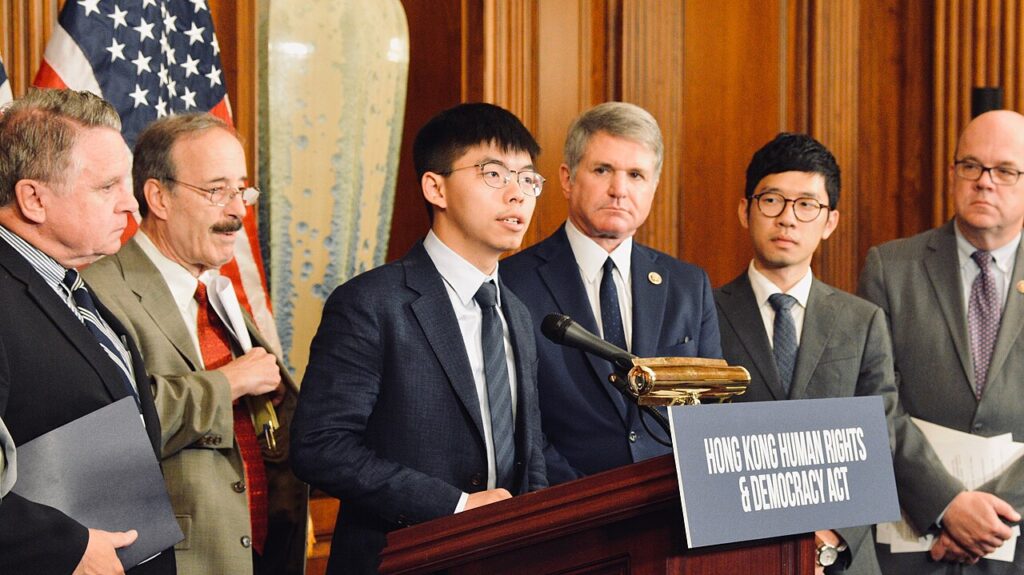
The case turned on lobbying Wong did in the open, much of it before the security law existed. Prosecutors pointed to his meetings with American politicians — including former House Speaker Nancy Pelosi and Marco Rubio, then a senator and now the US secretary of state — and to social media campaigns urging foreign governments to act. The lobbying continued after the law came into force, prosecutors said, and the United States went on to sanction more than a dozen Hong Kong and Chinese officials after 2020. The judge noted that Wong and his co-conspirators “continued to promote such calls not only through their own social media accounts but also via prominent news media or outlets in the West, reaching both local and international audience.”
Wong is already serving four years and eight months for his part in the “47 case,” the largest national security prosecution in Hong Kong’s history, over an unofficial primary election held to screen opposition candidates for the city’s legislature in 2020. He has been in custody since November 2020, when he was 23. He is the only activist in Hong Kong to have been prosecuted twice under the security law.
In a mitigation letter shown to CNN, Wong wrote that his activism “was never driven by hatred.” He said he has spent his time in prison studying the law and keeping up with advances in artificial intelligence. “Yet none of my aspirations for the future is more important than my solemn wish to care for my ageing parents once I complete my sentence,” he wrote.
Outside the court, dozens of supporters had camped out for as long as two nights to catch a glimpse of one of the city’s most famous prisoners. One supporter, Lui Yuk-lin, held up a card bearing Wong’s name as she entered the building. “He’s a child in my heart,” she said.
Hong Kong’s Chief Executive, John Lee, defended the sentence after it was announced, saying Wong and Law had committed “extremely serious offences, which not only severely undermined national sovereignty, security, and development interests, but also directly prejudiced the well-being of the general public and the stability of society.”
Rights groups condemned the ruling. Human Rights Watch called the charges baseless, and Amnesty International described the sentence as cruel, saying it was a grim reminder of the city’s disdain for human rights. The two organisations’ statements are linked below.
Why this matters
Wong was 15 when he first became a public figure, leading school sit-ins in 2012 that forced the government to drop a plan for Chinese civic education in schools. Two years later he was one of the faces of the Umbrella Movement, when tens of thousands of mostly young protesters blocked Hong Kong’s main roads for 79 days demanding greater democracy. In 2016 he co-founded the party Demosisto, which sent Law into the legislature as its youngest member. The party dissolved itself within hours of the security law passing in June 2020; Law fled the city days later and now lives in exile with a bounty on his head.
Six years after that law took effect, the sentence shows how far the ground has shifted. The activity Wong is now serving a decade for — asking foreign governments to pressure Beijing — was the public work of a young activist who once testified before the US Congress and was welcomed by lawmakers. Hong Kong’s legislature now contains only pro-Beijing loyalists, most of the city’s pro-democracy figures are in prison or in exile, and independent news outlets and civic groups have largely disappeared. Wong’s case is the starkest marker of that change: a man who was a teenager when he began campaigning will spend his entire thirties in prison.
For the rest of the world, the ruling is also a test of how much leverage outside pressure still carries. The United States and other governments sanctioned Hong Kong officials after the security law, and the lobbying Wong did helped bring that about. Beijing’s answer, delivered in a Hong Kong courtroom on Thursday, is that the same lobbying is now a crime carrying a decade in prison — and that the man who did it will not be free again until 2036.
Related: Hong Kong Housing Chief Winnie Ho Resigns as Tai Po Fire Report Blames Four Departments — our earlier report on Hong Kong politics.
Sources: Human Rights Watch; Amnesty International Australia