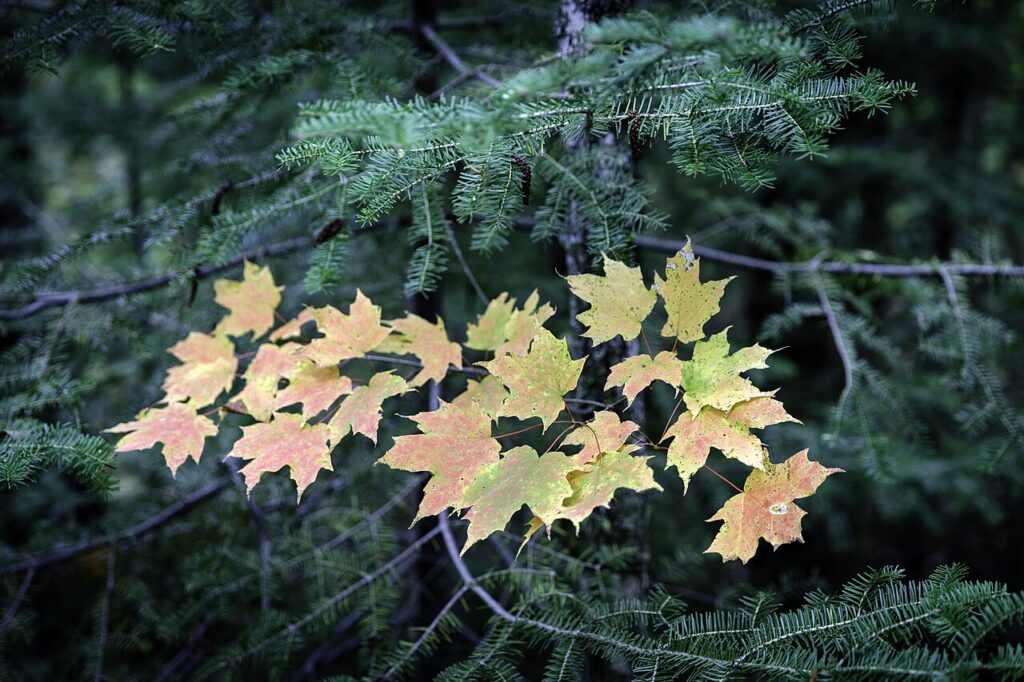
Informopedia Explains: the yellows were there all summer, the reds are made fresh in autumn, and the whole show is triggered not by cold, but by the shortening day. Stand under a maple in October and the obvious question is also the wrong one. The leaves do not really “turn” yellow and orange. Those colours were there all along, hiding under green. The reds are a different story — they are manufactured on the spot, in a final burst of chemistry before the leaf is abandoned. And the signal that starts it all is not the cold. It is the dark.
Green is a mask
A leaf’s summer job is photosynthesis: capturing sunlight and turning it into sugar. The pigment that does the heavy lifting is chlorophyll, which absorbs blue and red light and reflects green — which is why leaves look green to us. Chlorophyll is expensive for a tree to make and maintain, and it only pays while there is enough light and warmth to photosynthesise profitably.
But chlorophyll was never the only pigment in the leaf. All summer, two other families of pigments sit quietly underneath it: carotenoids, including xanthophylls (yellow) and beta-carotene (orange, the same compound that colours carrots). They help harvest light and protect the leaf, but their colours are drowned out by chlorophyll’s dominant green. You can prove it in a school experiment: grind a green leaf and separate its pigments by chromatography, and the yellows and oranges appear even in July.
The trigger is daylight, not frost
As nights lengthen after the autumn equinox, trees read the shortening day — the photoperiod — as the reliable calendar it is. Temperature varies from year to year; day length does not. On that signal, the tree begins to shut the leaf down. It stops making chlorophyll, and the chlorophyll already there breaks down. The tree salvages what it can, pulling valuable nitrogen and other nutrients back into the twig for winter storage.
As the green fades, the carotenoids are unmasked. That is the yellow and orange phase: not new colour, but old colour finally visible. Meanwhile a layer of cells called the abscission layer forms where the leaf meets the branch, slowly sealing the leaf off. When it is complete, the leaf falls — a clean break, not a tear, which is why a healthy tree drops its leaves without wounding itself.
Red is made fresh — and that is the interesting part
Reds and purples come from anthocyanins, pigments that are generally not present in summer leaves at all. They are built in autumn from sugars trapped in the leaf as the abscission layer closes the veins. Warm, sunny autumn days keep photosynthesis running and sugar production high; cool nights close the veins and trap those sugars in the leaf. The sugars break down into anthocyanins, and the leaf flames scarlet, crimson or magenta depending on the sap’s acidity.
Why bother? Scientists still argue. One leading idea is that anthocyanins act as sunscreen, shielding the leaf’s machinery while the tree strips out nutrients — a final act of protection for a structure about to be discarded. Another is that bright red warns insects away from laying eggs on the tree. Either way, the tree spends energy making a pigment for a leaf it is about to drop, which suggests the colour is doing real work, not decoration.
Why some years blaze and others fizzle
The recipe for a spectacular autumn is specific: sunny, warm days, cool (but not freezing) nights, and dry weather. Sun makes sugar; cool nights trap it; an early hard frost cuts the process short and dulls the show. Drought in late summer can mute colours; a long, mild, bright autumn extends them. That is why the same woodland can look incandescent one October and merely brown the next — and why forecasters of “peak foliage” are really forecasting chemistry, not scenery. The same seasonal machinery drives other climate stories, from El Niño’s record temperatures to the hidden climate leak in every air conditioner.
Eventually the pigments themselves break down, tannins — the brown compounds also found in red wine — dominate, and the leaf turns the dull brown of the forest floor. By then its job is done: the nutrients are banked in the twig, the buds for next spring are already formed, and the tree waits out winter leafless, having traded a season of green for survival.
Why this matters. Autumn colour is a visible readout of a plant’s internal calendar and chemistry — and as climates warm, that calendar is shifting. Leaf-fall timing, tracked by scientists and citizen observers for decades, is one of the quietest, most beautiful datasets in climate science. The trees are telling us about the changing seasons. We just have to learn to read the colours.