Informopedia Explains: every time your phone drops a pin on your street, it is settling a question Einstein asked a century ago — and correcting for it thousands of times a second. You open maps, a blue dot settles on your street, and within seconds you are being talked around a traffic jam you cannot even see yet. It feels like magic. It is, in fact, the most demanding timekeeping exercise humanity has ever built — and it only works because engineers took Albert Einstein seriously.
A constellation of flying clocks
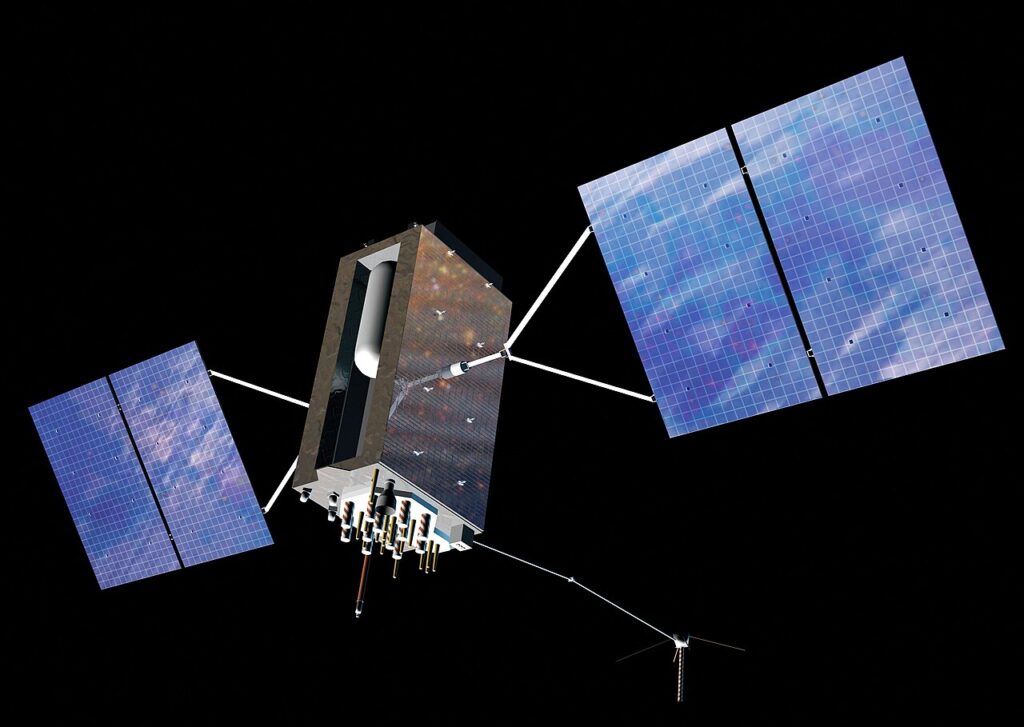
The Global Positioning System is a fleet of at least 24 operational satellites — currently around 31 in service — orbiting about 20,200 kilometres above Earth in medium Earth orbit. Each satellite carries several atomic clocks, usually caesium and rubidium standards, and broadcasts two things continuously: where it is, and exactly what time it thinks it is.
Your phone listens. It notes the instant each signal arrives, compares it with the instant it was sent, and multiplies the difference by the speed of light — 299,792,458 metres per second — to get its distance from that satellite. Light moves about 30 centimetres in a nanosecond, a billionth of a second, so a timing error of just 10 nanoseconds puts you three metres from where you actually are. That is why atomic clocks matter: a caesium-133 atom vibrates at exactly 9,192,631,770 cycles per second, a rhythm stable enough to define the second itself, and GPS clocks lose or gain less than a second in hundreds of thousands of years.
One distance puts you somewhere on a sphere around a satellite. Two narrow it to a circle. Three pin you to two possible points. A fourth solves the last unknown — the error in your phone’s own cheap clock — and fixes your latitude, longitude and altitude. The technique is called trilateration, not triangulation: it measures distances, not angles. Four satellites, four distances, one position. That is the whole trick, and it depends entirely on every clock in the system agreeing to within tens of nanoseconds.
Einstein, twice over
Here is where it gets strange. Einstein’s two theories of relativity pull those satellite clocks in opposite directions, and both effects are large enough to break the system if ignored.
Special relativity, from 1905, says a moving clock ticks slower than a stationary one. GPS satellites race along at about 3.87 kilometres per second, roughly 14,000 km/h. At that speed, their clocks should lose about 7.2 microseconds — millionths of a second — per day relative to clocks on the ground.
General relativity, from 1915, says a clock deeper in a gravitational field ticks slower than one higher up. A satellite at 20,200 km sits in gravity roughly a quarter as strong as at Earth’s surface. Freed from the deepest part of Earth’s gravitational well, its clocks should gain about 45.9 microseconds per day.
The two effects partly cancel. Net result: satellite clocks gain about 38.6 microseconds a day. That sounds negligible until you multiply it by the speed of light: 38.6 microseconds is roughly 11.6 kilometres of position error, accumulating every single day. Ignore relativity and your blue dot would be a suburb away by tomorrow and useless within a week.
Engineers solved this before the first satellites flew, after physicists including Neil Ashby at the University of Colorado Boulder argued the corrections had to be built in from day one. GPS satellite clocks are deliberately tuned to tick slightly slow before launch — 10.22999999543 megahertz instead of 10.23 megahertz — so that once in orbit, relativity speeds them up to exactly the right rate. Ground stations then track each satellite continuously and upload small corrections, because orbits are not perfect circles and the real world is messier than the equations. Satellites, and what happens when their predictions go wrong, are also the subject of our explainer on falling satellites, while Google’s quantum breakthrough shows how far precision physics has come since.
Why this matters
GPS is no longer just about driving directions. It times financial trades, synchronises power grids, guides aircraft and farm machinery, and underpins the emergency-location system that finds a caller who cannot speak. All of it rests on the same bargain: measure time fanatically well, and correct for the fact that time itself does not tick at the same rate everywhere.
There is a quiet pleasure in that. A theory devised with pencil and paper, about trains and light beams and falling lifts, now runs silently in your pocket, correcting itself thousands of times a second so that a dot on a screen lands on the right street. Einstein never owned a phone. His equations navigate for billions of people every day anyway.
What happens next: newer satellite systems — Europe’s Galileo, China’s BeiDou, Russia’s GLONASS — all apply the same relativistic corrections, and the next generation of clocks, based on optical rather than microwave atomic transitions, will be more precise still. The physics will not change. The dot will just get sharper.