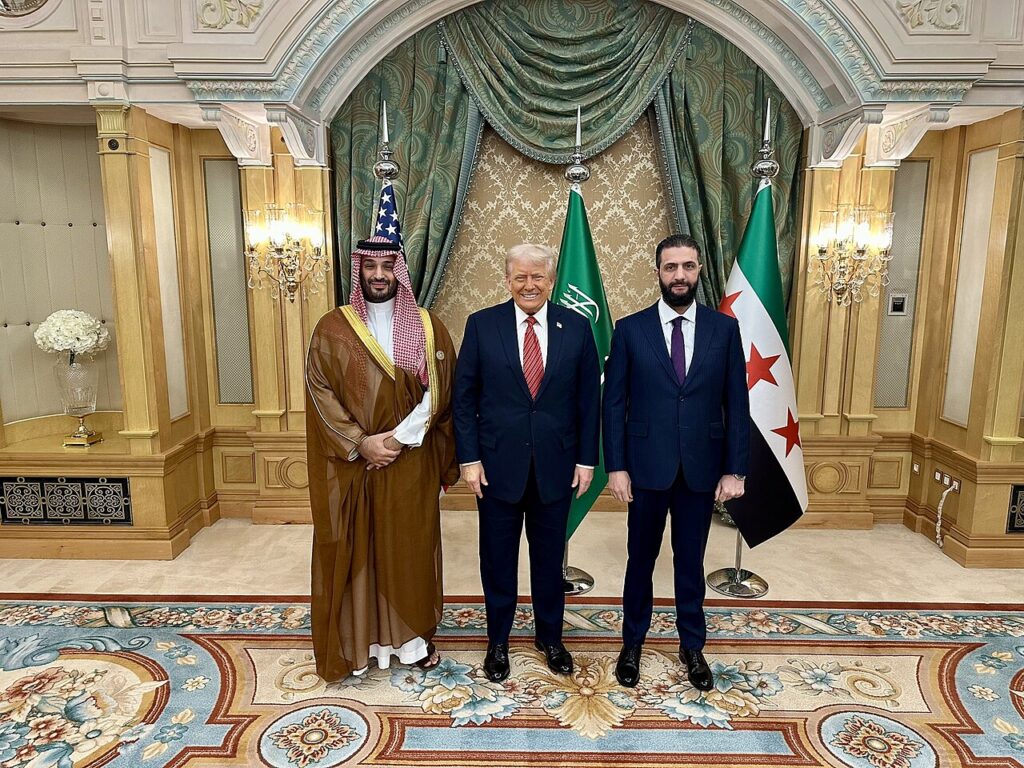
Syria has started sending military personnel to Saudi Arabia to help the kingdom defend itself against attacks from Yemen’s Houthis, Reuters reported on Friday. Two Syrian military sources and a senior American official told the news agency that advisers and training teams were already travelling to the kingdom — and that scores of Syrian personnel had arrived in recent weeks.
The deployment follows a defence cooperation agreement signed on Wednesday in Riyadh, during a visit by Syria’s President Ahmed al-Sharaa. It was his second meeting with Saudi Arabia’s Crown Prince Mohammed bin Salman in less than a month. Neither government has published the agreement’s text, and no details of its terms were announced.
What the deal covers, on the record, is modest: advisory support, training and “exchange of expertise”, according to a senior Syrian diplomat. A senior Saudi official told Reuters that joint training exercises were already under way, with more planned, and that the sharing of expertise was “mainly to restructure the Syrian forces” — while adding that Syria’s partners could also help with “combat experience regarding fighting militias”.
The sources, though, describe something more concrete. The senior US official said Syrian advisers and training teams were travelling to Saudi Arabia to train Saudi and Yemeni units inside the kingdom and improve their combat effectiveness. The two Syrian sources said scores of military personnel had gone in recent weeks, and that their mandate “could be broader” than training.
Not everyone in Damascus is comfortable saying so in public. The same senior Syrian diplomat who described the deal’s contents also told Reuters that “any suggestion of military deployments at this stage is premature”, insisting Syria’s focus remained on internal security, its borders and reconstruction.
Washington, for its part, has urged Damascus to move cautiously. The senior US official said any Syrian deployment to help in the Yemen war risked pulling the country into the wider regional war — something it has avoided so far.
Saudi Arabia has been locked in worsening hostilities with the Iran-allied Houthis since July, when the Yemen war reignited amid the wider conflict in the Middle East. The Houthis have fired missiles at Saudi airports and oil facilities — including a strike on Riyadh airport in October that killed 12 people — while Saudi Arabia has launched airstrikes in support of its Yemeni allies.
The deal sits inside a bigger redrawing of the region’s defence map. In August, Saudi Arabia, Türkiye and Pakistan signed the Mecca defence pact, a mutual-defence agreement; Türkiye’s parliament ratified it on Thursday. Syria’s Foreign Minister Asaad al-Shaibani said at a recent conference in Bahrain that Damascus was studying whether to join it. A senior Syrian diplomat told Reuters the new Saudi-Syrian agreement “may evolve to include broader defence cooperation in the future, such as” the Mecca pact.
The visit also produced six Saudi development loans worth more than $403 million — $100 million for damaged hospitals, $105 million for civil defence, $90 million to rehabilitate the Aleppo power plant, $60 million for housing and $30 million for drinking water. It is a measure of how far Syria has travelled: less than two years ago, rebels led by Sharaa toppled Bashar al-Assad, an ally of Iran, after more than a decade of civil war. Syria’s reconstituted army is made up of the former rebels who fought Assad and the Iran-backed groups that defended him.
At the Bahrain conference, al-Shaibani put it plainly: “Syria considers the security of the Arab Gulf part of regional security … Syria stands by the people and the governments of the Gulf in the face of challenges and militias operating across borders.”
Two years ago, Syria was the battlefield other countries fought over. Now its soldiers — fighters hardened by years of war — are being sent abroad as trainers, to a kingdom under missile attack. That is the story in one sentence: the Middle East’s alliances have flipped so completely that the country Iran once propped up is now helping defend the Gulf against Iran’s allies. The risks are just as plain. Damascus has no money, no air force to speak of and a reconstruction bill in the hundreds of billions; getting drawn into Yemen’s war would strain all three. Washington’s warning is the tell: even Syria’s friends are nervous about where this leads. And because neither government has published a word of the agreement, nobody outside Riyadh and Damascus knows what Syria actually promised — or what it was promised in return.