Informopedia Explains: how mud pulled from beneath a secret Cold War base — forgotten in a freezer for decades — has just told scientists something new about Greenland’s future. The ground under Camp Century, a US Army base buried in the Greenland Ice Sheet, was once bare tundra under a warm summer sky. Now researchers have measured exactly how warm that summer was, and the number should give everyone pause.
Buried nearly a mile beneath the ice in northwestern Greenland, Camp Century was built by the US Army Corps of Engineers in 1959 and presented to the world as a research station. Its real purpose, Project Iceworm, was to hide nuclear missiles in tunnels under the ice. The plan failed, the base was abandoned in 1967, and the ice swallowed it. But before the Army left, its drills had pulled up something far more valuable than a missile silo: a 3.44-metre core of sediment from the ground beneath the ice sheet, frozen mud that had last seen sunlight hundreds of thousands of years ago.
Mud that remembered summer
The sediment’s journey to the laboratory was almost as strange as its origin. It was brought to the University at Buffalo in 1975 by Chester Langway, who had led the ice-core drilling at Camp Century. When Langway retired in the mid-1990s, the samples stayed behind in storage, then sat largely forgotten for more than two decades at the University of Copenhagen until a chance freezer cleanout brought them back to scientists’ attention. An earlier analysis of the same mud had already shown something remarkable: the ground beneath Camp Century was once ice-free. What nobody had done until now was put a number on how warm it was when the ice was gone.
That number comes from fat. The sediment holds fatty molecules left behind by soil bacteria, and the types and proportions of those molecules change with temperature. “By comparing them with similar molecules found in modern Arctic lakes, we were able to estimate how warm it was at Camp Century,” says John Michael Aguilar, a postdoctoral fellow at the University at Buffalo’s RENEW Institute and first author of the study. His team, led by Elizabeth Thomas at Buffalo with colleagues including Paul Bierman and Jason Briner, published the result on 28 September 2026 in the journal Climate of the Past.
The number: 4.7 degrees
Summers at Camp Century were 4.7°C (8.5°F) warmer than today, the team found, with an uncertainty of plus or minus 3.2°C. The ice-free period dates to about 416,000 years ago, during a warm interval geologists call Marine Isotope Stage 11, which ran from roughly 424,000 to 374,000 years ago. It is, the researchers say, the first quantitative estimate of land-based summer temperatures anywhere in Greenland during that ancient warm period — a measurement that was hard to obtain because later ice advances scoured away most sediment from that time.
For the site to have been ice-free at all, the Greenland Ice Sheet must have pulled back more than 60 miles (97 kilometres) from its present-day edge in that region. Camp Century sits well inside the modern ice sheet, under about 1,387 metres of ice. “It’s striking that a period of moderately warmer temperatures coincided with such a substantial retreat of the ice sheet,” Aguilar says. The warming was moderate — a few degrees of summer warmth, not a furnace — and still the ice gave up 60 miles of ground.
Time matters as much as heat
The surprise in the study is not just the size of the retreat but the comparison the researchers draw with a much more recent warm spell. Greenland experienced similarly warm summers roughly 5,000 to 10,000 years ago, in the centuries after the last ice age. Yet Camp Century stayed covered by ice. Same kind of warmth, different result. The difference, the team argues, is duration. The warm conditions 416,000 years ago may have lasted tens of thousands of years, giving the ice sheet far longer to melt back. How long the warmth lasts may matter as much as how hot it gets.
That is the finding’s sharp edge, and the study’s authors are careful about how it is read. “Today’s human-caused warming is more intense than the warm period 400,000 years ago,” says Thomas, the corresponding author. “And climate projections suggest that this warmth could persist for hundreds or thousands of years. Both the magnitude and duration of warming are important to understanding how the ice sheet will respond.” In other words, the present day combines the two things that undid the ice sheet in the past — stronger warming, and warming that does not let up.
A second warning from next door
Camp Century is not the only place in northwestern Greenland telling this story. The first study from GreenDrill, a National Science Foundation-funded project co-led by Buffalo and Columbia University that drills through the ice sheet to retrieve the bedrock beneath, found that the Prudhoe Dome ice cap — a high point of the ice sheet about 1,700 feet thick — had completely melted away around 7,000 years ago, far more recently than scientists had expected. That disappearance happened during the early Holocene, when regional summer temperatures were about 3 to 5°C warmer than today. Some projections suggest Prudhoe Dome could reach those temperatures again by 2100. Two different sites, two different warm periods, the same lesson: this ice is sensitive to mild warming, given time.
Why this matters
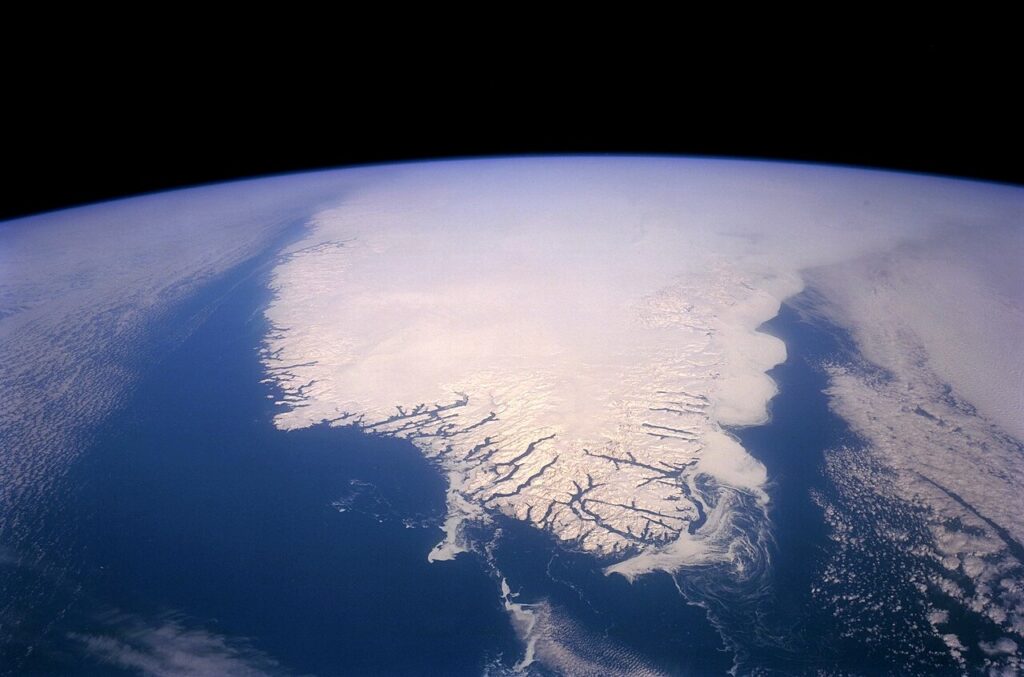
None of this is ancient history for its own sake. Greenland is losing about 270 billion tonnes of ice a year, according to NASA’s GRACE satellite measurements, which have tracked the ice sheet’s weight since 2002. The sheet itself is roughly three times the size of Texas and up to two miles thick in places; the water locked in it could raise global sea levels by more than 7 metres if it all melted. Nobody expects that to happen soon. But the Camp Century result sets a scale: a few degrees of sustained summer warmth once moved the ice edge back 60 miles in one region alone.
The Arctic is warming faster than anywhere else on Earth, and the Intergovernmental Panel on Climate Change projects average annual Arctic temperatures could rise anywhere from 3.3 to 10°C by the end of the century, depending on emissions — a range that would put the region squarely in the territory that once left Camp Century ice-free, and then keep it there. For the background on why the world’s climate body has struggled to keep up, see our earlier piece on why the IPCC suspended its biggest climate meeting in years. And the heat is not theoretical: this year brought the hottest summer on record for western Europe, part of the same warming pattern pressing on the Arctic.
What happens next
The sediment that started this story still has more to say. Thomas and her collaborators spent years working out how to read it — accounting, among other things, for how the land’s elevation changed as the ice sheet grew and melted, which changes how temperatures can be compared across time. GreenDrill, meanwhile, is drilling more sites across Greenland’s frozen interior, building a map of where the ice has vanished before and how much warmth it took. Each new core narrows the uncertainty about what sustained warming does to an ice sheet that holds the future of coastlines from Miami to Mumbai.
The Camp Century mud does not predict the future. It does something more useful: it shows the future has a precedent. A world a few degrees warmer, kept warm long enough, once turned a buried military base into open tundra. The question now is not whether the ice can retreat 60 miles. It already did. The question is how long we give it to do it again.