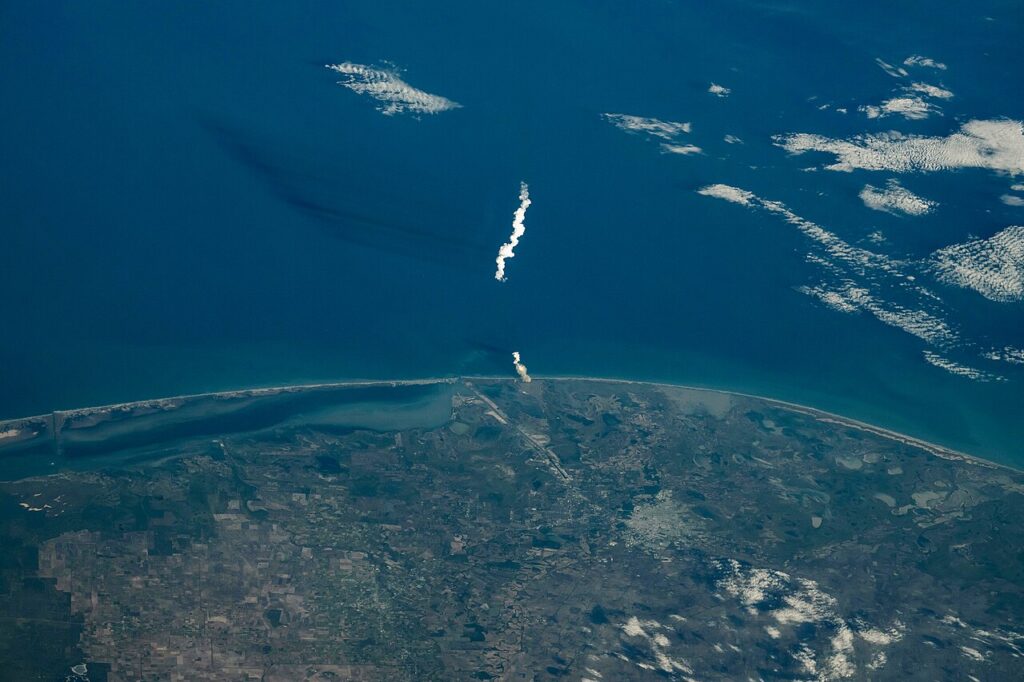
SpaceX went for history on Friday — and got half of it. Starship Flight 15 lifted off from Starbase in Texas at 4:47 p.m. local time (5:47 p.m. Eastern), the first mission ever to attempt catching both stages of the giant rocket. The booster catch was called off minutes later. The upper stage, meanwhile, is still flying, and the second half of the gamble comes today.
What was Flight 15 trying to do?
Starship is the largest rocket ever flown — 124 metres tall, fully stacked — and SpaceX’s plan is to make the whole thing reusable. The first stage, called Super Heavy, and the second stage, called Ship, are both meant to fly back to the launch tower and be caught by its giant mechanical arms, nicknamed the “chopsticks”. Three Super Heavy boosters from the earlier version of the rocket, known as V1, have been caught this way. The V3 booster flying on Flight 15 had never been caught — and still hasn’t.
Flight 15 was the first attempt to catch both stages on the same mission. If it works, Starship becomes the first fully reusable orbital rocket: nothing thrown away, both halves back on the pad, ready to fly again.
What happened to the booster?
About two minutes after liftoff, the Super Heavy booster — Booster 22 — separated from Ship and began its return. Roughly six and a half minutes into the flight, SpaceX decided not to attempt the catch and diverted the booster to a splashdown in the Gulf of Mexico. It exploded moments before hitting the water, bursting into flames as its remaining propellant burned off.
SpaceX has not yet said what went wrong. The company only attempts a catch when every system needed to guide the booster through the atmosphere and into the tower is healthy; on Friday, something was not. The booster was meant to return to Pad 2 at Starbase. Instead it ended its flight in the sea, as the mission plan always allowed for.
What about the Ship?
The upper stage, Ship 42 — nicknamed “Don’t Panic” — had a clean flight. All six of its Raptor engines fired at stage separation, it completed its burn into orbit at about 6:13 p.m. Eastern, and it deployed 26 of SpaceX’s latest Starlink V3 internet satellites. That makes this only the second time a Starship upper stage has reached orbit and deployed its payload.
Ship 42 is now on a long coast phase: 14 orbits of Earth over roughly 22 and a half hours. If all systems stay healthy, it will fire a short deorbit burn and attempt a catch back at the Starbase tower at about 3:20 p.m. local time today (4:20 p.m. Eastern). SpaceX has built in three checkpoints along the way; if anything looks unsafe, the Ship can be diverted to pre-cleared splashdown sites near Hawaii or off the coast of Chile instead. Residents of Cameron County, Texas, may hear sonic booms as it comes home.
Why did the launch happen on such a strange day for American aviation?
By coincidence, Flight 15 flew on one of the most extraordinary days in US aviation history. The Federal Aviation Administration authorised the launch hours before it ordered a nationwide ground stop that grounded every departing flight in the country over a communications failure. The two events are unrelated — Starship flies from its own range at Starbase, under its own launch licence — but the timing was hard to miss: the biggest rocket ever built went up on the same afternoon the rest of American aviation stood still. Read our report on the FAA ground stop that grounded every departing US flight — and the week’s other big space story, Amazon’s Project Leo passing its 1,000th satellite.
Was the flight a failure?
Not in the way that matters most to SpaceX. The company treats these flights as tests, and it designs them so that a missed catch is a setback, not a disaster — the booster was always going to end up in the sea if the catch was called off. The goals that survived Friday are substantial: a clean launch, a successful orbital insertion, a payload deployment, and a Ship still in position to attempt the first-ever upper-stage catch today.
The catch that failed matters too, though. Reusability is the whole point of Starship: without recovering both stages, the rocket is an expensive one-off, not the cheap workhorse SpaceX needs for its satellite network, its Moon contract with NASA, and eventually Mars. Every aborted catch is data — but the V3 booster has now flown without being caught, and the company will want to know why before the next attempt.
Why this matters
Today’s Ship catch attempt is the one to watch. If Ship 42 lands in the tower’s arms, SpaceX will have recovered an orbital upper stage for the first time — the hardest half of the reusability problem, since the Ship has to survive re-entering the atmosphere at orbital speed. If it is diverted to the sea instead, the questions about V3 recovery will get louder. Either way, Flight 15 has already shown that the rocket can put a full payload into orbit. What it has not yet shown is that it can come all the way home.