Key takeaways:
- US Central Command says it destroyed five Iranian oil tankers — four in the Gulf of Oman and one near Kharg Island — after Iran’s Revolutionary Guard twice tried to hit a US warship with ballistic missiles.
- Iran confirmed the five tankers were targeted and fired missiles at the Muwaffaq Salti Air Base near Al-Azraq in Jordan, which hosts US forces. Jordan says 18 of 20 missiles were intercepted and no one was hurt.
- It is the sharpest exchange yet in a war now in its seventh month, and it comes two days before Donald Trump, Vladimir Putin and Xi Jinping meet in Shenzhen.
The United States destroyed five Iranian oil tankers on Tuesday, in the largest single strike on Iranian shipping since the war in the Gulf began — and within hours Iran fired ballistic missiles at an American base in Jordan.
US Central Command, known as CENTCOM, said the strikes were a direct response to two attempts by Iran’s Islamic Revolutionary Guard Corps (IRGC) to target an American warship with ballistic missiles over the previous two days. The warship evaded both attacks, the command said.
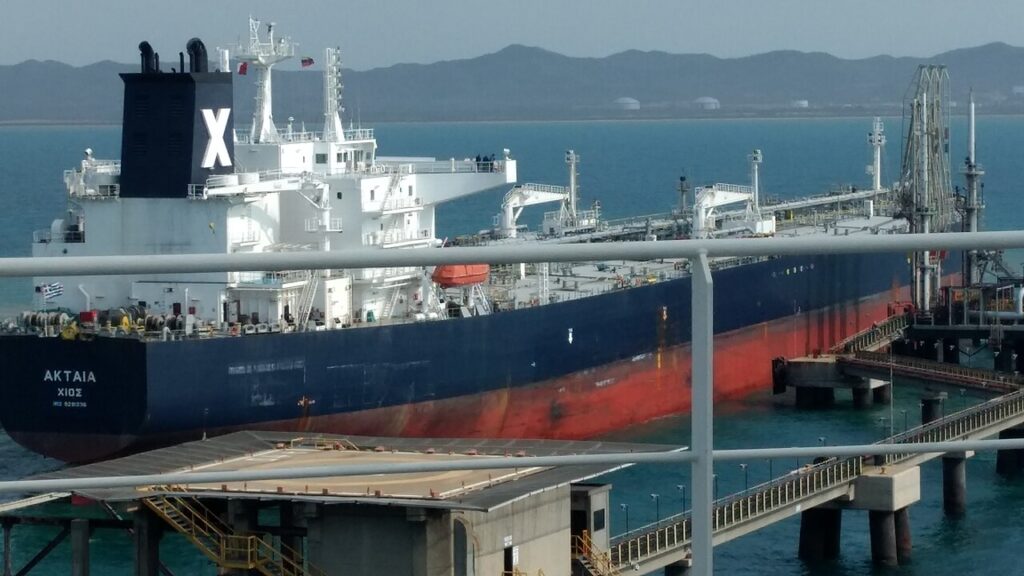
The five vessels were the M/T Kaviz, M/T Charminar, M/T Horizon 1 and M/T Riesco in the Gulf of Oman, and the M/T Derya near Kharg Island, Iran’s main crude export terminal. CENTCOM said the ships were tied to the Revolutionary Guard’s oil-smuggling network, and that their crews were ordered to abandon ship before the strikes rendered the tankers inoperable.
It was the second round of US strikes on Iranian tankers in four days. American forces hit three tankers in September, one of which sank, and three more last weekend after an earlier attempted attack on US Navy ships.
Iran’s answer came on Wednesday. The Revolutionary Guard said it had subjected the Al-Azraq base in Jordan to “fierce missile strikes” and claimed hangars used by US fighter jets were destroyed. That claim has not been independently verified — and Jordan’s account tells a different story.
Jordan’s armed forces said air defences intercepted 18 of the 20 ballistic missiles fired toward its territory, and that the two that got through fell in unpopulated desert. There were no reports of casualties. Asked about the strikes on the Jordanian base, CENTCOM said it had no information to offer.
CBS News reported that several US aircraft were damaged in the attack, including an A-10 Thunderbolt with a wing torn off and around eight F-15s with minor damage. US officials have not confirmed that account, and have characterised the Iranian response as largely ineffective.
The Guard also claimed it had attacked ten ships near the Strait of Hormuz — two American vessels and eight oil tankers — and fired missiles at two US Navy destroyers, the DDG-119 and DDG-53, causing what it called “significant damage”. None of those claims has been independently verified either.
Tehran also announced a maritime restricted area stretching from Chabahar into the Gulf of Oman and the Arabian Sea, and its navy warned crews of oil tankers near ports in Kuwait and Bahrain to leave their vessels, saying the ships could be targeted in retaliation.
The wider region was pulled in overnight. Kuwait’s air defences intercepted hostile drones on Tuesday night, and Bahrain said it had intercepted an Iranian drone attack on a US radar system at the Sheikh Isa air base — a claim of a direct hit that CENTCOM denied.
The war began on February 28, when US and Israeli strikes killed Iran’s supreme leader and other senior officials as nuclear talks collapsed. A ceasefire took hold in the spring, then broke down. Since then the fighting has increasingly moved onto the water: tankers have been mined, seized and struck, and traffic through the strait — the channel for about a fifth of the world’s seaborne oil — has thinned sharply. Just last month, a supertanker hit a naval mine in the strait with two million barrels of crude aboard.
Why this matters: Tuesday’s exchange crossed two lines at once. Washington has now moved from intercepting and seizing Iranian tankers to sinking them openly, in numbers, and naming them. Tehran has answered by firing directly at a base hosting American forces in a third country — Jordan, one of Washington’s closest Arab allies. Both sides are still describing their own operations as responses, not openings. But with a third US aircraft carrier arrived in the region this week and a trilateral summit in Shenzhen two days away, the space for calling this a contained tanker war is shrinking fast.
What happens next: Watch whether Iran’s restricted maritime zone is enforced — a closure of shipping lanes would force the question Washington has avoided for months — and whether the Shenzhen meeting produces any pressure on Tehran or Washington to stop. If the tanker sinkings continue at this pace, insurers and shipowners, not generals, may decide how much oil moves through the Gulf next week.