Informopedia Explains: at 2:44 on a freezing morning in March 1989, the lights went out across an entire Canadian province — and nobody on Earth had touched a switch.
The date was March 13, 1989. In 90 seconds, without warning, the whole Hydro-Québec transmission system collapsed. Six million people in Quebec and the north-eastern United States lost power, most of them for nine hours, some for days. It was the middle of the night in sub-zero cold. And the cause was 150 million kilometres away: the Sun had thrown a cloud of magnetised plasma at the Earth, and the Earth had answered with electric currents in its own rocks.
Three weapons, one target
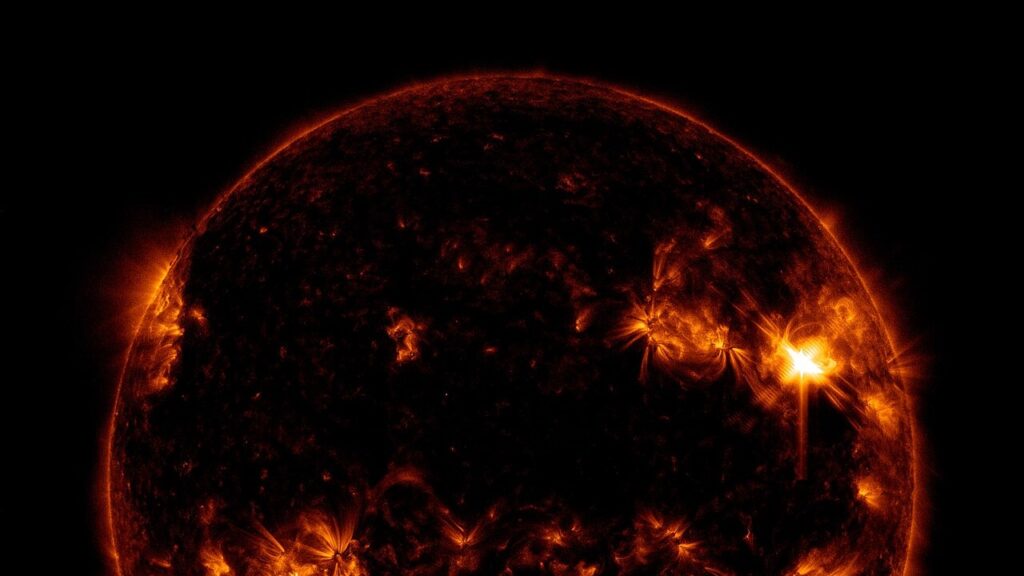
A “solar storm” is really three different things arriving at different speeds. First comes the solar flare — a sudden flash of radiation from a sunspot, travelling at the speed of light and arriving in eight minutes. Flares cause radio blackouts on the daylight side of the planet, but they do not touch power grids. Monitors recorded an M1.1-class flare on Tuesday night: middling by solar standards, and no threat to anyone.
The second is the solar wind, a constant stream of charged particles. The third is the dangerous one: a coronal mass ejection, or CME — a billion-tonne bubble of plasma and magnetic field hurled off the Sun. A fast CME crosses the 150 million kilometres to Earth in about two days. The March 1989 CME made the trip in roughly 55 hours. When it slammed into Earth’s magnetic field, the field swung and buckled. And a swinging magnetic field does to the ground beneath our feet what a school physics experiment does to a coil of wire: it induces an electric current.
Engineers call the result a geomagnetically induced current, or GIC. Power lines, pipelines, railway signals and undersea cables all act as accidental antennas. The currents flow through the grid like uninvited electricity, and they attack the most expensive and least replaceable part of it: the transformers that step voltage up and down. A saturated transformer overheats, distorts the waveform, and trips its safety relays. In Quebec, that cascade took 92 seconds.
Why Quebec, why then
Quebec was unlucky in three ways. It sits on the Canadian Shield, a slab of ancient igneous rock that conducts electricity poorly — so storm currents found a more attractive path in the high-voltage transmission lines. Its grid stretches more than 1,000 kilometres from the hydroelectric dams of James Bay to the cities of the south, giving the currents a very long antenna to flow through. And the storm was enormous: it pushed the auroral oval far south of the Arctic, and peaked at Kp 9, the maximum on the planetary disturbance scale.
The damage spread beyond the border. A large transformer at the Salem Nuclear Power Plant in New Jersey was permanently damaged by the induced currents and had to be replaced. Canada spent more than a billion Canadian dollars hardening the Hydro-Québec grid in the years that followed, and utilities across North America rewrote their protection standards. The US regulator now requires grid operators to assess and manage the risk from geomagnetic disturbances.
1859: the storm that set telegraphs on fire
The benchmark against which all of this is measured happened before there was a power grid at all. On September 1, 1859, the English amateur astronomer Richard Carrington was sketching sunspots when a brilliant flare erupted. Hours later, the most intense geomagnetic storm in recorded history hit the Earth. Currents surged through Victorian telegraph wires, sparking and in some cases setting telegraph offices on fire, and operators found they could send messages with their batteries disconnected — the storm itself was powering the lines. Auroras were seen near the equator. The Carrington Event was roughly two to three times as strong as the 1989 storm.
There was a sequel in May 1921, the “Great Railroad Storm”, which crippled telegraph and railroad signalling across the world. Researchers now believe both great storms were delivered by double CMEs — one clearing the path, the second striking harder.
2024: the dress rehearsal
For decades, the question was whether a modern, electrified, satellite-dependent civilisation would survive a storm on that scale. In May 2024, we got a partial answer. Between May 10 and 12, five M-class and eight X-class flares erupted from a single sunspot region, launching seven Earth-directed CMEs in succession. The result was the Gannon storm: the first G5 — the highest category on NOAA’s geomagnetic scale — since the Halloween storm of 2003, and the largest geomagnetic storm in more than 20 years.
Auroras danced over latitudes that rarely see them. Thousands of satellites in low Earth orbit suddenly felt extra atmospheric drag; the storm prompted almost 5,000 simultaneous satellite manoeuvres, most of them by SpaceX’s Starlink fleet. Power levels in transatlantic internet cables fluctuated, but nothing failed. The impacts, researchers later wrote, were relatively minor — the individual eruptions were not particularly severe, and the grid held.
But the same cycle had already shown what a smaller storm can do to satellites. In February 2022, SpaceX launched 49 new Starlink satellites. A day later a minor geomagnetic storm thickened the upper atmosphere just enough that 38 of them could not climb to safety. They fell back and burned up within days — about $50 million of hardware lost to a storm that barely registered on the power grid.
Could it happen again — and would we survive it?
The Sun runs on an roughly 11-year cycle, and Solar Cycle 25 — which peaked in 2024 and 2025 — has been stronger than forecasters expected, still producing frequent X-class flares. A Carrington-scale storm is not a question of if, but of when; the historical record suggests one every century or so, and the last was 167 years ago.
One widely cited estimate puts the direct damage from such a storm at $1–2 trillion: fried transformers, dead satellites, broken communications. The largest high-voltage transformers cost $2–7 million each, take 12–18 months to manufacture, and are built by only a handful of factories in the world. Lloyd’s of London modelled a Carrington-level event in a report published in March 2025, and called it a systemic risk to the satellite industry.
The defences are better than they were in 1989, and they are the reason the May 2024 storm was a spectacle rather than a disaster. NOAA’s Space Weather Prediction Center watches the Sun continuously and can spot an Earth-directed CME as it leaves the solar surface — giving grid operators one to three days to prepare, reduce loads, and postpone maintenance. Series capacitors can block GICs from flowing through transmission lines. Satellites can be put into safe modes. And Amazon’s satellite internet network and its rivals are now designed with storm drag in mind.
What has not changed is the physics. The next Carrington-scale storm will arrive with a day or two of warning, and then the grid operators of the world will have to do in hours what took Quebec’s engineers years to learn: keep the transformers alive while the sky itself pushes current through the wires. We know it can be done. We know it because, in May 2024, it was.
Why this matters: The power grid is the one piece of infrastructure everything else depends on — hospitals, water, food, banking, the internet, and the satellites that keep time itself honest (the same satellites that forced the leap second into retirement). A solar storm is the only natural disaster that can attack all of it at once, everywhere on Earth, in the same hour. That is why space weather forecasting is now treated as critical infrastructure — and why a flare on a Tuesday night is worth more than a shrug.
Follow the forecasts yourself: NOAA’s Space Weather Prediction Center publishes storm watches, flare classes and the G-scale in real time.