Informopedia Explains: it is the question every child asks, and most adults have never actually had answered. The sky is blue — but the air is colourless, space is black, and sunlight is white. So where does the blue come from?
It comes from the air itself, from what sunlight does on its way through it. And the same trick that paints the sky blue at noon is what sets it on fire at sunset — and what makes the sky on Mars the exact opposite of ours.
Sunlight is white, but it isn’t one colour
Start with the light. Sunlight looks white, but white is what you get when every colour arrives at once. Pass sunlight through a prism and it splits into the rainbow: red, orange, yellow, green, blue, indigo, violet. Each colour is light with a different wavelength — red has the longest waves, violet the shortest, blue not far behind it.
Now picture that light arriving at Earth and plunging into the atmosphere: a thin shell of gas, mostly nitrogen and oxygen, about 100 kilometres deep. The air molecules are far too small to see — each one is roughly a thousand times smaller than a wavelength of visible light. But they are not nothing. When sunlight hits them, something happens that the 19th-century physicist Lord Rayleigh worked out in the 1870s, and which still carries his name: Rayleigh scattering.
The air shakes the light apart
A light wave is an oscillating electric field. When it hits an air molecule, it makes the charged particles inside that molecule — its electrons and protons — oscillate with it. An oscillating charge radiates light of its own, in all directions. The molecule has, in effect, caught the sunlight and thrown it back out again, scattered in every direction.
Here is the crucial part: the shorter the wavelength, the harder the molecule is shaken, and the more light gets scattered. The effect is dramatic, because scattered intensity grows with the fourth power of the frequency. Blue light, with its short waves, is scattered roughly ten times more strongly than red light. Violet is scattered even more strongly than blue.
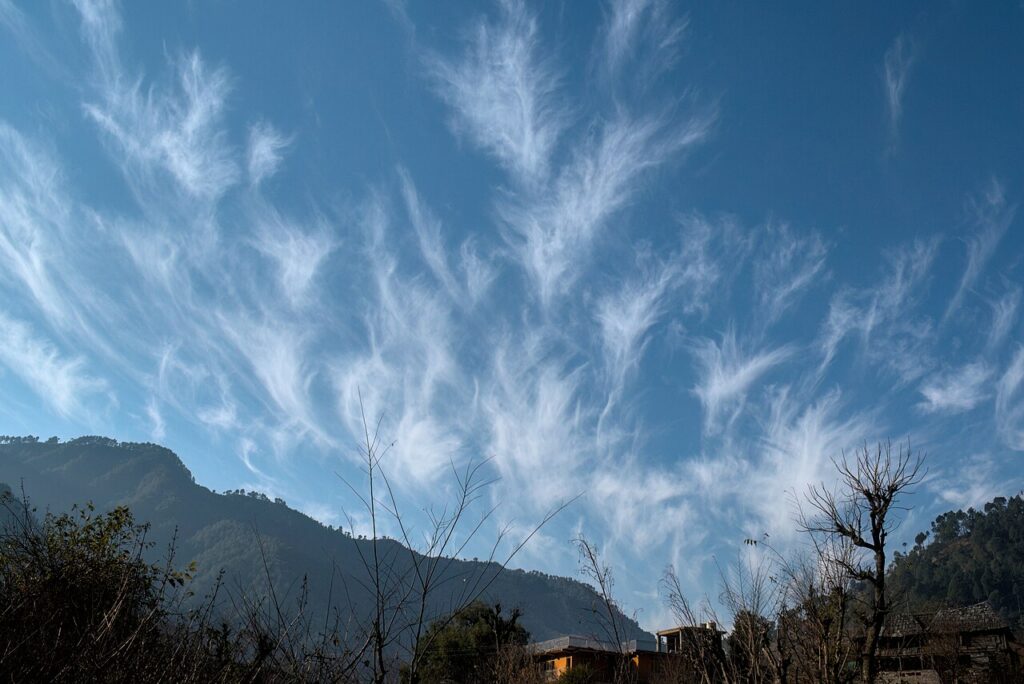
So when you look up at the sky on a clear day, away from the sun, you are not looking at the sun’s light directly. You are looking at the light the atmosphere has scattered into your line of sight — and because blue is scattered ten times more than red, that scattered light is overwhelmingly blue. The sky is not blue the way a painted wall is blue. It is blue because the air is constantly throwing blue light at your eyes from every direction.
Then why isn’t it violet?
Fair question: if violet is scattered even more than blue, why isn’t the sky violet? Two reasons, both about us and the sun rather than the sky. First, the sun simply puts out less violet light than blue light to begin with. Second, our eyes are less sensitive to violet than to blue — and the upper atmosphere absorbs some of the violet before it ever reaches us. What survives, and what our eyes register best, is blue. The same physics that makes the sky blue is the reason why leaves change colour in autumn is a chemistry story, not a light story — the colours we see are always a negotiation between the light, the material and the eye.
Sunsets are the same physics, in reverse
At noon, the sun is overhead and its light takes the shortest possible path through the air. At sunset, the sun sits on the horizon, and its light has to cross nearly 38 times as much air to reach you — the equivalent of about 320 kilometres of sea-level air. Over that long journey, almost all the blue is scattered away before it can reach your eyes. What survives the trip is the light that barely scatters at all: the long waves, the oranges and reds. By one careful calculation, only about 0.02% of the blue light survives the sunset path, against about 15% of the red. The sun looks red because the blue has been stolen from it, a little at a time, across hundreds of kilometres of sky.
Pollution can make sunsets more spectacular — tiny aerosol particles of sulfate, dust and soot scatter even more blue away — but it is not required. Clean air and a long path are enough. That is why the reddest sunsets often follow volcanic eruptions, when the upper atmosphere fills with particles, and why desert sunsets, with their dusty air, are famously vivid.
Why clouds are white
If the sky is blue because air scatters blue light, why are clouds white? Because clouds are not made of air molecules. They are made of water droplets, and those droplets are much larger than the wavelength of light — about the same size or bigger. Particles that big scatter all colours roughly equally, a different regime called Mie scattering. Equal parts red, green and blue add up to white. A cloud is white for the same reason snow is white and milk is white: it scatters everything, evenly. When a cloud grows thick enough that light struggles to get through at all, the white turns grey, then black — not because the cloud has changed colour, but because it is blocking the light.
And on Mars, everything is backwards
The loveliest proof that this is all about the air comes from another planet. Mars has a thin atmosphere full of fine dust, and the dust scatters light differently from our clean air. The result is a sky that is butterscotch-coloured during the day — and, around the setting sun, blue. NASA’s Curiosity rover photographed it on 15 April 2015, its 956th Martian day: a small white sun sinking into a cold blue glow. Earth does the opposite — blue by day, red at sunset — because our sky is ruled by tiny gas molecules and Mars’s is ruled by dust. Same sunlight, same physics, different air, inverted sky.
What if there were no air at all?
There is one more way to check the answer: remove the atmosphere entirely. On the Moon, which has essentially no air, the sky is black even at noon, and the sun hangs in it like a hard white coin. The Apollo astronauts saw stars in broad daylight. No air, no scattering, no blue — the proof, standing on a grey plain a quarter of a million miles away, that the colour of our sky is something our own atmosphere does to sunlight.
So the blue above your head is not a thing, and not a place. It is an event: sunlight being shaken apart by the air, ten times harder in blue than in red, all day, in every direction, for as long as there is an atmosphere to do the shaking. You are looking at scattered light — the sky is the sun’s light, borrowed and returned in blue. Read NASA’s explanation for the short version, and next time a child asks, you will have the real one.