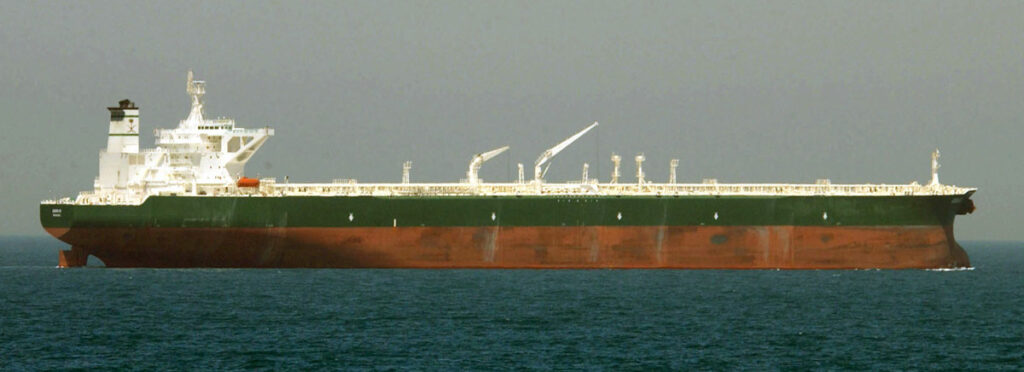
Iran’s Revolutionary Guard navy says three oil tankers caught fire after hitting naval mines in the Strait of Hormuz on Monday. It named no vessel, no flag, no owner and no casualty — and nobody outside Iran has been able to confirm that it happened at all.
The claim, carried by Iran’s Press TV, described the tankers as “violating” vessels that had switched off their navigation and identification systems and tried to slip through a route Tehran considers prohibited. The U.S. military, which says it has cleared the main shipping routes through the strait of mines and continues to escort tankers along the southern route, has not confirmed the incident.
Oil traders, for their part, barely blinked. Brent crude slipped to $88.97 a barrel on Tuesday, near a three-month low, and U.S. crude fell to $79.94 — a market that has heard this story before, and has learned to price in the claim rather than the confirmation.
A pattern, not an isolated incident
November 3: The Guard’s navy says three tankers exploded and caught fire after striking mines on an unauthorised route. No vessel is named; nothing further emerges.
November 11: The United Kingdom Maritime Trade Operations office reports a tanker struck by two unknown projectiles near the strait — a different weapon, and a different kind of incident, from a ship’s own security officers.
November 14: Iran’s navy says three tankers — one of them a supertanker — caught fire after hitting mines in a single day. Again, no names. Reuters reports it cannot immediately verify the accounts. Satellite fire readings over the strait show no heat at sea in 16 passes across November 13 and 14, though the same readings also missed the strike UKMTO did confirm on November 11.
November 23: The latest claim — three more tankers, three more fires, three more unnamed vessels.
The repetition is the story. In a waterway where most vessels now sail with their transponders switched off, a mine strike that leaves no name, no photograph and no casualty is a claim that can neither be proved nor disproved quickly — which makes it a useful weapon in itself. Each announcement reminds shipping companies, insurers and oil buyers that Tehran says the strait is dangerous, whether or not any hull has actually been holed.
The other front in the tanker war
The mines are only half of it. The Wall Street Journal reported that the United States is investigating whether Iran was involved in cyberattacks on as many as 50 energy tankers — a quieter campaign, if true, that would explain why some vessels have gone dark or turned back without any explosion at all.
Meanwhile the physical toll of the wider conflict is real enough. According to figures the UN shared with the Security Council, 134 confirmed incidents had been recorded around the strait since February, killing 25 seafarers, the International Maritime Organization said, with October the worst month yet. That is the verified ledger. The mine claims sit alongside it, unverified and unverifiable, in a separate column.
Why this matters
The Strait of Hormuz carries about a fifth of the world’s traded oil, which is why the Strait of Hormuz matters far beyond the Gulf. Every claim of a burning tanker, verified or not, nudges insurance premiums, reroutes cargoes and reminds the market that the world’s most important oil chokepoint is also a war zone.
Just this month, four tankers were hit in the strait in two days, and a supertanker carrying two million barrels of crude was reported to have struck a mine. The pattern is now familiar: an Iranian claim, no names, no independent confirmation, and a market that has stopped panicking and started shrugging.
That shrug is itself a development. When the first mine claims surfaced, oil spiked. Now Brent sits near a three-month low, with analysts pointing to rising supply and a potential surplus. The danger has not gone away — but the market has decided, for now, that the strait will stay open, and that Tehran’s announcements are a pressure tactic rather than a blockade.
The question is what happens the day a claim turns out to be true, with a named ship, a photograph and a casualty list. Until then, the Hormuz tanker war is fought mostly in words — and words, unlike mines, do not sink ships.