When your central bank moves interest rates, it is gambling on a question that sounds simple and turns out to be brutally hard: what will millions of households and businesses actually do next? The two economists honoured with this year’s Nobel Prize in Economics spent their careers making that gamble less of a gamble.
The Royal Swedish Academy of Sciences announced on Monday, October 12, that the 2026 Sveriges Riksbank Prize in Economic Sciences in Memory of Alfred Nobel goes to Robert E. Hall of Stanford University and Michael Woodford of Columbia University, “for microeconomic foundations of macroeconomic stabilisation.” The prize — the final Nobel of the 2026 season — carries a purse of 12 million Swedish crowns, about $1.2 million.
In plain terms, the pair built the bridge between two halves of economics that rarely spoke to each other. Microeconomics studies how individual people, firms and workers make decisions — when to spend, when to hire, when to invest. Macroeconomics tracks the big aggregates: inflation, unemployment, growth, recessions. Hall and Woodford developed mathematical models that start from the decisions of individual households and firms and show how those choices, multiplied across an economy, produce booms, busts and inflation — and, crucially, how well-timed government action can smooth them out.
“This year’s laureates in economic sciences, Robert E. Hall and Michael Woodford, have developed new macroeconomic models that have significantly improved our ability to implement effective stabilisation policy,” the Academy said in its announcement. “On the basis of these models, well-timed fiscal and monetary policy measures can reduce the economy’s peaks and troughs.”
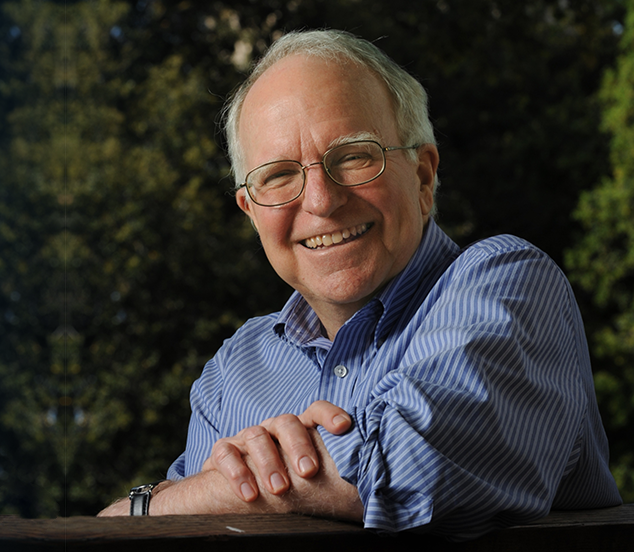
The two laureates arrived at the problem from different ends. Hall, 83, is Stanford’s Robert and Carole McNeil professor and a senior fellow at the Hoover Institution, where he has worked since 1978. He earned his doctorate from MIT under Robert Solow, himself a Nobel laureate. Since 1978, Hall has chaired the National Bureau of Economic Research’s Business Cycle Dating Committee — the small, famously secretive group of economists that officially declares when American recessions begin and end. He served as president of the American Economic Association in 2010. Alongside Alvin Rabushka, he also co-authored the original flat-tax proposal that reshaped tax debates across Eastern Europe and the United States in the 1980s.
Woodford, 71, is Columbia’s John Bates Clark Professor of Political Economy and one of the world’s most influential monetary theorists. His 2003 treatise, Interest and Prices: Foundations of a Theory of Monetary Policy, became the standard reference for central bankers thinking about how interest rates steer inflation. He trained at the University of Chicago, Yale Law School and MIT, and has won the MacArthur Fellowship, the Deutsche Bank Prize and the Banque de France/TSE Prize in Monetary Economics.
Why this matters
There is a straight line from this prize to your wallet. When inflation surged across the world in the early 2020s, every central bank — from the US Federal Reserve to the State Bank of Pakistan — leaned on the same intellectual scaffolding: models in which households and firms make forward-looking decisions, and in which the central bank’s interest-rate signals shape those decisions. That framework is what Woodford spent his career formalising; the question of how the real labour market and household spending actually behave in a downturn is what Hall spent his career measuring. The Nobel citation honours both sides of that coin: better microeconomic foundations, and better stabilisation policy as the payoff.
The award also closes out a Nobel season that spread its honours unusually wide. The medicine prize went to the pioneers of optogenetics, physics to Belgian neutrino hunter Francis Halzen, chemistry to Henri Kagan and Kenso Soai, literature to Canadian-Icelandic writer Anne Carson, and on Friday the peace prize to South African jurist Navi Pillay. Learn more about how the prizes are chosen — and why nobody knows who almost won — in our explainer on the Nobel nomination process.
The economics prize, first awarded in 1969, is the only Nobel created by Sweden’s central bank rather than by Alfred Nobel’s 1895 will. Most of its laureates have been Americans; only three women have ever won it, most recently Claudia Goldin in 2023 for her work on gender gaps in pay and employment. Last year’s prize went to Joel Mokyr, Philippe Aghion and Peter Howitt for explaining how new technologies drive economic growth.




One Comment