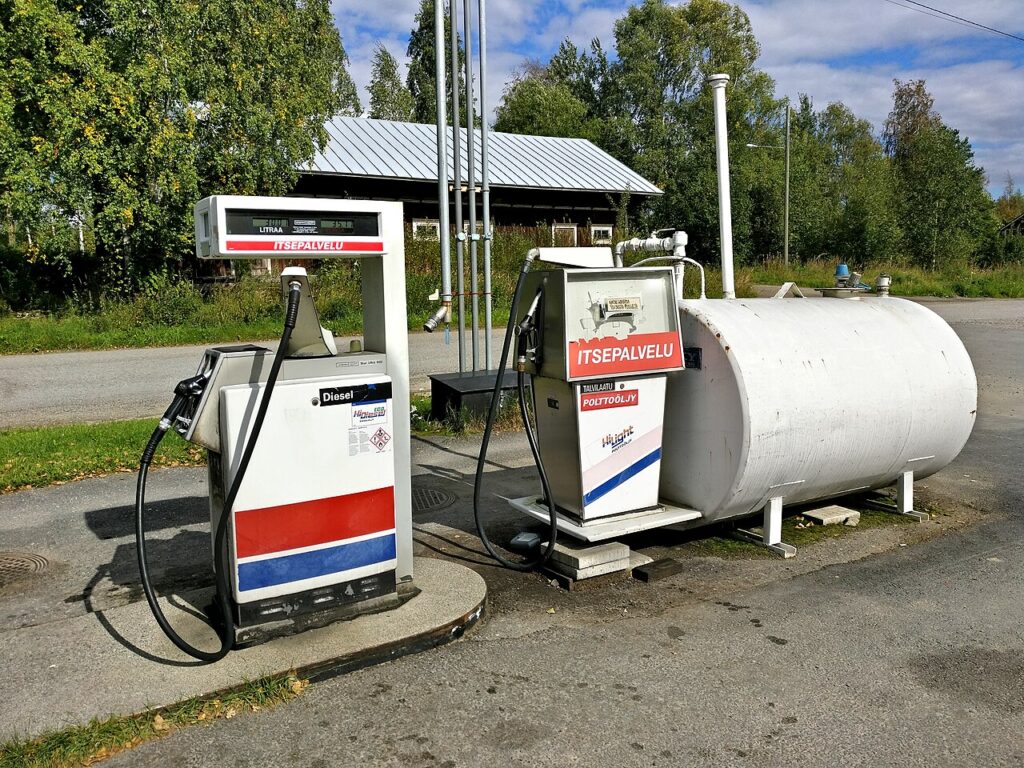
In September, the number on the pump that American truckers watch the way other people watch the weather hit $6.52 a gallon — the most expensive diesel in US history. A few weeks later came the stranger headline: the president of the United States had spent months asking Ukraine’s president to stop bombing Russia’s oil refineries — and then cut a deal to buy Russian diesel. Informopedia Explains: the deal is the politics. The price is the economics. And the economics are why diesel has cost more than petrol for twenty years, wars or no wars.
It wasn’t always like this
For most of the 20th century, diesel was the cheap fuel. It is less refined than petrol — simpler to make, closer to crude — and for decades it sold at a discount, except in hard winters when demand for heating oil (chemically almost the same fuel) pushed it up. Then, in September 2004, the relationship flipped. Diesel moved above petrol in the United States and never really came back down.
The US Energy Information Administration points to three things that happened at once. First, demand: China and India were motorizing and building at a furious pace, and Europe was falling in love with diesel cars — diesel’s share of new European car registrations climbed from under 14 percent in 1990 to more than half by 2007. Second, environmental rules: from 2006, US refiners had to strip sulfur out of highway diesel to protect air quality, cutting it to just 15 parts per million. Refineries spent billions on new hydrotreating equipment, and compliant diesel became permanently more expensive to make. Third, taxes: the US federal excise tax on highway diesel has been 24.4 cents a gallon since 1993 — six cents higher than on petrol. (Europe shows the tax lever works in reverse: there, governments taxed petrol harder and diesel stayed the cheap option for years.)
Diesel demand doesn’t bend
Here is the structural fact that makes every diesel shock worse than a petrol shock: petrol demand is flexible, diesel demand isn’t. When petrol gets expensive, people drive less, carpool, cancel the road trip. When diesel gets expensive, the trucks still roll — because the alternative to a truck is no groceries on the shelf. The tractors still harvest, because the alternative is no harvest. The ships still sail and the furnaces in the American Northeast still burn heating oil, which is basically diesel’s twin.
Economists call this inelastic demand, and it means diesel buyers absorb almost any price rather than buy less — which means prices can spike violently when supply tightens. One congressional analysis found this year’s diesel prices added $1.4 billion to US crop planting costs, a 63 percent jump, with Illinois, Iowa and Minnesota hit hardest. In Britain, diesel has neared £2 a litre, and small businesses there describe fuel bills eating half a day’s pay. The fuel that moves everything taxes everything it moves.
Why refinery outages hit diesel harder than crude prices do
A barrel of crude contains a fixed menu of products, and diesel sits in the middle of it — the “middle distillates,” alongside heating oil and jet fuel. You can’t make more diesel without also making the rest of the menu, and most refineries already run near their limits. So when a refinery goes offline — bombed, sanctioned, shut for maintenance — diesel is the product that runs short first and recovers last.
That’s why diesel prices track refineries, not just crude. Brent crude is around $104–106 a barrel right now — expensive, but not record-breaking. Yet refiners are earning more than $100 for every barrel of diesel they squeeze out of crude, a margin that averaged $20 to $30 in normal times. Valero and Marathon have reported margins roughly doubling. That gap — the “crack spread” — is the market screaming that the problem isn’t the oil in the ground, it’s the machines that turn it into fuel.
And those machines have been taking hits from every direction. The EIA has identified reduced refining activity in Russia, China and the Middle East as a driver of the current shortage. America’s own diesel inventories are thin, and while US diesel exports have grown tenfold since 2005, that means domestic supply is now lashed to a global market where a drone strike on the other side of the planet moves the price at an Iowa truck stop.
The 2022–2026 price story, in broad strokes
The last big diesel spike tells you everything about the current one. When Russia invaded Ukraine in 2022 and the West stopped buying Russian fuel, the US diesel-petrol gap blew out to nearly a dollar a gallon — a record at the time — because America, despite importing little Russian crude, had relied on Russian diesel and heavy oils. The market gradually adjusted; by 2023 the national diesel average had settled into the mid-$4s.
Then came 2026. The US-Israeli war with Iran, which began in February, upended Gulf shipping and set diesel climbing from about $3.71 a gallon. Over the summer, Ukraine’s drone campaign started hammering Russian refineries — Kyiv claims more than half of Russia’s refining capacity is now offline, and independent data shows Russian refining output fell 30 percent year-on-year in June to its lowest level in more than two decades. In July, Moscow banned most diesel exports to protect its own supply, extending the ban through October. The G7 agreed to release 100 million barrels from reserves; Washington pressured allies to free up emergency stocks and widened access to tax-exempt red-dyed diesel for farmers. It wasn’t enough. On September 22, US diesel hit $6.52 a gallon — the record. EIA data had it at $6.20 in early October, AAA near $6.27, up 70 percent since the Iran war began.
What the Trump–Putin diesel deal actually changes
Against that backdrop, Donald Trump’s announcement on October 9 that Russia would supply up to 4.8 million tons of diesel to the US and global markets — 300,000 tons immediately, 500,000 in November, a million “immediately thereafter,” and three million more “within a short period” — sounds dramatic. The market’s verdict was a shrug: diesel futures fell just 1.4 percent.
Do the arithmetic the way the analysts did. The first 300,000 tons is roughly two million barrels. The United States exports about 1.5 million barrels of diesel a day. “It’s a drop in the bucket,” Denton Cinquegrana, chief oil analyst at Dow Jones Energy, told Barron’s. And the biggest tranche — those three million tons — is explicitly conditional on “the condition of Russian refineries,” the same refineries Ukraine keeps hitting and whose fuel crisis forced Moscow’s export ban in the first place. One energy analyst was blunt: he doubts Russia can export that much while its own pumps run dry.
The deal also required the Treasury to issue a temporary license easing US energy sanctions on Russia — the biggest loosening of the sanctions regime since the Ukraine invasion — which drew bipartisan fury in Congress, with Republican senators Lisa Murkowski, Susan Collins and Tom Tillis joining Democrats Ron Wyden and Richard Blumenthal in demanding a reversal. Kyiv, for its part, offered a trade: Ukraine stops hitting Russian refineries if Russia stops hitting Ukrainian power plants. Washington said no. (For the full story of the deal, read our report on how Trump struck a diesel deal with Vladimir Putin — and Zelensky’s furious response to the energy ceasefire he declared days earlier.)
Why this matters
There are two diesel stories tangled together here, and only one of them has a fix. The 2026 spike is geopolitical: two wars, bombed refineries, an export ban, a president buying fuel from an adversary three weeks before the midterms. That part can ease — and already has, slightly — if shipping lanes calm and refineries come back online.
The other story is permanent. Diesel carries higher taxes, costs more to refine cleanly, and serves buyers who cannot stop buying. No deal with Moscow changes any of that. Every diesel record is really a tax on movement itself, paid by everyone who eats food that rode a truck — which is everyone. The pump number that matters isn’t just what drivers pay; it’s what it costs to keep the whole machine of the economy moving.
What to watch from here
Watch three things. First, winter: the Northeast’s heating season and Europe’s diesel-hungry freight fleets arrive just as inventories sit thin, which is historically when diesel punishes complacency. Second, the refineries: Ukraine has shown no sign of stopping its drone campaign, and every strike makes the “condition of Russian refineries” clause in Trump’s deal more theoretical. Third, the midterms on November 3: a president who promised diesel prices would come down “in record numbers, and fast” now owns every penny of the number on the pump. The structural premium isn’t going anywhere. The only question is whether the spike on top of it gets worse before it gets better.




One Comment