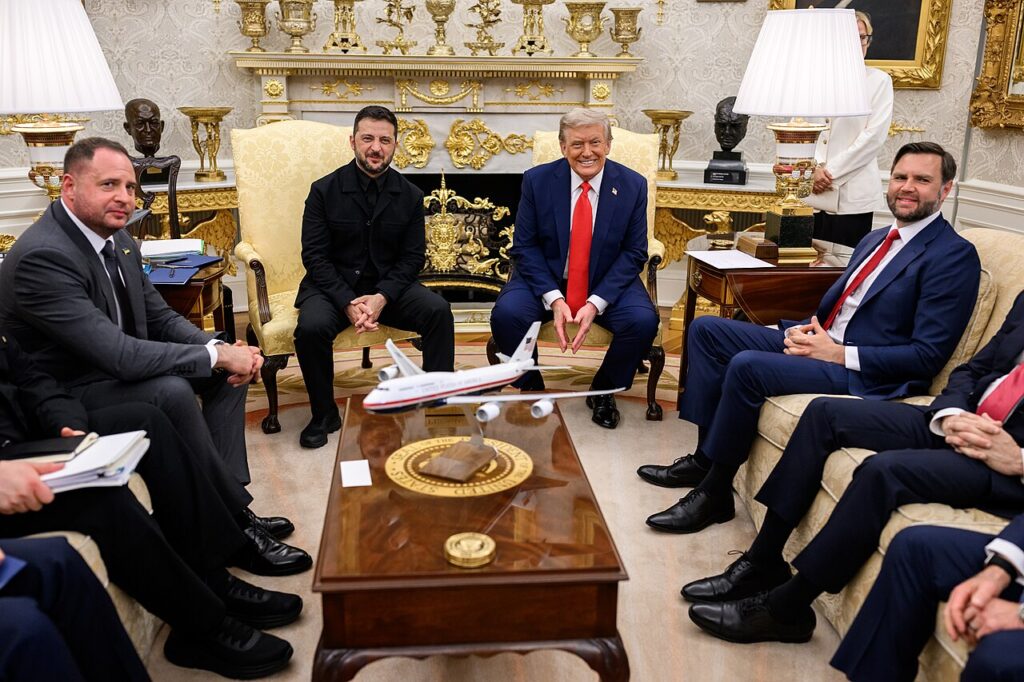
Volodymyr Zelensky walked into the European Council summit in Brussels this week to find the ground shifting under him in Washington — and a continent closing ranks around him in response.
Over two days of meetings on October 15 and 16, the leaders of the European Union’s 27 member states gave Ukraine’s president something Washington no longer offers: public, unconditional backing. The show of solidarity came just hours after US President Donald Trump tore into Zelensky in a television interview, calling Kyiv’s resumed strikes on Russian oil refineries “a disgrace” and saying he found the Ukrainian leader “more difficult to deal with than” Vladimir Putin.
The contrast between the two capitals has rarely been starker.
In an interview with Newsmax aired on Thursday evening, Trump accused Zelensky of driving up global fuel prices by targeting Russian energy infrastructure. “All he’s doing is making the world oil price higher. Well, I think that’s a disgrace,” he said. He added that he was “not a big fan” of the Ukrainian leader and suggested Ukraine should hold new elections — something Ukraine’s martial law, in force since Russia’s full-scale invasion in 2022, does not allow.
Zelensky’s answer arrived in Brussels. Addressing EU leaders on Friday morning, he laid out a blunt funding request: the war will cost 155 billion euros next year, he said, and Ukraine needs at least 70 billion euros in additional European support for defense, weapons and resilience. He thanked the leaders present as “real leaders” who had stood by Ukraine from the start of the war — a remark few in the room missed.
The EU side responded in kind. European Commission President Ursula von der Leyen, who flanked Zelensky as he arrived, told reporters Europe would “not lift any sanctions unless Russia stops the war” and that sanctions “have to increase.” António Costa said this was “no time to withdraw support” and asked the European Commission to prepare a proposal for Ukraine’s 2027 financing. Draft summit conclusions, meanwhile, put on paper the bloc’s “regret” at Washington’s decision to temporarily lift sanctions on Russian diesel — the US-Russia deal Trump struck with Putin on October 9 that has infuriated Kyiv.
The EU’s foreign policy chief, Kaja Kallas, drew the sharpest line between Europe’s approach and Washington’s. “Squeezing Ukraine is not the right approach, and that is why Europe is standing beside Ukraine,” she told reporters.
Brussels stopped short of handing Zelensky the money he asked for. No new funding decisions emerged from the summit; the financing conversation moves to next year. But the political message was the point: as one US president publicly takes the other side, the EU is staking its claim as Ukraine’s last unreserved backer in the West.
That matters because Ukraine is heading into winter exposed. Zelensky told the summit that Russia had launched more than 850 drones at Ukraine in a single barrage, striking 15 regions — a reminder that the three-day pause on Ukrainian energy strikes, agreed at Washington’s request, collapsed because Moscow never stopped attacking Ukrainian power stations. Kyiv resumed its refinery campaign this week with a strike on the Rosneft refinery at Ryazan, southeast of Moscow. It is precisely that campaign Trump now blames for rising oil prices weeks before the US midterm elections.
There was at least one relief for Kyiv in an otherwise bruising week: Ukrainian officials said access to Starshield — the military-grade satellite communications system from Elon Musk’s SpaceX that Ukraine’s forces depend on for drone operations — was being restored after a sudden disruption had fueled suspicions of deliberate US interference. Musk has said the system is controlled by the US military and the White House; a senior US official denied the president had restricted it.
Why this matters. The transatlantic split over Ukraine is no longer a difference of tone — it is a difference of policy. Washington is doing business with Moscow on diesel while scolding Kyiv for hitting refineries; Brussels is writing down its objection and keeping sanctions in place. For the rest of the world, that divergence has consequences far beyond Ukraine’s borders: Europe’s willingness to fund the war into 2027 will decide whether Ukraine can keep fighting, whether Russia’s wartime economy keeps weakening, and whether the West still acts as one when the US president publicly prefers dealing with Putin. Zelensky put it plainly in Brussels, calling the Russian leader’s posture toward peace “a parody of a genuine desire to end the war.” Europe, for now, is choosing his side.


One Comment