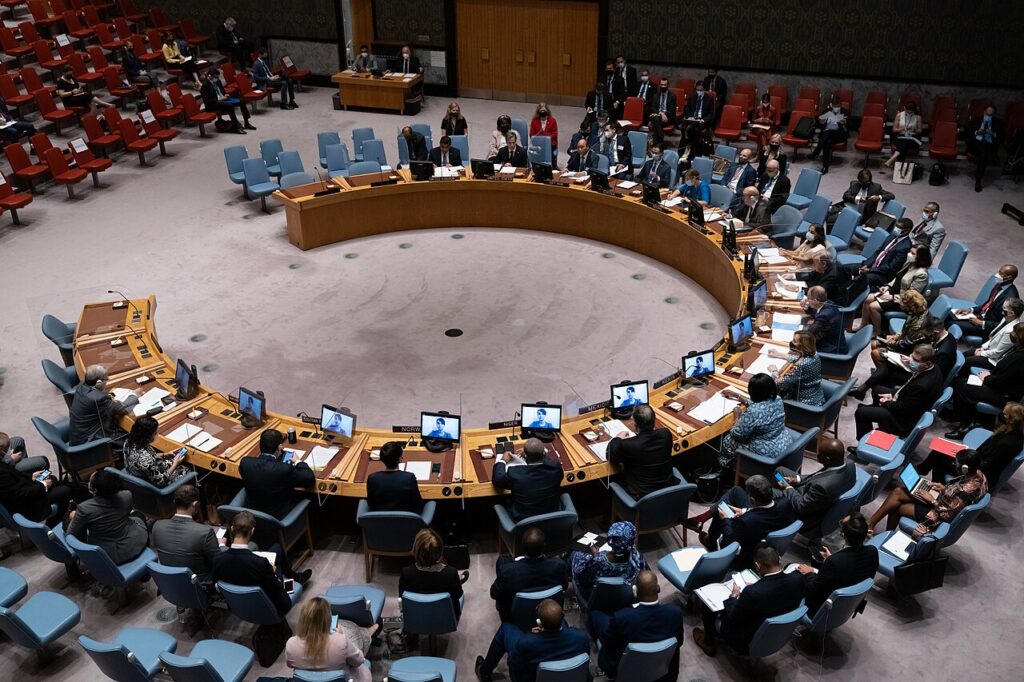
The race to choose the next leader of the United Nations ran into a familiar wall on Friday: politics.
A sixth secret ballot by the UN Security Council kept Rebeca Grynspan, Costa Rica’s 70-year-old former vice president, narrowly in front of the field to become the 10th secretary-general. And it still didn’t produce a winner.
Here’s how the numbers landed, according to diplomats close to the process. Grynspan collected nine “encourage” votes, five “discourage” votes and one “no opinion” — with two of the five discourages coming from the council’s five permanent members. Guyana’s UN ambassador, Carolyn Rodrigues-Birkett, took eight encouragements against six discouragements, again with two permanent members opposed. Rafael Grossi, the Argentine director general of the International Atomic Energy Agency (the UN’s nuclear watchdog), landed in roughly the same spot — with one fewer permanent member behind him.
None of it is enough. Under the council’s rules, a candidate needs at least nine positive votes out of fifteen — and not a single “discourage” from a permanent member. Britain, China, France, Russia and the United States each hold that blocking power, and on Friday every leading candidate had at least two of them against them.
Friday’s ballot was different from the five before it in one revealing way: the ballots were color-coded for the first time, so everyone in the room could see which votes came from the veto powers and which came from the council’s ten elected members. The result was blunt. The split isn’t just between candidates — it’s inside the permanent membership itself.
“Compared to previous rounds, differences between the top three are very, very slim now,” said Minh-Thu Pham, a former adviser to ex-secretary-general Kofi Annan, who now leads the Starling Institute. “It seems to be a split decision with no P5 convergence. It means there is a path open for new entrants.”
New candidates, in other words, can still jump in. And they might have to: council officials have less than three months to land a successor to António Guterres, whose term ends on December 31.
The jockeying is already visible. Ahead of Friday’s vote, Panama’s president, José Raúl Mulino, declared that his country’s vote would go to Grossi. Panama holds one of the council’s elected seats.
So what does all this secret-ballot arithmetic actually mean for anyone outside UN headquarters? Quite a lot, as it happens.
The secretary-general is the closest thing the world has to a chief diplomat for the entire planet — the person who sets the tone when wars erupt, who can walk into a room with presidents and prime ministers, and whose office is supposed to speak for countries that have no other voice. The person chosen this winter will inherit a stack of crises: wars still burning in Ukraine and the Middle East, a Saudi–Houthi conflict that keeps escalating — just this week missiles hit Aden’s airport while Saudi defenses intercepted a strike aimed at Yanbu, the kingdom’s oil lifeline.
On top of that, the institution itself is wobbling. The United States has cut back its contributions and pulled out of dozens of UN agencies, and the organization’s political relevance has been openly questioned. That matters because when the Security Council still manages to act — its recent condemnation of Houthi attacks on Saudi Arabia, for instance — it remains one of the few tools the world has for coordinated pressure.
That is the job on the table: run a weakened institution through multiple wars, with the five most powerful countries unable to agree on who should run it.
The deadlock is, in its own way, the story. Four of the five previous ballots also had Grynspan narrowly ahead — only an August round put Rodrigues-Birkett on top — and nothing has moved since. With the color-coded system now in place, every future round will show exactly where each veto power stands. There is no more hiding behind anonymity.
“It could get messy,” Pham warned.
It already is. The question now is whether someone new steps into the mess — or whether the permanent five eventually settle on one of the three names already on the table. The next ballot will tell.


One Comment