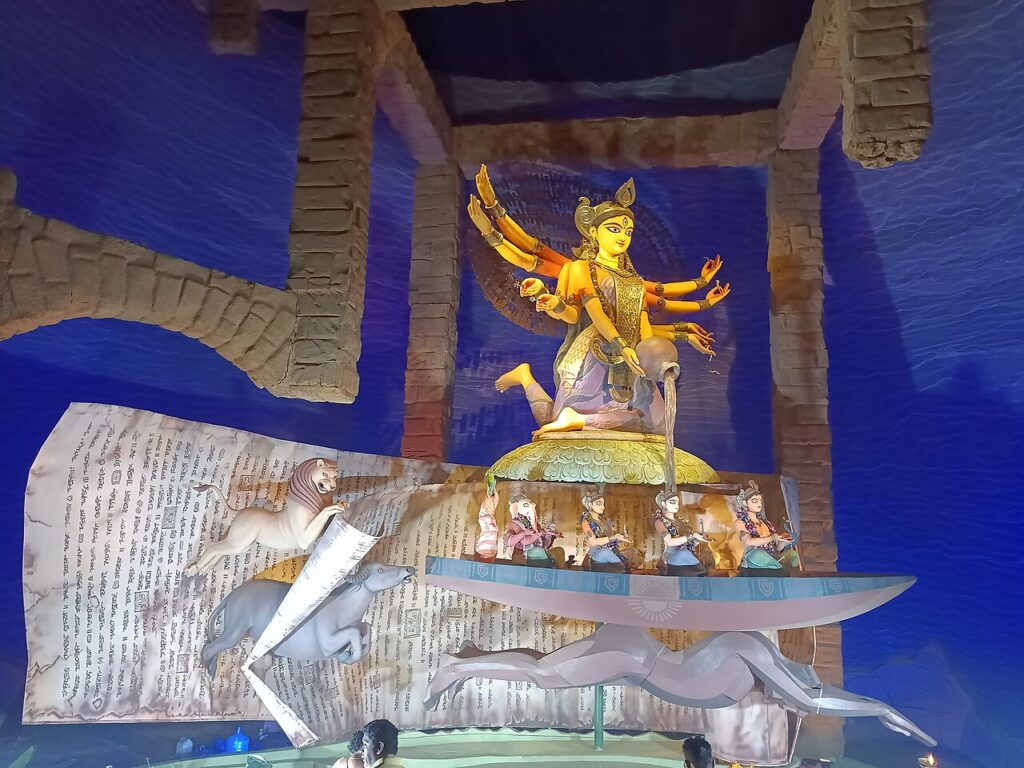
Seventeen people are dead and at least 25 injured after a crowd crush at a Durga Puja pavilion in Kolkata on Saturday evening — turning one of the world’s biggest street festivals into a scene of scattered footwear, upended gates and wailing ambulances.
The stampede broke out at about 7:40 pm local time at the exit gate of the Chorbagan Sarbojanin pandal — a community worship tent in north Kolkata’s Girish Park area — as heavy rain began to fall over a throng of visitors. West Bengal Chief Minister Suvendu Adhikari confirmed the toll late Saturday: “Seventeen people were brought dead to Calcutta Medical College and Hospital, while 25 others are injured,” he said. One of the injured is in critical condition.
Exactly what set off the rush is now the subject of a police investigation. Adhikari said an announcement made by the pandal’s organisers caused a surge among the revellers, calling it a “painful incident” and describing information so far as pointing to “a wrong announcement” by the organisers. A senior police officer told reporters that people waiting outside pushed forward when the rain started and some fell on the road, triggering the crush. Photographs from the scene showed the exit gate buckled under crowd pressure, with shoes and sandals strewn across the wet pavement. Members of the puja committee were detained at the local police station. Visitors and local residents alleged that crowd management at the site was inadequate; those claims could not immediately be verified.
Police, fire crews, disaster-management teams and medical units flooded the area within the hour. Kolkata Police said roughly 35 people were taken to Calcutta Medical College for treatment; officials said other victims were carried to Nil Ratan Sircar and R G Kar medical colleges. The pandal was shut to visitors, and the state government opened a toll-free helpline, 1800-3455678, for families seeking information.
India’s top leadership moved quickly to respond. Prime Minister Narendra Modi said in a statement: “The stampede in Kolkata is extremely distressing. My thoughts are with those who have lost their loved ones. May the injured recover at the earliest. The local administration is providing all possible assistance to those affected.” He announced compensation of Rs 2 lakh — roughly $2,300 — to the next of kin of each person killed and Rs 50,000 for each injured person, paid from the Prime Minister’s National Relief Fund. Union Home Minister Amit Shah said he had spoken to Adhikari, postponed his scheduled West Bengal engagements for Sunday and would visit the injured in hospital. President Droupadi Murmu expressed condolences and wished the injured a speedy recovery.
The tragedy has cut across India’s political lines. Former West Bengal chief minister Mamata Banerjee, who led the state before Adhikari’s government took office, said she was “deeply shocked and saddened” by the stampede. “I pray to Maa Durga for the speedy recovery of all those injured and for strength and courage for their families during this difficult time,” she said. Governor R N Ravi also conveyed condolences to the bereaved families.
For a global reader, some context is needed. Durga Puja is eastern India’s defining festival — a ten-day autumn celebration honouring Durga, the warrior goddess, that transforms Kolkata into an open-air gallery. Thousands of elaborately decorated pandals, or temporary temples, draw millions of visitors each year; the Chorbagan Sarbojanin celebration, now in its 91st year, is one of the city’s best-known. This year’s theme was “Beyond Sound”. The same streets that carry devotional processions by day become some of the most densely packed public spaces on earth by night.
That is why Saturday’s deaths will resonate far beyond Bengal. Crushes at mass religious gatherings are one of the world’s most stubbornly recurring disasters: from the 2015 Hajj stampede that killed more than 2,000 people to crowd disasters at Kumbh Melas, football stadiums and concerts, the pattern is depressingly familiar — a bottleneck, a sudden trigger, and a crowd with nowhere to go. Investigators will now ask the same questions asked after every such tragedy: who controlled the exits, how many people were allowed in, and why an outdoor pavilion in monsoon-season India had no plan for a rain-driven surge. When the first reports of the crush emerged on Saturday evening, the death toll had not yet been confirmed; the confirmed figure of 17 now makes this one of the deadliest festival accidents in Kolkata’s recent history.
Adhikari, who visited the hospital with Chief Secretary Manoj Agarwal, said he was holding an emergency meeting to decide whether more doctors and facilities needed to be brought in for the injured, and urged puja committees across the city to follow police instructions and increase the number of entry and exit gates. The investigation into the cause continues.


2 Comments