An ammunition stockpile blew up inside a Popular Mobilization Forces (PMF) headquarters in eastern Baghdad on Saturday, killing one paramilitary fighter and wounding four others, according to Iraqi security and medical sources. The blast shook a residential district on the capital’s east side and sent up a fire that crews battled for hours before bringing it under control.
The explosion hit a PMF facility east of Baghdad’s Army Canal on Saturday evening, the paramilitary group’s media office said. A correspondent for Channel8 in Baghdad reported that the blast was powerful enough to be heard in Sab’ Abkar, a residential neighbourhood on the northern Rusafa side of the city. Witnesses described panic among residents living near the facility, and Channel8 images showed the blast site with significant damage.
The PMF says the detonation came from a stockpile of old, damaged and unserviceable ammunition stored at the headquarters. “Specialized committees have initiated procedures to investigate the circumstances of the incident and determine its causes, with the results to be announced upon the completion of the investigations,” the group said in a statement, adding that the resulting fire had been “brought under control”.
There are conflicting accounts of the casualty toll. The PMF’s media office said five of its members suffered minor injuries and initially recorded no deaths; security and medical sources cited by Reuters later put the toll at one killed and four wounded. A security source who spoke to Shafaq News said four PMF members were hurt, some of them seriously. Iraqi Prime Minister Ali al-Zaidi ordered an investigation into the blast, an official statement said.
The explosion is the second involving armed-group ammunition in Baghdad this month. On October 1, munitions stored at a site belonging to an armed faction detonated in the capital’s southern Dora district, causing no reported injuries, a security source told Shafaq News at the time.
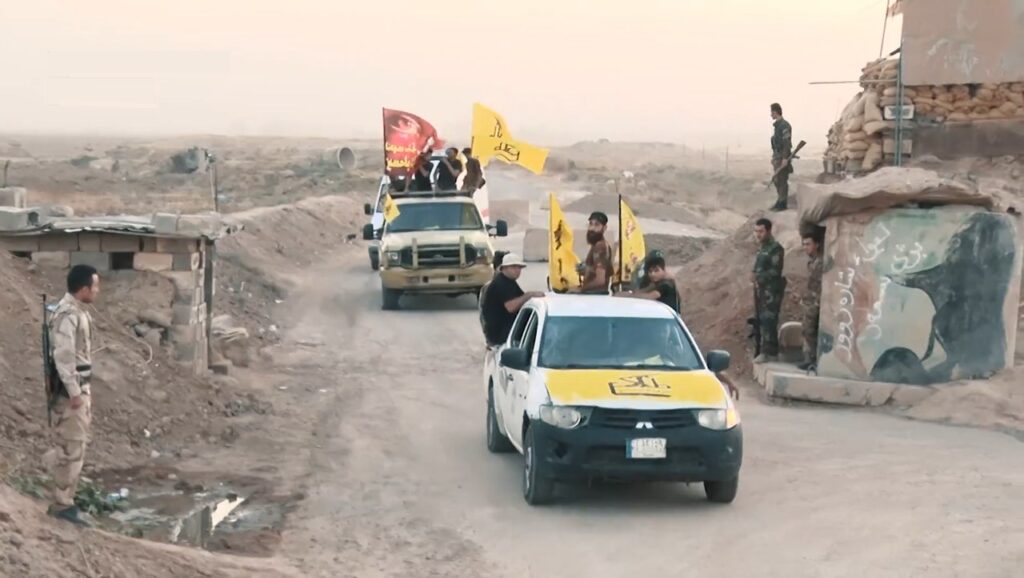
The PMF — known in Arabic as Hashd al-Shaabi — is an umbrella of mostly Shia paramilitary factions that were brought together to fight the Islamic State (ISIS) militant group. The Iraqi state gave the force official status in 2016, making it formally part of the country’s armed forces, but several of its most powerful factions are aligned with Iran and belong to what Tehran calls the Axis of Resistance: a network of Iran-aligned governments and armed groups, including Hezbollah in Lebanon, the Houthis in Yemen, and Hamas and Palestinian Islamic Jihad in the Palestinian territories, that opposes Israel and US military influence in the region. Earlier this month the Houthis struck the presidential palace in Yemen’s Aden, killing five — a reminder of how the region’s separate conflicts are blurring into one.
Why this matters: Baghdad is the quietest frontline of the Middle East’s widening confrontation — and that is exactly why a depot explosion there gets everyone’s attention. In a city where the US, Israel and Iran all watch each other’s moves, an accidental ammunition cook-off and a sabotage attack look identical from the smoke. The prime minister’s rapid order of an investigation is as much about proving the first as it is about finding facts. And a second such blast in barely two weeks, both inside a crowded capital of more than 7 million people, raises a question that goes beyond who was hurt today: how many armed groups are storing old explosives inside the city, and how long before one of these accidents becomes a catastrophe — or a pretext. The fallout from the region’s escalation has already emptied Saudi Arabia’s diplomatic calendar; an unstable Baghdad would give the whole map one more front.