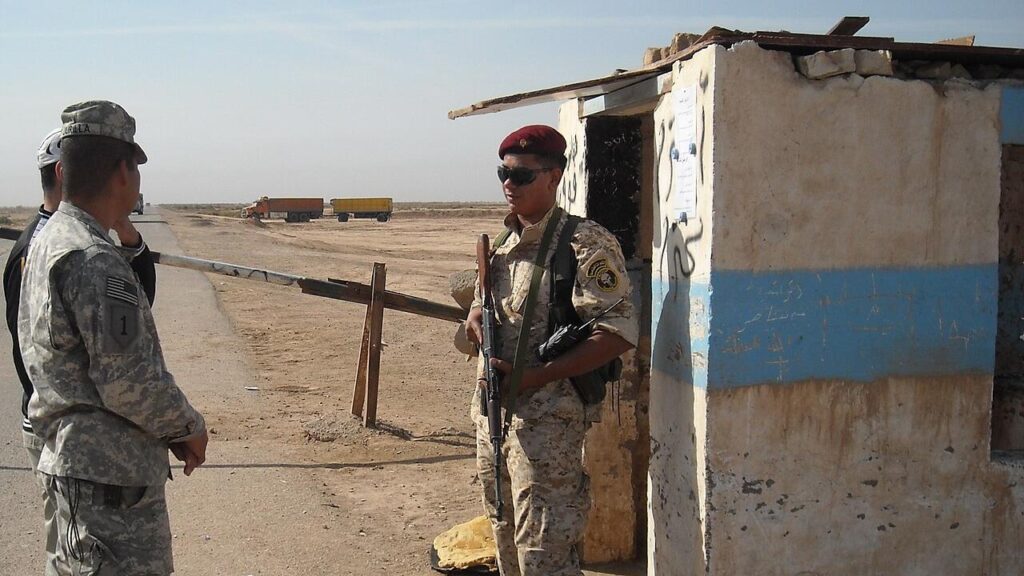
Iraq moved to seal its frontier with Iran on Wednesday, ordering the busy Sheeb border crossing shut to passengers, vehicles and commercial trucks “until further notice” — and warning that more of the country’s border gates could be closed in stages over the coming days.
Iraqi Prime Minister Ali al-Zaidi personally ordered the indefinite closure of Sheeb, an Iraqi government official told Al Jazeera, adding that several other crossings with Iran would be closed gradually. The shutdown, which covers both people and goods, took effect on Wednesday.
Two sources at the crossing confirmed to Reuters that Sheeb is closed until further notice while Baghdad reassesses the security arrangements inside the facility. An Iraqi border crossings official told Reuters the point of the shutdown is to review security and install detection equipment designed to stop the smuggling of prohibited materials — and admitted, in a striking line, that the current security measures at Sheeb are “weak and inadequate.”
Sheeb is one of the main entry points for goods and travelers between the two countries, and the only crossing feeding directly into Iraq’s southern Maysan governorate. Iraq shares seven land border crossings with Iran across five governorates.
Not the first closure — and not, it seems, the last
The move has a precedent. Iraq ordered the closure of another Iran crossing, Shalamcheh, in September as a precaution after drone attacks on Saudi Arabia — and Riyadh said the drones used in those attacks had been launched from Iraqi territory.
That history is hard to miss in the current context. Washington is reportedly pressuring Baghdad to shut down the Iran border gates, according to a report by the UAE’s Al-Ain news service cited by the Jerusalem Post — a signal of how exposed Iraq’s territory has become in a war it keeps trying to stay out of.
Iraq is caught in a two-sided squeeze. On one side, Iran has been pressing Baghdad to expel exiled Kurdish opposition groups from Iraqi soil. On the other, the United States wants Iraq to rein in the Iranian-backed militias — most prominently the Popular Mobilization Forces (PMF), the largely Shia, state-recognized militia network that dominates Iraq’s armed landscape and answers in large part to Tehran’s interests. An ammunition depot explosion at a PMF headquarters in eastern Baghdad earlier this month — which killed one person and prompted al-Zaidi to order an investigation — was a reminder of how close that militia world sits to the capital itself.
Why this matters beyond Iraq
A state does not seal its borders in stages unless it expects trouble. The Sheeb closure, and the promise of more to come, reads as Baghdad’s admission that it fears a return to full-scale fighting between the United States, Israel and Iran — and that it wants fewer holes in its frontier when it happens. Border crossings are not just trade routes in a war zone; they are where weapons, drone components and foreign operatives slip through. Closing them is Iraq’s way of telling both Washington and Tehran that its soil will not be the runway for anyone’s next strike — even as Tehran, which has told Pakistan’s army chief it will hold no talks with Washington until its demands are met, shows no sign of backing down.
But closures cut both ways. Sheeb handles a heavy flow of goods and travelers, and shutting it indefinitely — with more to follow — disrupts trade, pilgrimage routes and the informal economies that depend on open gates. Iraq is trying to thread a needle: compliant enough that Washington keeps its pressure off, quiet enough that Tehran does not punish it, and sealed enough that the next escalation does not start from an Iraqi field. It is a defensive move, and defensive moves are sometimes the surest sign that something bigger is coming.