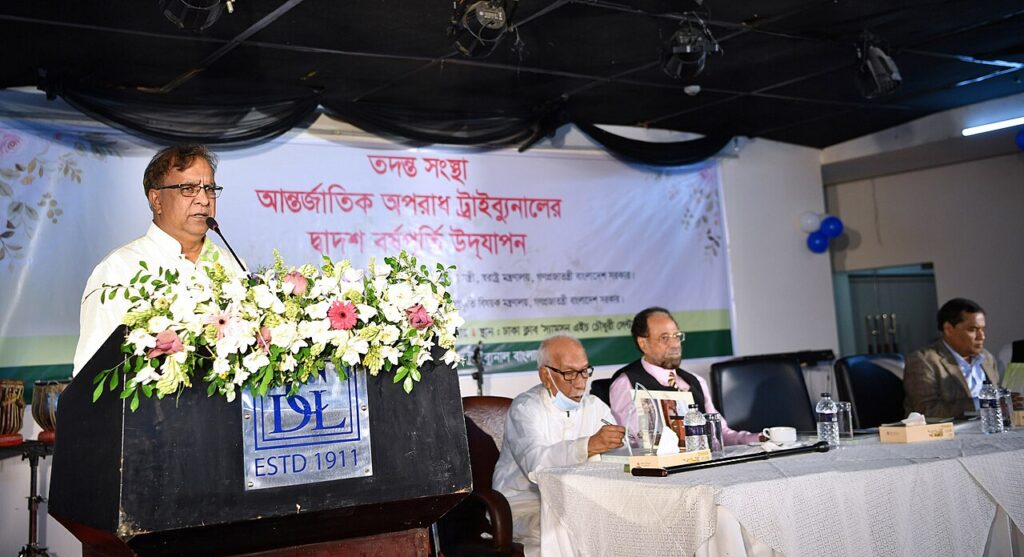
A court in Dhaka has sentenced one of Bangladesh’s most prominent former ruling-party figures to death for his part in the killing of six people during the mass uprising that ended Sheikh Hasina’s 15-year rule.
Mahbubul Alam Hanif, joint general secretary of Hasina’s Awami League, was sentenced to death on Thursday by the International Crimes Tribunal-2, a three-member bench headed by Justice Nazrul Islam Chowdhury. The tribunal also sentenced three other Awami League leaders from Kushtia district to imprisonment for the remainder of their lives.
All four men were tried in their absence. They remain at large, and a state-appointed lawyer represented them at the trial.
The case concerned six people killed in Kushtia, a district in western Bangladesh, on 5 August 2024 — the day Hasina fled the country. The dead, named in Bangladeshi court reporting, were Mohammad Abdullah Al Mustakin, 16, Mohammad Suruj Ali Babu, 41, Mohammad Ashraful Islam, 37, Mohammad Bablu Farazi, 58, Mohammad Yusuf Sheikh, 56, and Mohammad Usama, 18.
Prosecutors brought charges of crimes against humanity, backed by testimony from 19 witnesses. One charge alleged that Hanif and the others conspired at a party meeting in Kushtia on 29 July 2024 and gave direct orders that led to the killings. Hanif was sentenced to death on the first charge and to life imprisonment on further charges; the three co-accused received imprisonment until death on the first charge and life terms on the others.
The three men sentenced alongside Hanif are Sadar Uddin Khan, president of the Awami League’s Kushtia district unit and a former district council chairman; Azgar Ali, the district unit’s general secretary; and Ataur Rahman Ata, general secretary of the party’s Kushtia city unit. The tribunal also ordered the confiscation of half of all four men’s immovable property, to be distributed as compensation to the families of people killed or injured during the uprising.
Chief prosecutor Md Aminul Islam told reporters after the verdict that the charges against the convicts had been proved beyond doubt. The state-appointed defence lawyer, Md Amir Hossain, called the verdict unacceptable.
For readers outside Bangladesh, the names need unpacking. The Awami League was Hasina’s party, in power continuously from 2009 until August 2024. The International Crimes Tribunal is a domestic Bangladeshi court that has in recent years been used to try cases arising from the 2024 crackdown as well as from the country’s 1971 independence war.
Hasina herself was sentenced to death by hanging in absentia in November 2025 over the wider crackdown. She fled by helicopter to neighbouring India in August 2024 and has refused to accept the tribunal’s authority. The government of Prime Minister Tarique Rahman, which won a landslide victory in February’s elections — the first since Hasina was ousted — has asked India for her extradition. Hasina, 78, has said she intends to return to Bangladesh of her own volition in December, despite the sentence hanging over her.
The United Nations has estimated that as many as 1,400 people were killed between July and August 2024, when Hasina’s government tried to suppress a student-led uprising that grew into a nationwide revolt. Thursday’s verdict brings the total number of people convicted over the uprising to 72. Of those, 23 have been sentenced to death — but only four are actually in custody. That gap, between sentences handed down and people behind bars, is the central tension in Bangladesh’s reckoning with 2024.
It is also why this verdict will be watched beyond Bangladesh. Trials in absentia are a familiar tool in post-uprising justice, from the Middle East to South Asia, and they always raise the same uncomfortable question: does a death sentence against a fugitive deliver justice to victims’ families, or does it mainly record a political verdict that can never be carried out? Hanif’s case will not settle that argument. But for the families of the six killed in Kushtia — one of them a 16-year-old — it puts names, a date and a courtroom finding on a day that, until now, had been remembered mostly as the day a prime minister fled.
The case also lands in a week when death-penalty politics has crossed borders: in South Korea, prosecutors have again asked a court to impose the death penalty on a former president, Yoon Suk Yeol, over his martial-law declaration. South Korea prosecutors again seek death penalty for ex-president Yoon over martial law
What happens next is procedural, but it matters. The tribunal has ordered the property confiscations to take effect, and the prosecution will now have to decide how — and whether — it pursues men who are not in the country. Until any of them is in custody, Thursday’s death sentence remains a verdict waiting for an enforcement that may never come.



One Comment