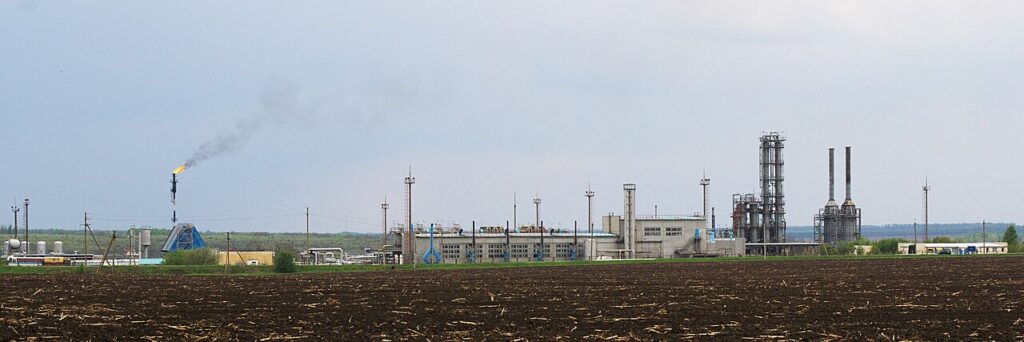
A drone strike late on Sunday night hit Iraq’s Khor Mor gas field, setting a gas storage tank on fire and halting production at one of the Kurdistan region’s largest energy facilities. The shutdown cut gas supplies to five power stations and knocked out about 2.8 gigawatts of electricity generation — roughly two-thirds of the power the semi-autonomous region in northern Iraq normally produces.
The Kurdistan Regional Government’s ministries of natural resources and electricity said in a joint statement that the field “came under a terrorist attack” at 11pm local time. A Kurdish security source told the AFP news agency that an explosive-laden drone hit the field, in the Chamchamal district of Sulaymaniyah province. Another source said it was not yet certain whether the weapon was a drone or a rocket, though debris collected at the site pointed to a drone.
An engineer at the field told Reuters that a gas storage facility was hit and that all crew were ordered into shelters for fear of further attacks. Smoke was seen rising from the site, and the fire was still raging when the first reports came in.
Iraqi Prime Minister Ali al-Zaidi said an initial assessment found no casualties, and ordered a joint investigation with the Kurdistan Region authorities into the circumstances of the attack.
The electricity ministry said the region would lose about 2.8 gigawatts of generating capacity — the Kurdistan region normally produces around 4 gigawatts. Gas was cut to power stations serving five major urban centres: Erbil, Sulaimaniyah, Bazian, Chamchamal and Duhok. Ministry spokesperson Omed Ahmad told Kurdistan24 that the ministry would switch on hydropower stations at the Dukan and Darbandikhan dams, along with power plants that can run on alternative fuels, to prevent a region-wide blackout and keep hospitals and water stations supplied.
Khor Mor produces about 750 million cubic feet of natural gas a day. It is operated by Pearl Petroleum, a consortium that includes the United Arab Emirates-based Dana Gas and Crescent Petroleum. Its gas feeds power plants across the Kurdistan region rather than export markets, so the direct effect on global energy supply is limited — but for the roughly six million people who live in the region, the loss of two-thirds of their electricity is immediate and severe.
No group has claimed responsibility. Suspicion has fallen on Iran or its allied militias in Iraq, which have carried out repeated missile and drone attacks on the Kurdistan region since the war with the United States began. Kurdish authorities have long blamed Iran-backed armed groups for strikes on Khor Mor. Less than a day before the attack, a figure from Kataib Hezbollah, the Iran-backed Iraqi militia, made veiled remarks that referred to the gas field — a detail reported by Kurdish media that investigators are now likely to examine. The field has been hit many times in recent years: a drone strike in April 2024 killed four Yemeni workers there, an attack last November also halted production, and Dana Gas shut the field’s main facilities in July this year over security threats before restarting them later the same month.
The timing stands out. The strike came only hours after US President Donald Trump told CNN, in a 20-minute phone interview on Sunday, that renewed American strikes on Iran were “highly unlikely” as long as negotiations over Tehran’s nuclear programme and the reopening of the Strait of Hormuz made progress. He repeated the point five times.
“It depends on whether or not they sign a very strong agreement,” Trump said. “The answer is highly unlikely it’s going to be necessary. I would if necessary, but we hit them really hard.”
Trump also said three American aircraft carriers were now in the region and that the United States had identified infrastructure targets inside Iran, including 38 bridges he said could be brought down within an hour. Hours later, Secretary of State Marco Rubio struck a very different note, saying the negotiations were “not productive” and calling Tehran’s demands “unacceptable, in some cases outrageous, and ridiculous.” Oil prices fell when trading opened on Monday, with Brent crude down 0.64 percent to $97.67 a barrel.
Iran’s foreign minister, Abbas Araghchi, said on Sunday that mediators had made no progress in recent days since the American midterm elections. A senior Iranian official told Reuters last week that Tehran had sent a nuclear proposal to Washington through Qatar and that the United States was reviewing it — but that further discussion depended on Washington first meeting seven Iranian demands, including sanctions relief, access to frozen Iranian money in foreign banks and war reparations.
The attack also landed as Washington tightens its economic pressure on Iraq. Iraq’s foreign minister, Fuad Hussein, said the US Treasury had asked Baghdad to close all but two of its border crossings with Iran. Iranian media, meanwhile, reported projectile impacts on Qeshm Island, which it attributed to the United States — claims that remain unverified, and which follow the explosions on Qeshm and Jask at the weekend.
Why this matters: Eight months into a war that has mostly been fought at sea — around tankers, mines and the Strait of Hormuz — the Khor Mor strike shows the fighting spreading to energy infrastructure on land. It is the second front of the same conflict: whoever ordered the drone did not need to sink a ship to hurt millions of people. They only needed to hit one storage tank. And it exposes the gap between the diplomacy and the facts on the ground. Trump says new strikes are unlikely; Rubio says the talks are going nowhere; and while both men talk, a gas field burns and a region’s lights go out. The next questions are practical ones: how quickly can production be restored, who is formally blamed, and whether Washington treats an attack on a field run by a Gulf company as a reason to change its mind about restraint. Tehran, for its part, has form here — Iranian drones hit a Kurdish opposition base in northern Iraq earlier in the war — and Kurdish officials have been asking Baghdad for drone defences for Khor Mor for years without getting them.