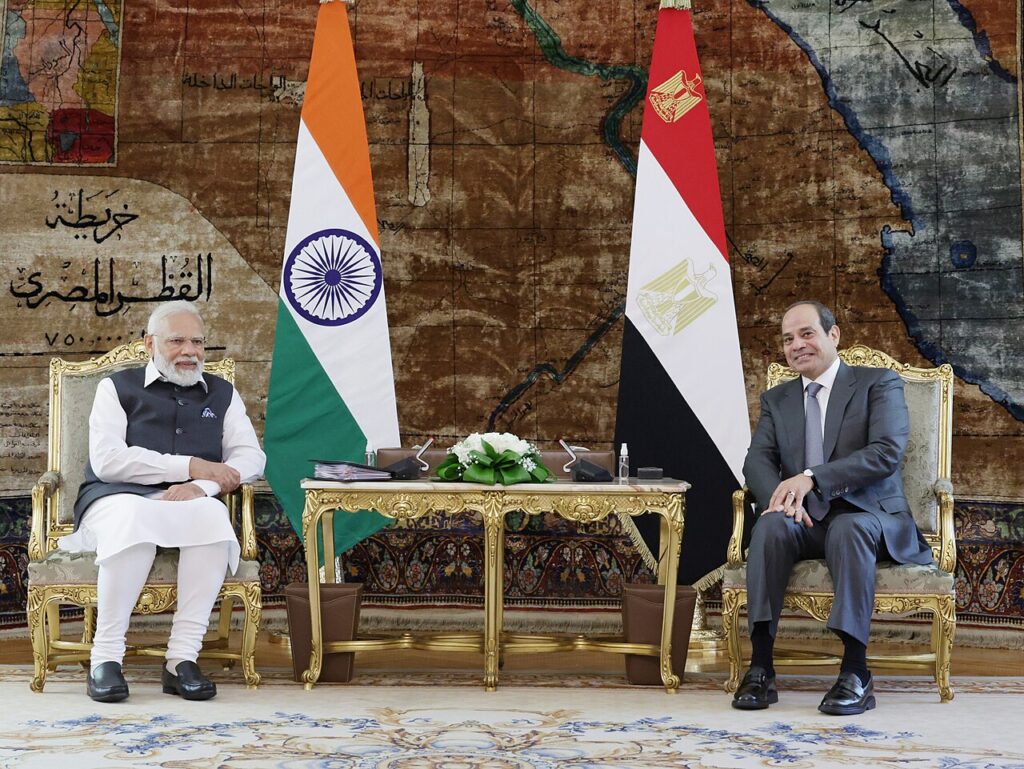
Egypt has moved further than at any point since the Yemen war reignited toward joining the fight. The country’s National Defence Council — the body chaired by President Abdel Fattah el-Sisi that controls the highest decisions of war and peace — declared on Sunday that Cairo would give Saudi Arabia “all necessary and possible forms of support” against Houthi attacks, and Sisi has asked parliament to authorize the deployment of Egyptian forces to the kingdom if Riyadh asks.
The announcement came after a meeting at Al Ittihadiya Palace in Cairo attended by the prime minister, the speaker of parliament, the defence minister, the army chief of staff and the intelligence chiefs. According to Egypt’s State Information Service, the council declared Egypt’s “full solidarity” with Saudi Arabia, describing the kingdom’s security as inseparable from Egyptian and broader Arab national security.
The pledge covers defending the kingdom’s security and stability, protecting its resources and territorial integrity, and safeguarding the Islamic holy sites — a reference to Mecca and Medina, whose status makes any threat to Saudi Arabia a matter of religious as well as political sensitivity across the Muslim world.
Sisi: “We will only defend Saudi Arabia”
The council’s statement followed a speech Sisi gave on Saturday at the Military Academy, where he made his most direct comments yet on the prospect of Egyptian involvement. “It is inconceivable that we would allow Saudi Arabia, its security or stability to be harmed,” he said. “We do not want to fight or attack anyone. We will only defend Saudi Arabia.”
He added that Egypt would act only if Riyadh requested it, and in line with guidance from Saudi King Salman and Crown Prince Mohammed bin Salman — the de facto ruler, who visited Sisi in Cairo last month after the fighting in Yemen flared up again.
The constitutional mechanics matter here. Under Article 152 of Egypt’s constitution, the president cannot declare war or send the army on a combat mission abroad without consulting the National Defence Council — which has now happened — and securing the approval of two-thirds of parliament. Sisi called an emergency parliamentary session for Sunday to authorize him to approve any Saudi request for defence assistance, including troops and military equipment. Parliament extended its session by two days, suggesting the vote could come as early as this week.
The Houthis are already warning Cairo off
The response from Yemen was swift. The Houthis — the armed group known as Ansar Allah, which controls much of northern Yemen and is backed by Iran — publicly warned Egypt against any military intervention. The warning underscores how seriously the group takes the threat: an Egyptian deployment would mean the region’s largest standing army joining a war that has, until now, been fought between the Houthis and the Gulf monarchies.
Egyptian state television quoted no specifics about what form support might take, and the official council statement did not mention troops. But Mostafa Bakry, a member of parliament and a television host close to the state, wrote on X that the council had approved sending forces to Saudi Arabia on “a defensive mission.” That claim has not been confirmed by any official statement, and it should be treated as such — but coming from a figure with close ties to the establishment, it signals the direction Cairo’s thinking is moving.
Why Riyadh needs the help
The request for allies’ assistance did not come out of nowhere. Saudi Arabia has been pressed for weeks by a barrage of Houthi drone and missile attacks that have left the kingdom short of missile interceptors and forced it to seek air-defence help from France, Britain, Pakistan and Egypt. The Houthis have struck Riyadh’s international airport twice and hit Saudi Aramco’s Dhahran headquarters for the first time, while at least 19 people have been killed in the campaign and thousands of flights have been disrupted.
Their weapons are getting harder to stop: drones and missiles that change direction mid-flight, designed specifically to defeat interceptors. And the war in Yemen has restarted in earnest — the Houthis are fighting Saudi-backed forces again after a truce collapsed, with the UAE going back to war in Yemen as its rift with Riyadh closes.
Why this matters beyond the Middle East
Egypt is not a neutral bystander here; it has a direct financial stake. The Suez Canal — the waterway that carries a significant share of global shipping between Europe and Asia — has already lost revenue from Houthi attacks on Red Sea shipping over the past two years. Cairo’s calculus is simple: the same Houthi capability that threatens Saudi airports can threaten shipping through the Red Sea, and a wider war that chokes the canal would hit Egypt’s hard-currency income at a moment it can ill afford it.
There is history, too. Egypt joined the Saudi-led coalition that intervened in Yemen in 2015, though its combat role was limited. And the two countries are close strategic and economic partners: Saudi Arabia and other Gulf states bankrolled Egypt with billions in aid, central-bank deposits and investments after the military’s 2013 removal of Islamist president Mohamed Morsi — the upheaval that brought Sisi to power.
The council also said it would intensify diplomatic efforts to de-escalate the crisis. But the sequence of events — the council pledge, the request for parliamentary authorization to deploy troops, the two-day extension of the emergency session — points in one direction. Egypt, the Arab world’s most populous country and its largest military power, is preparing to fight in a war that is rapidly becoming the region’s widest. The question now is whether parliament’s vote, expected within days, turns the pledge into boots on Saudi soil.