Informopedia Explains: in January 2022, a volcano erupted off the coast of Tonga, and an entire country went quiet. The blast severed the single undersea cable linking the Pacific island nation to the rest of the world. Phone calls failed and bank transfers stalled. It took a repair ship weeks to restore the link, exposing a fact most of us never think about: nearly everything we do online crosses an ocean through a wire lying on the seabed.
A network you could wrap around the Earth 37 times
Over 600 submarine cable systems are in service or under construction worldwide, according to TeleGeography, the research firm that tracks them. Laid end to end, they stretch past 1.5 million kilometres — enough to circle the equator roughly 37 times. They connect about 186 countries and carry over 99 percent of the data that moves between continents.
Satellites, for all their visibility, carry a sliver of that traffic. Figures from the US regulator cited by TeleGeography put satellites at just 0.37 percent of America’s international capacity. The cloud lives on the seafloor, not in the sky.
What is actually inside one of these cables?
Cut a modern submarine cable open and the first surprise is how little of it is the internet itself. At the centre sit a handful of hair-thin strands of glass — the optical fibres. Each fibre carries pulses of laser light, and a single modern cable can carry more than 300 terabits per second, because each fibre carries many colours of light at once, a technique called wavelength division multiplexing.
Around those fibres, the cable is built like an armoured suit. A copper layer carries electrical power along its length, steel wires wrap the core for strength, and layers of plastic — plus heavy steel armour in shallow water — protect it from the outside world. In deep water, where almost nothing can reach it, the cable is slim, roughly the width of a garden hose. Near shore it is thicker, heavier, and often buried in a trench.
Light travels at about 200,000 kilometres per second inside glass. A signal crossing the Atlantic takes around 30 milliseconds each way — but light fades, and after a few dozen kilometres it needs a boost.
Repeaters: the amplifiers on the ocean floor
That boost comes from repeaters — sealed metal cylinders spliced into the cable every 50 to 100 kilometres, where optical amplifiers lift the fading light back to full strength without ever converting it into electricity. A transoceanic cable needs dozens of them, and each one has to work flawlessly for a quarter of a century, at depths of up to 8,000 metres.
There is no socket on the seabed, so the repeaters are powered from land. Equipment at the landing stations pushes direct current down the cable’s copper layer, often at 3,000 to 15,000 volts.
How a cable gets laid
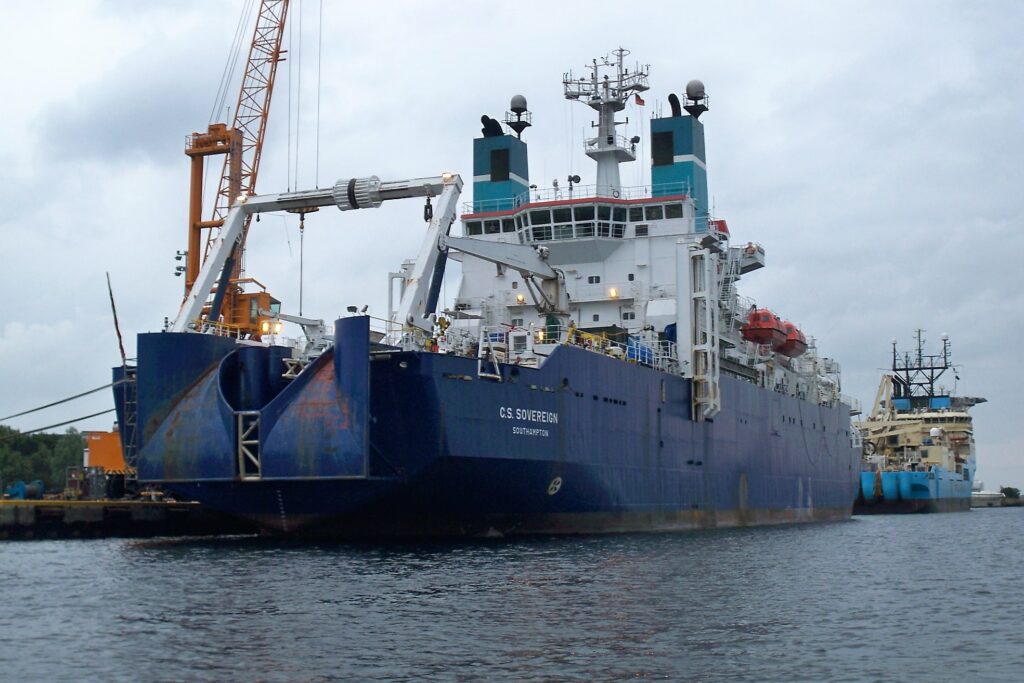
Laying a cable is slow, deliberate work, done by a small fleet of specialised ships that look like floating factories. A cable ship carries thousands of kilometres of cable coiled in vast tanks below deck, along with repeaters and the machinery to pay the cable out at a carefully controlled speed.
The ship follows a surveyed route, easing the cable over its stern and down to the seabed at a walking pace. In shallow water, a plough or trenching machine buries it a metre or two under the seabed; in deep water it is simply laid on the ocean floor. A single transoceanic job can take weeks, and the system is designed to last at least 25 years.
At each end, the cable comes ashore at a landing station — a heavily secured building that looks unremarkable from the outside and functions, in practice, like a data centre. There the light signals are converted, routed, and handed to the terrestrial fibre networks that carry them onward.
What breaks them — and it is usually not spies
For all their armour, cables break a lot: the International Cable Protection Committee records roughly 150 to 200 faults a year worldwide. Fishing gear and ship anchors account for around 70 to 80 percent of all damage, mostly in shallow water less than 300 metres deep. Earthquakes and underwater landslides do most of the natural damage.
Deliberate sabotage makes the headlines and accounts for a tiny share of faults, but the recent incidents have still rattled governments. In February 2024, three major systems — AAE-1, the Europe India Gateway, and SEACOM — were damaged in the southern Red Sea, most likely by the anchor of the Rubymar, a cargo ship hit by a missile that drifted for days before sinking. At the time, around 90 percent of Europe–Asia communications flowed through Red Sea cables. In November 2024, two cables in the Baltic Sea — the BCS East-West Interlink and C-Lion1 — were cut within about a day of each other. A Chinese bulk carrier, the Yi Peng 3, was tracked over both locations, but investigators established no conclusive evidence of wrongdoing.
The pattern matters more than any single incident. The routes that make cables efficient — narrow straits, shallow seas, busy shipping lanes — are the same places where a dragged anchor can sever several systems at once. Traffic simply reroutes around the break, through the cables still standing.
Fixing a cable in the middle of the ocean
Operators at the landing station can tell from the signal exactly where a fault lies, often to within a few hundred metres. Then a repair ship sails to the spot — a journey that can take days if the nearest suitable vessel is far away.
On site, the crew uses a grapnel or a remotely operated vehicle to find the cable on the seabed and haul it to the surface. The damaged section is cut out, a fresh length is spliced in, the joints are sealed and tested, and the cable is lowered back down. In good weather the job takes days; in bad weather, or in a conflict zone, it can take weeks — the Tonga repair took more than a month.
That fragility is why the network is built with redundancy. Major routes have several cables running in parallel, often owned by different companies and landing at different points. When one fails, traffic shifts — which is why Tonga, with a single cable, was the exception that proved the rule.
Why satellites cannot replace them
If cables are so vulnerable, why not move the internet into space? A single fibre-optic cable carries vastly more data than any satellite link, and it does so with far less delay. A signal to a geostationary satellite has to climb 35,786 kilometres up and the same distance back down, adding roughly half a second of round-trip delay. A cable across the Atlantic answers in about 60 milliseconds round trip.
Low-orbit satellite constellations, such as Amazon’s Project Leo, which recently passed its 1,000th satellite launch, shrink that delay considerably, and they are genuinely valuable for places cables cannot reach. But even thousands of satellites cannot match the sheer capacity of a fibre pair. The two systems are complements, not rivals: satellites fill the gaps, cables carry the bulk. You can read more about what happens when those constellations come back down in our explainer on why falling satellites are so hard to predict.
Why this matters
Undersea cables are the closest thing the internet has to a single point of failure — and proof of how resilient a decentralised network can be. Roughly 200 faults a year, and the internet keeps working, because traffic has somewhere else to go. But that redundancy is not evenly spread: island nations with one cable, and regions where every cable funnels through a single strait, are more exposed than they look.
That exposure is now a geopolitical fact: governments treat cables as critical infrastructure, and the tech giants that consume about three-quarters of international bandwidth are increasingly paying for the cables themselves.
What happens next
The network keeps growing: new systems to the Pacific islands, across the Arctic as the ice retreats, and along Africa’s coasts, where the 2Africa cable — one of the longest ever built — is bringing capacity to places that long relied on a single link. Engineers are also adding more fibre pairs per cable, and designing cables that double as ocean sensors, listening for earthquakes through tiny changes in the light signal.
The more interesting question is whether the world will protect what it is building — and simply build more of it, so no single cut matters as much. The next time your call crosses an ocean without a stutter, remember where it went: down to the seabed, through a thread of glass, boosted every few dozen kilometres by a machine nobody will ever see.
Explore the network yourself on the TeleGeography Submarine Cable Map, and read the International Cable Protection Committee for the industry’s own account of faults, repairs, and protection.