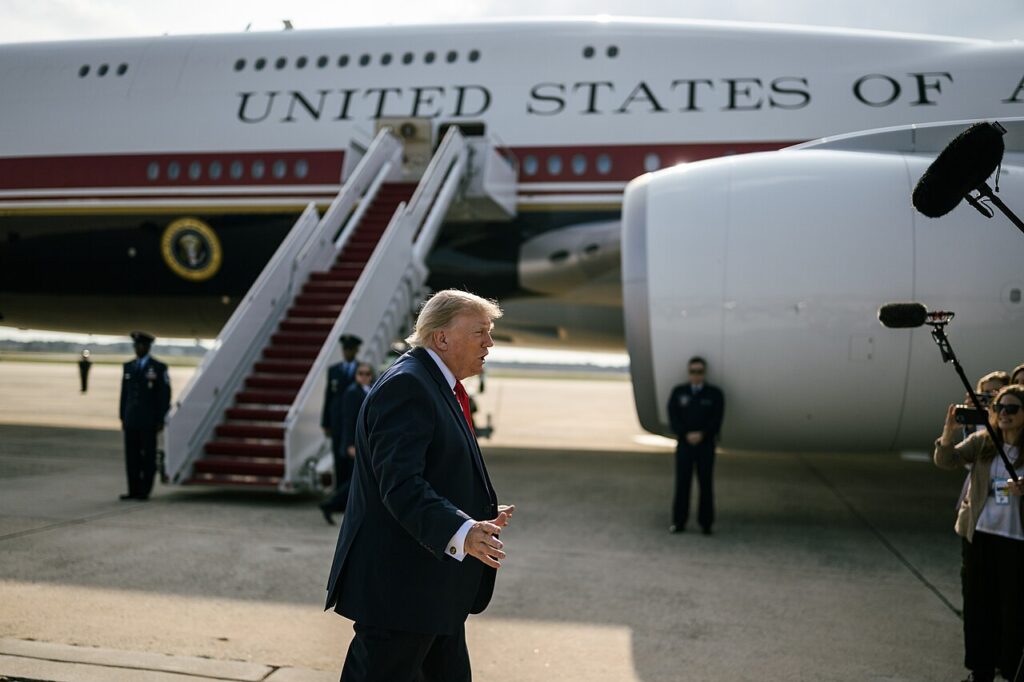
Donald Trump has put the question back on the table. On Thursday, the US president met his national security team to weigh whether to resume military operations against Iran, and hours later he told reporters in the Oval Office that a decision would come soon.
“Now we will make a decision,” Trump said. “Do we want to go further” with strikes to ensure Iran’s nuclear programme is dead and that “it will never happen again?” Then he added the line that will be quoted around the world this weekend: “I would rather not destroy the rest of the country if possible, but maybe I will have to. You’ll know soon enough.”
It was the first meeting of its kind since Tuesday’s midterm elections, held as part of his weekly intelligence briefing. Two US officials said the president is weighing three options: launch new strikes, keep squeezing Iran’s economy, or cut a deal that would involve significant concessions to Tehran.
The military is getting ready — but has no order yet
US Central Command, known as CENTCOM — the American military command that covers the Middle East — is finalising preparations for a possible resumption of major combat operations in Iran, a US official said. It has not received a formal directive from Washington.
That distinction matters. Preparation is not the same as a decision, and the gap between the two is where diplomacy still has room to work. One signal to watch is the arrival of a third US Navy aircraft carrier strike group in the region. The USS Theodore Roosevelt and its strike group will spend a few days in Singapore starting Friday for a port call, and a US official said it will not reach CENTCOM’s area of responsibility before mid-November.
Fox News also noted that November 9 brings a new moon in the Middle East, leaving minimal moonlight — conditions long considered advantageous for military operations. The date is a marker, not a deadline, but it has sharpened speculation about timing.
A sharp turn from three days earlier
What makes Thursday’s meeting striking is how quickly the tone has changed. On November 2, Trump was asked whether he was considering strikes after the midterms and answered “no”, adding that a deal with Iran “could happen”. Reports at the time said the Israeli prime minister, Benjamin Netanyahu, had urged him to consider renewed strikes once the voting was over.
Behind the scenes, diplomacy has not stopped. Iranian negotiators were in Doha for a third day of talks with Qatari mediators, and Qatar has prepared a draft agreement built around a three-day sequence of confidence-building measures. Iran’s foreign minister, Abbas Araghchi, said Tehran was prepared for both diplomacy and military confrontation, and warned that any renewed action would invite a stronger response than before.
Trump’s own framing points the other way. The United States struck Iran’s nuclear sites in June, and the president’s question on Thursday was whether that campaign needs a second round to guarantee the programme is permanently dismantled. Iraq’s prime minister, Ali Faleh Al-Zaidi, has already told Trump that Iraqi soil must not be used to launch strikes against neighbouring countries — a reminder that any operation would need staging, overflight and political cover from states that would rather stay out of it.
The administration had previously warned allies to brace for possible strikes after the midterms, and the geography of any confrontation still runs through the Strait of Hormuz, the narrow waterway that carries a large share of the world’s seaborne oil.
Why this matters beyond Washington and Tehran
A second round of US strikes on Iran would not be a contained event. It would put Gulf Arab states in the firing line of any Iranian retaliation, push oil prices up at a moment when energy markets are already jumpy, and test whether the ceasefire understandings built up since June can survive another shock. For Europe, it would mean another security crisis competing for attention with the war in Ukraine. For China and India, both major buyers of Gulf oil, it would mean higher import bills and harder choices about supply.
The diplomatic track is also on the clock. If the Doha talks produce a workable sequence of steps, Trump can claim the June strikes forced Iran to the table. If they stall, the same president who said “no” on Monday and “you’ll know soon enough” on Thursday will have to choose between a deal his own advisers describe as involving real concessions and a bombing campaign whose end state nobody has defined in public.
For now, the only certainty is the one Trump offered himself: a decision is coming, and it is coming soon. The new moon on November 9 gives that promise a date to be measured against.