The water rose two metres in ten minutes.
That is the number that tells you everything about what happened in Nepal’s Gorkha district before dawn on Sunday. Between 8:30 and 8:40 in the morning, the Budhi Gandaki River jumped from already dangerous levels to a raging surge 8.43 metres deep — more than three metres above the danger mark — according to Nepal’s National Disaster Risk Reduction and Management Authority (NDRRMA). Within minutes, entire marketplaces were gone.
The flood struck the Chumnubri Rural Municipality, about 100 kilometres west of Kathmandu, in the early hours of Sunday. By the time most of Nepal was waking up, Salleri Bazaar — a riverside market town — had been swept away completely, and Jagat Bazaar had suffered severe destruction. Local resident Bishal Ghale confirmed to local media that Salleri Bazaar was gone and Jagat badly damaged.
At least 35 to 40 houses across five settlements — Paiyun, Jagat, Bagar, Salleri and Ghattikhola — were washed away, according to Chumnubri Rural Municipality vice-chairperson Laxmi Gurung. Several bridges were destroyed, including suspension bridges linking Nyakchet, Sirdibas, Philim Bazaar, Machhakhola and Kerauja, an iron bridge at Soti, and a highway bridge connecting Gorkha with neighbouring Dhading district. Floodwaters also tore through a construction camp belonging to the planned 341-megawatt Budhi Gandaki hydropower project, sweeping away equipment.
Four people staying in a shed beside the Ungilung River in Chumchet remain missing. As of Sunday afternoon, officials said there were no confirmed deaths — though with whole settlements cut off and damage assessments still underway, that figure may change.
“We have asked villagers living along the river banks downstream to evacuate and remain safe,” Gorkha’s chief district officer, Dharmendra Kumar Mishra, told Reuters — the clearest sign of how seriously authorities are taking the possibility of further surges.
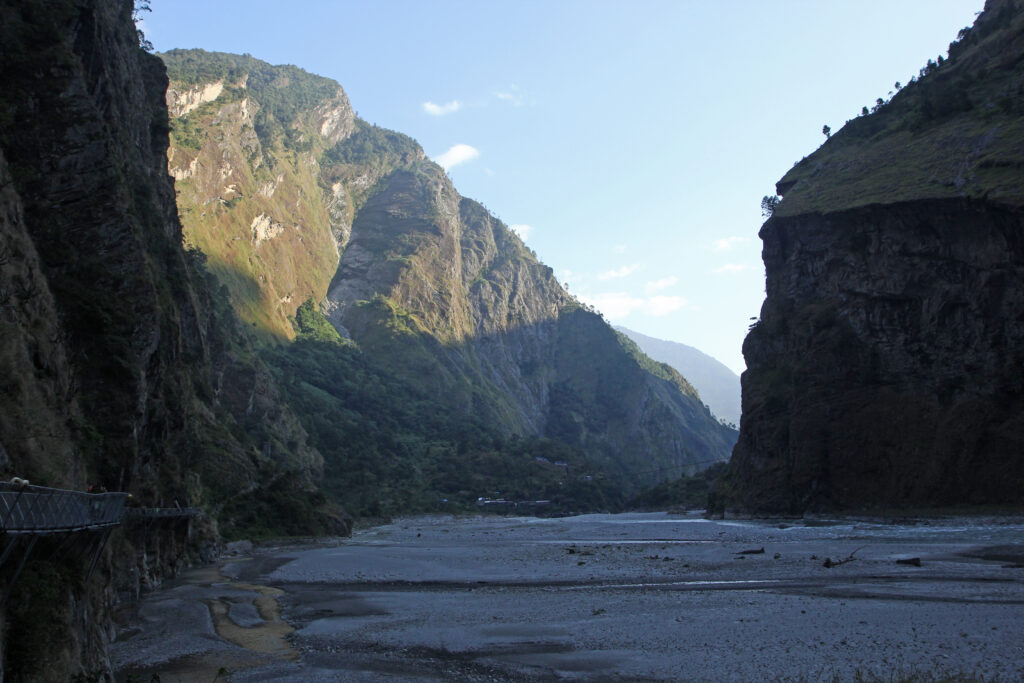
The flood was not caused by rain. The NDRRMA said in a statement that based on preliminary information and satellite images, “it is estimated that the river may have been blocked and then breached, causing a sudden flood” — likely a dry landslide near Chhekampar that dammed the Budhi Gandaki until the weight of water behind it broke through. Detailed technical analysis is still ongoing. The river turned black and grey with thick mud and debris, as videos posted online showed — the flood even washed away the NDRRMA’s own measurement station at the river, including the bridge it stood on.
Nepal’s government moved fast. The NDRRMA’s Flood Forecasting Section sent an SMS alert at 6:40 am warning people to stay away from the river up to Trishuli Dobhan and move to higher ground. The Nepali Army deployed helicopters for rescue and relief, and six people were airlifted from the Jagat area. Police have urged residents of Khorlabensi, Machhakhola, Soti, Arkhet and Arughat to move to safer locations.
Why this matters goes beyond one district. This is the second catastrophic Himalayan flood in Nepal in under three months. On August 26, a glacier collapse upstream of another tributary caused a flood that killed 1,457 people and left thousands missing, according to reports at the time. The pattern — steep Himalayan valleys, glacial retreat, sudden landslides damming rivers that then burst — is exactly what climate scientists have been warning about for years. The first study after the August floods found that record July–August heat and rapid glacial retreat played a major role. The Budhi Gandaki case looks like a textbook repeat: no rain, a sudden blockage, an explosive release.
There is also an economic layer. The Budhi Gandaki Hydropower Project, a 341-megawatt storage-type plant, is one of Nepal’s most important energy investments — the damage to its construction site is a reminder that the Himalayas’ engineering ambitions now sit directly in the path of its changing climate.
For now, the river is still being watched. Downstream communities along the Budhi Gandaki and the Trishuli as far as Benighat and Mugling have been told to stay on high alert. Sunday’s flood may not have had rain as its trigger — but the mountain that produced it has not finished moving.



One Comment